Exploring the Funeral Traditions and Spiritual Beliefs of Ancient Egypt
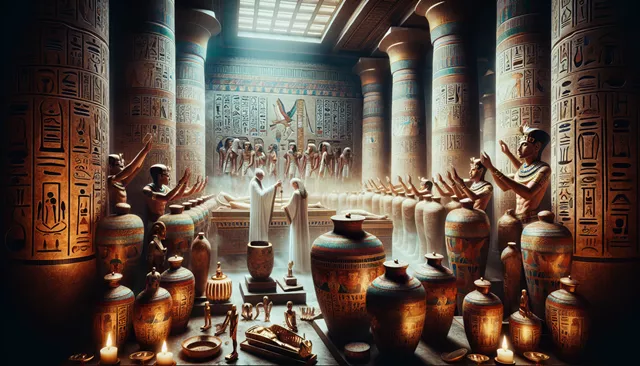
Journeying back over 4000 years, we find ourselves in the fabled Nile Valley, the birthplace of the ancient Egyptian kingdom, where the enigmatic pyramids stand as enduring witnesses to history, revealing a cycle of death and rebirth. To the ancient Egyptians, funerals were not simply the end of life but a profound spiritual passage. Death was viewed not as a conclusion but as the beginning of the soul's new journey. This article explores the funeral traditions and spiritual beliefs of ancient Egypt.
A fundamental aspect of ancient Egyptian culture was their belief in an afterlife, a core tenet deeply embedded in the civilization's soul. They believed that the souls of the deceased would be resurrected in the afterlife and thrive in a new form under the guidance of the god Osiris. Consequently, funerals held great significance as they were considered a crucial step for the deceased to enter the afterlife, emphasizing the transformative power of deep-seated religious convictions.
To delve into this mystique, it's essential to follow the rituals from their inception. The funeral rites begin at the bedside of the deceased, where friends and family, still part of the living world, gather to mourn, their tears flowing like a spring, saturating the entire household. The subsequent washing ritual features a mysterious herb used for purifying the body, a task carried out by the highest-ranking priests. Pure water mixed with these special herbs transforms the priest into a washer, acting as a bridge between the earthly and divine realms.
Following this is the critical mummification process, a meticulous preparation for the journey into the afterlife. The intestines are removed, and the organs are cleansed. Recognizing the onset of decay often begins with internal organs, the ancient Egyptians, with their belief in life after death, relied on these practices. The organs were extracted, purified, and treated with herbs and spices to minimize decay, ensuring the deceased retained their form for rebirth in the afterlife.
Interestingly, they left the heart in place, as it was considered the seat of the soul, thought, and emotion. Revering life meant respecting the spirit, so the heart remained in the body, now devoid of blood, holding the god Thoth's sacred inscriptions and resonating with its own rhythm.
The next step involved wrapping the body in linen—long strips of cloth winding around the deceased, a process requiring about 40 days. The intricacies of this wrapping are enshrined in an incantation recited by ancient Egyptian priests during the funeral: “I wrap you in 60 bowls of milk, and what clings to you is a noble covenant.”
The funeral procession saw family and friends of the deceased assuming various roles, carrying models that symbolized the deceased's life, accompanied by song and dance to celebrate their existence. The procession concludes with a symbolic shadow, representing the soul and embodying the Egyptians' belief in the afterlife; only then is the funeral deemed complete.
This glimpse into ancient Egypt's funeral culture carries with it echoes of history, belief, mourning, and hope. Despite a span of thousands of years, the spiritual reflections on life, death, the soul, and religion continue to resonate with us today.
Every funeral tradition, whether secular or sacred, reflects an era's and a culture’s perspective on death and respect for life. Though death lingers like a shadow within the corners of life, embracing life with a smile emphasizes that each death is intrinsically a new birth.
Cultural transmission is akin to a magical time capsule; opening it reveals the flowing river of history, highlighting the ancient Egypt that evokes admiration through generations. Understanding their funerals not only provides insight into their beliefs and aspirations but also into their lives and emotions. Their pursuit of rebirth after death shows how they cherished others and aspired for life, all reflected in their funerals.
In essence, ancient Egypt's funeral culture comprises a profound philosophical framework, reflecting their views on life and death, worldview, and values. Even as time progresses and civilization advances, their perspectives on life and death offer valuable insights today. We should approach life with awe, grasp death's full meaning, and face it courageously, for only then can life truly hold significance, and the soul achieve true liberation.