Understanding Liu Heng's Facial Analysis: The Significance of the Philtrum in Fortune Telling
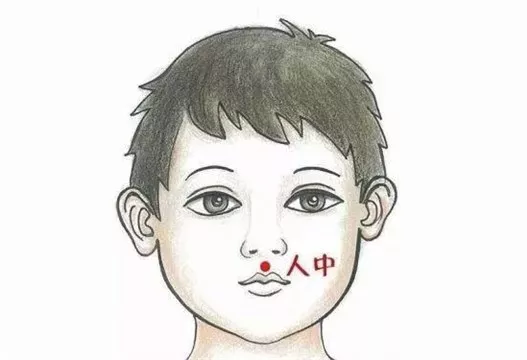
The human middle is one of the thirteen key facial features. It's located in the lower section of the "three divisions" of the face, known as the lower court. This area, along with the jaw, chin, and mouth, forms the face's lower section. Liu Heng mentions that the lower court mirrors the heavenly court, which dictates a person's future and social status, while the lower court controls one's wealth and authority. The human middle, along with the ears and nose, is linked to our lifespan. Its role in social matters is minimal, mainly related to human reproduction.
Where is the human middle located?
The human middle is positioned just below the nasal septum, at the top of the upper lip, and is characterized by a distinct narrow groove, also known as a channel. This feature is divided into three parts: upper, middle, and lower, each further subdivided into three sections, totaling nine sections. Each section is connected to the well-being of our internal organs, as shown below.
Why is it called the human middle?
The human body contains eight extraordinary meridians, with the Governing Vessel serving as the sea of Yang meridians, and the Conception Vessel as the sea of Yin meridians, managing all bodily meridians. Both the Conception and Governing Vessels begin at the perineum between the legs, with the Conception Vessel ascending the body's center and the Governing Vessel following the spine. Liu Heng highlights that these vessels intersect at the human middle, the point where Yin and Yang converge, hence the name human middle.
In nature, while weather descends, the earth's energy ascends. At the meeting point of these forces, everything, including humans, is created. Weather symbolizes Yang, and the earth's energy symbolizes Yin. Their convergence brings about human life, making the human middle, where bodily Yin and Yang meet, an essential point related to human reproduction.
Understanding health through the human middle
The human middle, being the convergence point of Yin and Yang, is where clarity emerges. Thus, when someone faints, applying pressure to the human middle helps unify Yin and Yang, assisting in regaining consciousness. The Governing Vessel is tied to the innate lightness of Qi and kidney energy, whereas the Conception Vessel connects to acquired heavy and turbid Qi, related to the spleen meridian. Consequently, the human middle can reflect the health of the spleen, stomach, and kidneys. Liu Heng points out that a short and shallow, or flat and full, human middle indicates deficiencies in spleen, stomach, and kidney energy.
Characteristics of auspicious and inauspicious human middles
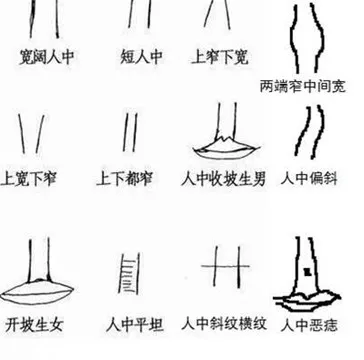
An auspicious human middle features a clear and deep groove, narrowing at the top and widening at the base, clearly defined by the lip line. Its color should be normal skin tone, clean, and blemish-free, signifying a positive trait.
An inauspicious human middle appears flat and full, short and reddish, with diagonal or horizontal lines, bad moles, scars, red or gray-black color, a narrow slit, or protruding appearance; these features are considered negative indications.
Liu Heng's observations from "The Divine Mirror of Physiognomy" on the human middle
1. The human middle acts as a communication channel (akin to water channels in fields). A clear channel allows unobstructed water flow; if shallow and narrow, water is blocked. The human middle's length can signal lifespan.
Liu Heng notes: A deep and long human middle that widens from the nasal septum suggests longevity. Conversely, a short and narrow or flat and full human middle indicates a deficiency in innate kidney energy, making a long life challenging.
2. The human middle's width can indicate offspring count, linking longevity to fertility. It should be long over short, centrally deep, outwardly wide, straight, not slanted, with wide, drooping sides as favorable signs.
Liu Heng notes: A deep, wide human middle suggests strong reproductive potential. A long, deep human middle implies many children and a long life, symbolizing fertility and longevity. Ideally, it should be deep at the center, wide at both ends, and straight, not slanted, which are longevity signs.
3. A narrow, long human middle predicts financial struggles; a flat, full one suggests disaster and stagnation; a narrow top and wide bottom imply many children, while a wide top and narrow bottom suggest few children; narrow ends with an average center foresee a challenging life; a straight, deep upper and lower half predicts many children; a flat, shallow upper and lower half suggests infertility; a deep, long human middle points to longevity, while a shallow, short one suggests early death.
Liu Heng notes: A narrow, short human middle suggests limited financial resources, bringing food insecurity. A flat and full human middle forebodes disaster and stagnation, creating obstacles in pursuits. A wide upper and narrow lower human middle indicates offspring difficulties, affecting lineage.
A human middle narrow at both ends but wide in the center suggests few children with challenges in raising them, leading to a difficult life. A slightly narrow top with a gradually widening bottom, featuring a clear groove, signals numerous children. A flat, shallow human middle at both ends indicates infertility. Conversely, a deep, long human middle indicates longevity, while a shallow, short one suggests early death.