Liu Heng's Facial Analysis: Goose Pattern on Forehead Suggests Hard Work and Perseverance
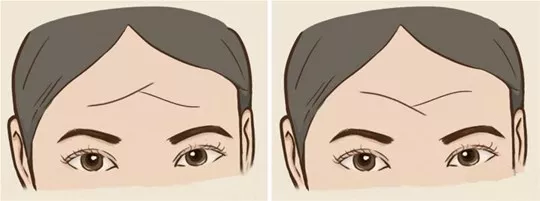
The human brain is nourished by essence and blood, and our facial features are connected to our internal organs. Internally, we have the heart, liver, spleen, lungs, and kidneys; externally, we have the eyes, ears, nose, tongue, and lips. The tongue corresponds to the heart, the lips to the spleen, the eyes to the liver, the ears to the kidneys, and the nose to the lungs. The forehead, though not considered one of the external features, is influenced by the kidney meridian and represents an outward expression of brain vitality.
The forehead is seen as a reflection of one's wisdom and potential. In physiognomy, it is called the "Heavenly Court" and is considered crucial for personal evaluation. Teacher Liu Heng interprets the concept of the Heavenly Court in physiognomy based on the "Ma Yi Shen Xiang" and supports it with his teachings, preserving the knowledge of physiognomy from the I Ching. Knowledge is humanity's greatest asset; those who dismiss it as mere superstition should maintain their distance, and those who overly revere modern Western science should remember that science is not the entirety of culture.
1. The ideal forehead is high, wide, prominent, shiny, and free of frown lines.
A forehead that is broad and square, appearing clear and bright, is associated with a fortunate life, early success, and achievements in youth. A smooth, rounded forehead suggests early wealth and recognition, while a broad forehead indicates a noble standing. An unblemished forehead signifies lifelong prestige.
Liu Heng's Interpretation: An optimal forehead should be high with a hairline that isn't too low, rounded, and prominent, wide, possessing a natural skin tone, and free from irregular lines and blemishes. This is considered a sign of good fortune. A clear, wide, square forehead, devoid of scars or blemishes, bright and full, is indicative of early academic achievements and acceptance into prestigious institutions.
A slightly rounded and smooth top of the head, paired with a round and wide forehead, signifies innate wealth and success. A broad, round forehead with a square face reflects a noble and trustworthy individual. A clean forehead without irregular lines (Liu Heng strongly notes that the presence of "goose-foot lines" signifies hardship and menial labor), free of blemishes, scars, or asymmetry, indicates a promising life.
2. A narrow and pointed forehead is undesirable.
A forehead that appears gray and wrinkled suggests bad luck; a flat and pointed forehead is often linked to a shorter lifespan.
Liu Heng's Interpretation: A narrow and pointed forehead with closed corners and a dull complexion indicates a restricted Heavenly Court, suggesting limited success opportunities (Liu Heng notes that those who achieve success must possess other favorable features). Additionally, a slanted forehead or one that is low, narrow, and sunken suggests a lack of wisdom and a reduced lifespan.
3. "A full Heavenly Court and a square Earth Pavilion."
The Heavenly Court refers to the upper forehead, while the Earth Pavilion refers to the jaw. In ancient physiognomy, the face is divided into three parts: the upper part represents heaven, the middle represents humanity, and the lower part represents earth. Each section symbolizes different attributes, with the upper part (forehead) primarily indicating early fortune and divine blessings.
Liu Heng's Interpretation: In physiognomy, the Heavenly Court represents achievements, while the Earth Pavilion symbolizes strength. A full and rounded Heavenly Court suggests a bright future, while the Earth Pavilion (including the nose and jawline, as Liu Heng notes) with a straight nose and square jaw signifies a solid and practical character. The Three Talents method divides the face into three: the Heavenly Court is heaven, the nose is humanity, and the chin is earth. The Heavenly Court foretells future prospects, the nose signifies actions, and the chin represents a foundational base.
4. The "Complete Text of Divine Physiognomy" states: "A small and narrow head leads to loneliness in old age."
A large and square forehead suggests good fortune in later years. A high and prominent forehead indicates elite status, and a full and rounded center of the forehead suggests success in official capacities. A wide forehead and head suggest noble status, while a square and prominent forehead is a favorable omen. A flawless forehead suggests longstanding prestige.
Liu Heng's Interpretation: Individuals with larger heads are more prone to success, while those with smaller heads may encounter setbacks. Larger heads are linked to greater wisdom, while smaller heads may imply stubbornness. A small head with a large body, narrow and pointed forehead, and low hairline suggests an unfortunate life marked by poverty and limited vision. Conversely, a large head paired with a square face and wide forehead portends a prosperous future. A round and open forehead, wide corners, a straight nose, and a square face with kind and profound eyes indicate a life of distinction and prominence.
Text and Images: Teacher Liu Heng