What Eye Shape Might Reveal About Personality and Luck

In traditional Chinese medicine, the liver corresponds to spring and is symbolized by the growth of trees. The liver is said to “open to” the eyes, and the eyes reflect benevolence. For this reason, spring is considered the best time to nourish the liver and support vision, leading to dietary advice that emphasizes green foods for liver and eye health. In physiognomy, the eyes are called the “palace of the spirit,” linked to both the liver and the heart. It is said that during sleep the spirit rests in the heart, and upon waking it returns to the eyes. Thus, a person’s gaze is believed to reveal character and moral state—one’s “inner self”—and even hint at wealth and status. In facial analysis, the eyes are known as the “inspectors,” summed up by the saying: “The three pavilions and nine officials are read from the face, while wisdom, courage, and timidity are seen in the eyes.”
What standards are used to assess the eyes in physiognomy? The system is symbolic. Ancient scholars compared eye shape and brightness to the observed traits and perceived moral qualities of various animals. Auspicious eye types include phoenix eyes, elephant eyes, cow eyes, dragon eyes, crane eyes, monkey eyes, peacock eyes, mandarin duck eyes, lion eyes, and magpie eyes. Inauspicious types include snake eyes, bee eyes, sheep eyes, mouse eyes, chicken eyes, pig eyes, fish eyes, horse eyes, dog eyes, crow eyes, and fox eyes. Hence the sayings: “Chicken eyes are small, round, and yellow, suggesting a restless and promiscuous nature. Snake eyes imply a poisonous heart, while mouse eyes suggest thievery. Dragon eyes connect to the divine, and tiger eyes exude courage. Cow eyes are steady and far‑seeing, while horse eyes indicate diligence. Dog eyes often bring disputes, and pig eyes imply greed and miserliness.”
Ideal eyes are first clearly defined in black and white (a dark iris and a bright white sclera) and have a sparkle, as if reflecting light. Eye shape is secondary. When the colors are distinct and the gaze is bright, it suggests decisiveness, intelligence, vitality, and good health. Below, we interpret fortune and character based on eye structure.
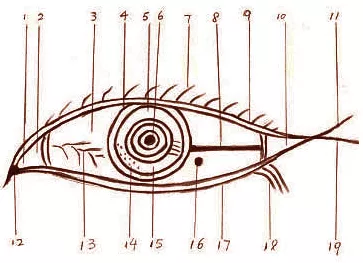
Diagram
1. Inner corner 2. Angry flesh 3. White sclera 4. Holy guard ring 5. Black iris 6. Pupil 7. Eyelashes 8. Red veins 9. Upper eyelid wave 10. Outer tip 11. Crow's feet 12. Roundness 13. Red veins 14. Yellow sand 15. Wheel 16. Mole 17. Lower eyelid line 18. Worry lines 19. Knife cut
Analysis
1. Inner corner: Said to relate to a person’s lifelong legal matters and misfortunes. Observe its width: a wide inner corner often indicates frequent close calls, while a narrow one suggests susceptibility to accidents and disputes.
2. Angry flesh: The reddish tissue at the inner corner is called “angry flesh.” A slightly red hue that is not too prominent suggests intelligence and cleverness, but a tendency toward heart issues. Prominent angry flesh points to a strong temper, while recessed or small angry flesh suggests someone who hides emotions and is less prone to anger, though they may be somewhat superficial.
3. White sclera: A clear contrast of black and white—white bright as jade and black dark as lacquer—indicates decisiveness and a carefree attitude, able to take on and let go.
- Yellowish hue: Indicates a strong romantic inclination.
- Murky color: Suggests heavy thoughts.
- Ivory color: Indicates reliance on connections and a need for clear benefits before taking action.
- Yellowish-white: Reflects a weary mindset.
- Blue: Indicates frequent disappointment; Yellow with red: Suggests long-term mental fatigue and a tendency toward startled sleep.
- Pale blue: Indicates unhappiness and poor emotional state.
4. Holy guard ring: A deep blue glow surrounding the eyeball is said to show strong vitality and longevity.
5. Black iris:
- Black: Nostalgic and sentimental.
- Dark black: Worldly and shrewd.
- Yellow: Sensitive to light.
- Brown: Calm and straightforward.
- Blue: Naive in handling matters.
6. Pupil: The larger, the better—said to indicate intelligence and quick memory. A small pupil suggests someone very stubborn and petty.
8. Red veins: A horizontal red line visible on the sclera. If this line crosses the iris to the other side, it is called a “red vein crossing the eye,” said to portend sudden death within a hundred days. Tradition advises that if you notice this in someone, encourage them to do good deeds and refrain from taking life; it is considered inappropriate to mention the ominous reading directly.
9. Upper eyelid wave: Commonly referring to the upper eyelid, which may be single or double. Generally, single eyelids are seen as more rational, while double eyelids are more emotional. Triple eyelids are called elephant eyes and are thought prone to romantic entanglements. If the left is single and the right is double, it suggests that for men the left eye is more significant, and for women the right eye is more significant for judgment.
10. Outer tip: A long outer tip is said to indicate that a man may marry a beautiful wife, and a woman may marry a handsome husband.
11. Crow's feet: People with this feature, regardless of gender, tend to have strong romantic inclinations and may engage in ambiguous relationships. Those with many crow’s feet before age 30 are often very romantic. Downward crow’s feet in women may indicate a risk of miscarriage. Fine crow’s feet suggest a husband who relies on a wealthy wife. Crow’s feet slanting upward indicate persistence in one’s endeavors.
12. Roundness: Used to assess whether a person can earn and save. A sharp, horizontal contour suggests the ability to earn and save money, while a curved, beak-like shape (like a parrot’s) suggests difficulty making money.
13. Red veins: Indicates physical fatigue and low energy; suggests getting more rest and taking care of the body.
14. Yellow sand: Suggests potential internal health issues that should be checked by a doctor as soon as possible.
15. Wheel: Typically appears as a deep yellow ring; the denser, the better—said to indicate high intelligence.
16. Mole: Associated with romantic entanglements. A mole on the white of the eye near the eyeball suggests an entanglement before marriage, while one near the outer corner suggests one after marriage. A mole on the left white indicates a willing involvement, while one on the right indicates emotional confusion. The left side is judged for men and the right side for women.
17. Lower eyelid line: Also known as the “sleeping worm” or eyelid line. A fleshier left sleeping worm indicates a clever son; a fleshier right one indicates a clever daughter. For men, the left side is more significant; for women, the right side is more significant. If a woman has a prominent sleeping worm, it may indicate poor fortune for her husband. Regardless of gender, a clear eyelid line suggests filial children.
18. Worry lines: A sign of mental exhaustion.
19. Knife cut: Downward crow’s feet symbolize harm to one’s spouse.