Interpreting Ice: How Skull and Bone Structure Unveil Personality and Destiny
Jiangnan Yilin previously remarked that Zeng Guofan's "Ice Mirror" opens with: "A mountain does not collapse; it relies on stones for support, which are called its bones." This implies that a mountain’s stability depends on the stones that fortify it. Likewise, bones in the human body are vital, akin to the reinforced concrete in a building's structure.
When discussing facial features, many can effortlessly list descriptors such as a full forehead, square jawline, nose shaped like a hanging gourd, lips resembling cinnabar, prominent brow, and distinctive bone structure, among others. These descriptors frequently appear in comedic dialogues, storytelling, novels, or television shows.
About "Bone Structure"
The term "unique bone structure" is often abstract and serves as a general assessment of an individual's skeletal framework, implying an unusual bone structure. It is frequently used as an adjective unrelated to facial features.
Many will recall the iconic scene from Stephen Chow's film "Kung Fu," where a bedraggled, enigmatic old beggar earnestly tells a group of unsuspecting children: "Young man, I see you have a unique bone structure; you are a rare martial arts prodigy. The world's peace rests on your shoulders. I have a secret manual of 'Rulai's Divine Palm' that I'll sell to you for just ten dollars, as I feel a connection with you."
Evaluating bone structure can be quite daunting, particularly regarding atypical skull bones. In ancient texts, individuals believed to possess unusual bone features often attained extraordinary fame. According to Chinese physiognomy, specific areas of the forehead, top, and sides of the head may exhibit unique bones—essentially unusual bone protrusions. In modern physiognomy, the skull's bones are not heavily scrutinized unless there are distinct, noticeable traits. Furthermore, when evaluating a woman's features, you wouldn’t lift her thick hair simply to examine her bone structure, would you?
However, the bones of the face, such as the forehead, cheekbones, and nose bridge, are significant, which Jiangnan Yilin will elaborate on in depth.
The History of Craniometry
Jiangnan Yilin will explore the history of craniometry, a topic unfamiliar to many Chinese people. Craniometry, founded by French anatomists Gall and Spurzheim in the early 19th century, revolves around the theory of brain function localization. The main concept is straightforward: craniometry suggests that various personality traits and abilities—such as musical and artistic skills—correspond to different brain areas, with the skull closely linked to these regions.
Without further detail, simply refer to the diagram below. You'll notice that craniometry divides the human skull into numerous small regions, initially 35, later extending to 42. Each region is thought to correspond to different personality traits and abilities, such as being "sentimental," "ambitious," or "meticulous." Analysts assess protrusion or depression in these regions to determine various conclusions. The most critical aspect in craniometry is whether a region protrudes, as protrusions are seen as beneficial, which is why craniometry is often termed "the art of reading protrusions."
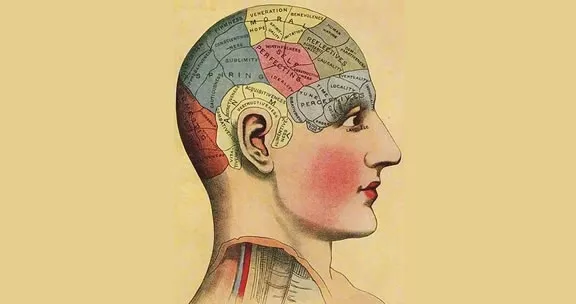
In the 19th century, craniometry gained tremendous popularity in France, Britain, and the United States, prompting the establishment of various societies, academies, and publications until it gradually faded away in the early 20th century.
In that era, some individuals in Europe and America were so enamored with craniometry that companies produced headgear fashioned according to craniometric principles, featuring various protruding regions. Newborns were made to wear these headgear, allowing their soft skulls to develop into the shape of the headgear, under the belief that this would endow them with advantageous traits and abilities. Countless innocent children endured considerable hardship during that time due to these headgear.
Today, however, anyone with basic common sense can challenge this theory. The skull is simply a protective shield for the brain, made of bone. Unlike the brain's intricate wiring, it's unfathomable how different skull regions could correlate with specific functions.
Regarding the craniometric headgear, Jiangnan Yilin advises caution. Some parents, particularly in rural areas, have their newborns sleep on hard wooden surfaces without using soft pillows. Over time, this causes the back of the child's head to become very flat, creating an edge-like appearance. Regardless of the implications for bone structure, this shape is unattractive, flattening an area that should be rounded. Parents should pay attention to this issue.
Jiangnan Yilin's Summary
To summarize, Western craniometry lacks scientific validity and has been debunked by modern medical and psychological research. However, it is important to note that while the cranial regions craniometry espouses are largely unfounded, the overall shape of the skull still plays a role in physiognomy. Chinese physiognomy generally values fullness, roundness, and durability, while it disapproves of concavity, sharpness, and thinness.
A child with a rounded skull, a full forehead, and a rounded back of the head tends to possess a different personality and destiny than a child with a flat, thin, or sunken skull. Consider this: what shapes do stones take on in nature? Furthermore, naturally occurring non-living objects seldom have angular shapes; they are typically round or oval. This simple observation might explain why ancient Chinese culture held roundness in high esteem.