Zeng Guofan's Guide to Understanding People: Start with Their Ambitions, Listen to Their Words, but Most Importantly, Observe Their Eyes.

Image source: QianKu Network
Zeng Guofan is celebrated as an astute judge of character, a reputation that remains largely undisputed. Even the sometimes disdainful Zuo Zongtang recognized Zeng Guofan's "insight into people." According to the "Chronicle of Zeng Wenzheng," compiled by Li Shuchang, Zeng first met Jiang Zhongyuan in 1844, the 24th year of the Daoguang era.
"Jiang Gong was renowned for his chivalrous spirit and nonconformity. We chatted over trivial market matters, sharing hearty laughter for a long time. After Jiang left, I turned to Guo Songtao and remarked, 'Such a person is rare in the capital.' I added, 'This person will achieve great fame, but he will meet his end with honor and righteousness.' In those peaceful times, such a statement was quite startling to those who heard it."
This excerpt likely aligns with the conclusion of Zuo Zongtang's "Biography of Jiang Zhonglie," with minor wording differences. Despite Jiang Zhongyuan's reputation for gambling and womanizing, Zeng Guofan's judgement was unaffected. Years later, Jiang bravely fought in battles across Jiangnan and Jiangbei, sacrificing his life for his country. He was posthumously honored with the title of governor and the epithet "Zhonglie," confirming Zeng Guofan's prediction.
When assessing people, Zeng Guofan prioritized their demeanor, spirit, and character before considering their words, appearance, and actions.
Gracefulness and dignity are signs of nobility; humility and tolerance are also esteemed qualities.
A purposeful approach to work is a mark of prosperity; a heart inclined to help others is likewise a sign of wealth.
The concepts of "graceful and dignified" and "humble and tolerant" are fairly straightforward. "Having a sense of purpose in work" suggests that one should have clear direction and resolution in tasks, knowing when to advance and when to retreat, adept at both letting go and taking charge, and capable of seeing things through effectively. "Having a heart for helping others" involves being charitable, actively supporting vulnerable groups and public welfare causes, and contributing to society. Generosity leads to greater rewards, hence it's an indicator of wealth. Zeng Guofan further elaborated on noble attributes, offering a insightful perspective:
"In carefully observing people, one should possess a complete spirit and abundant energy, with raised eyebrows and a straight nose, a strong build and a long waist, all in harmony. These qualities signify nobility and talent."
What does "complete spirit and abundant energy" entail? It means having clarity of mind and vitality. "Raised eyebrows and a straight nose" refers to having distinct brow bones and a straight nose. "Strong build and long waist" suggests a sturdy walk and upright posture. "All in harmony" means one's features and physique are well-proportioned. Such physical traits denote nobility and talent.
He also stated: "Craftiness leads to disaster, jealousy leads to disaster, stinginess leads to disaster. Filial duty brings fortune, diligence brings fortune, forgiveness brings fortune."
Crafty individuals are deceitful, love scheming, and enjoy trickery; jealous individuals cannot tolerate anything or anyone except themselves; stingy individuals are narrow-minded, preoccupied with trivial gains, and fail to see the big picture. These traits can easily lead to misfortune. In contrast, filial piety toward parents, dedication to hard work, and kindness towards others foster good fortune.
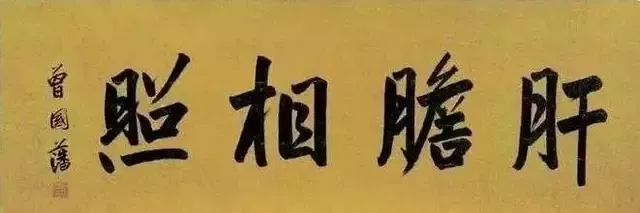
In evaluating people, Zeng Guofan favored those who were reserved, cautious in speech, and taciturn, considering them superior; while seeing the talkative, verbose, and boastful as lesser. The notable Xiang Army general Liu Songshan "was silent yet excelled in battle, tall and clear-minded," receiving high praise. Another Xiang Army general, Li Xubin, "remained silent among crowds all day," was equally praised. General Xiao Fusi, "awkward in speech but focused," was also rated highly. They epitomized the idea of being "slow to speak but quick to act," garnering Zeng Guofan's trust and favor.
Zeng Guofan valued "calmness," "conscience," and "filial piety" as superior traits, while considering "superficiality" and "slipperiness" as inferior. It's often said that the eyes are the windows to the soul. Zeng Guofan paid particular attention to a person's eyes; if someone had darting eyes, a shifting gaze, or only kept their eyes focused on their toes, with "eyes that move fiercely," "eyes that shift with reckless words," or "eyes devoid of spirit," they were negatively noted in his diary. He believed reliable individuals do not gaze aimlessly or shift their eyes needlessly.
Zeng Guofan appreciated those who were "calm and clear," "simple and sincere," and "clear-minded and kind-hearted." His diary contains many such evaluations, and individuals receiving them were often outstanding or commendable. Soldiers needed bravery and fortitude in battle, and in Zeng Guofan's assessments, anyone described as "tall and honest" or "tall and kind-hearted" received positive reviews. Conversely, those lacking vitality and masculinity rarely earned favorable evaluations.
On the eighth day of the third month in the ninth year of the Xianfeng era (1859), Zeng Guofan noted in his diary: "At night, I contemplated the method of assessing people and identified twelve characteristics: six positives and six negatives. The positive traits are long, yellow, lofty, tight, steady, and harmonious; the negative traits are rustic, dim, troubled, restless, angry, and evasive."
How can the six positive traits be defined? "Long" suggests being tall and lean; "yellow" refers to having hazel eyes; "lofty" to a dignified comportment; "tight" to focused energy; "steady" to composed behavior; "harmonious" to well-balanced features. What about the six negative traits? "Rustic" points to vulgar, coarse behavior; "dim" to confusion; "troubled" to a worried look; "restless" to anxiety; "angry" to a bad temper; "evasive" to a shifty gaze.
On the thirteenth day of the eleventh month in the fourth year of the Tongzhi era (1865), Zeng Guofan reflected on his past investigations into the "method of observing people" and crafted a memorable rhyme:
"To discern right from wrong, observe the eyes and nose; to discern truth from falsehood, look at the lips;
To discern achievements and fame, consider the spirit; to discern wealth and nobility, gauge the energy;
To discern intentions, observe the fingers; to detect troubles, watch the feet;
To understand order, listen to the words."
This rhyme is straightforward, yet mastering its nuances is difficult, as even a small error can result in significant misunderstanding. Moreover, there are many adept at masking their true selves, while those with genuine insight are rare. Even Zhuge Liang misjudged Ma Su, leading to a major setback. Assessing and utilizing talent is no easy feat.
Zeng Guofan's "method of assessing people" and "method of observing people" are captured in essence here. In selecting talented generals, he prioritized qualities such as calmness, reliability, integrity, loyalty, independence of thought, composure, resilience, open-mindedness, spirit, and conscientiousness. Wealth and status were not his main concerns. For leaders, enhancing discernment is crucial, and Zeng Guofan's methods offer valuable lessons.