What Would Happen to Earth if Nine Stars Aligned?
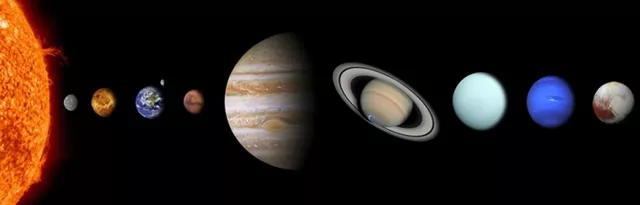
Many people may have heard of the "Nine Stars in Alignment" phenomenon. Across roughly 6,000 years of human civilization, various records have documented this event. This rare astronomical occurrence takes place when all the major planets line up in a straight trajectory on the same side of the Sun. Although Pluto is now classified as a dwarf planet, making it no longer one of the nine major planets, the occurrence of a Nine Stars in Alignment is still possible, and scientists have forecasted specific times when it might happen.
In ancient times, unusual celestial events were often seen as omens of impending disaster. During Emperor Qin Shi Huang's reign, a meteorite fell to Earth, and diviners interpreted this as a sign that the "throne would change hands," suggesting that the emperor was approaching the end of his life.
Among ancient celestial phenomena, the Nine Stars in Alignment was regarded as a harbinger of significant calamity and upheaval, making it one of the most feared events to witness.
The "Nine Stars in Alignment" Phenomenon
Contrary to its name, the "Nine Stars in Alignment" does not involve stars literally lining up in a straight line, which is impossible. Instead, it describes the alignment of the nine major planets as they orbit the Sun, all appearing to gather on one side, forming what looks like a straight line from a distance. This is known as the alignment phenomenon.
"Planetary alignment" is generally identified by scientists using the following four criteria:
First, the planets' positions are taken as their projected locations on the ecliptic plane.
Second, alignment is considered to occur when the planets cluster near the line connecting the Sun and Earth (without including the Sun in the alignment).
Third, the angle (θ) formed by the line connecting Earth to the planets and the line connecting the Sun to Earth serves as a quantitative "indicator" of "planetary alignment." This angle is regarded as an acute angle of less than 90 degrees.
Fourth, the maximum angle formed by the planets at any moment is calculated, and the moment when this angle is the smallest is counted as "planetary alignment." The planets considered in this include 6 to 9 out of all in the solar system, with Earth included.
The angular sector is determined by the θ angle. Scientists have calculated and recorded events over the past 300 years (from 1850 to 2150), finding 17 instances of "planetary alignment" with a θ angle less than 13 degrees. The most recent alignment occurred on May 20, 2000, at midnight, with a θ angle of 12.6 degrees. The last "seven stars in alignment" happened on March 6, 1965, at 9 AM, when Mercury, Venus, Earth, Mars, Saturn, Uranus, and Pluto aligned within a 9.3-degree range.
From 3001 BC to 3000 AD, records show that six-star alignments occurred 49 times, seven-star alignments 3 times, and eight-star alignments also 3 times. Alignments with fewer than six stars are even more frequent. These records only consider angular sectors less than 5 degrees; if expanded to 10 degrees, there are 709 six-star alignments, 52 seven-star alignments, and 3 eight-star alignments.
It might seem that a nine-star alignment has never been recorded, leading some to believe it's merely a legend. However, based on scientific simulations and analyses, the first predicted nine-star alignment in human history is set to occur on December 10, 2149, marking this rare celestial event.
Ancient Five-Star Conjunction
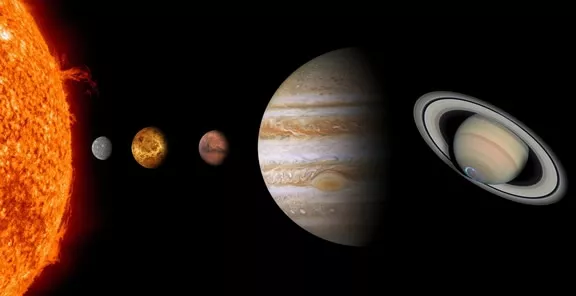
Before telescopes, humans couldn't witness a nine-star alignment; they only observed five-star conjunctions, as noted by ancient astrologers. From Earth, these five planets appeared to be closely grouped in the sky.
A notable record of a five-star conjunction occurred in 1076 BC, before King Wu of Zhou's campaign against King Zhou of Shang. These records often coincide with significant events like the founding or decline of a dynasty. In ancient astrology, such conjunctions were often seen as omens of the rise and fall of nations.
So, what might happen on Earth during the "Nine Stars in Alignment" in 2149?
The Rare "Nine Stars in Alignment"
The planets orbit the Sun at different speeds, with varying distances and orbital lengths, creating significant differences in their orbital completion times.
Mercury, closest to the Sun, completes an orbit in 88 Earth days, followed by Venus at 225 Earth days. Earth completes its orbit in 365 days, while Mars takes 687 days.
Neptune, the outermost planet, takes 60,192 Earth days (about 165 years) to complete its orbit. This makes it unlikely for someone to witness Neptune in the same position twice in their lifetime. Consequently, the probability of a "planetary alignment" is extremely low.
Including the dwarf planet Pluto, a nine-star alignment is predicted to occur roughly once every 6,000 years.
The Impact of "Nine Stars in Alignment" on Earth
Historically, humanity has held a profound respect for the stars. Whether during ancient times, in the early days of modern astronomy, or today, mysterious astronomical events have been linked to various disaster theories.
In contemporary discussions, the nine-star alignment often features in science fiction. For example, in time-travel novels, protagonists might encounter a time tunnel during the moment of alignment, leading them to another realm or era, starting an extraordinary journey. It's said that such an alignment might trigger unprecedented phenomena, potentially affecting time or the future.
Despite the changes in celestial phenomena, a fundamental concept in traditional Chinese culture is "the unity of heaven and humanity." Ancient Chinese believed that the heavens governed the course of human history and the world's fortunes. Leaders were seen as possessing a mandate from heaven, and failing to align with this could result in celestial warnings and disasters.
Humans are a part of nature's vast organism. Daoism teaches that heaven and humanity are one, with humans following the earth, the earth following the heavens, the heavens following the Dao, and the Dao following nature. Living in this universe, humans naturally respond to cosmic influences. Hence, when faced with rare celestial changes, living in harmony with these phenomena and accepting one's fate is always wise.