Astrology Basics: Planetary Aspects

Planetary aspects are the angles formed between planets in an astrological natal chart. Aspects reveal how a person may express their personality constructively in certain areas, as well as where they might experience psychological pressure or tension. Aspects are not inherently good or bad; modern astrologers generally believe that challenging aspects, such as squares, can provide motivation and drive—especially when well integrated with the rest of the chart.
If the recorded birth time is accurate, aspects to the Ascendant and Midheaven should be considered; if the time is unreliable, these should be disregarded. The Ascendant and Midheaven are the cusps of the first and tenth houses, respectively, and are highly time-sensitive. Additionally, when a planet forms no major angular relationships with other planets, it is referred to as an “unaspected” planet.
An exact conjunction means two planets occupy the same degree of the zodiac; an exact square places them 90 degrees apart; an exact trine places them 120 degrees apart. Exact aspects are rare, so astrologers use “orbs” to allow some variation around the precise angle. Generally, you’ll see the following:
Aspect Angle (degrees) Typical orb
Conjunction (Conjunction) 0 degrees 8–12 degrees
Semi-Sextile (Semi-Sextile) 30 degrees 2 degrees
Semi-Square (Semi-Square) 45 degrees 2–4 degrees
Sextile (Sextile) 60 degrees 2–7 degrees
Square (Square) 90 degrees 5–8 degrees
Trine (Trine) 120 degrees 4–8 degrees
Sesquiquadrate (Sesquiquadrate) 135 degrees 2 degrees
Inconjunct (Inconjunct) 150 degrees 2 degrees
Opposition (Opposition) 180 degrees 6–12 degrees
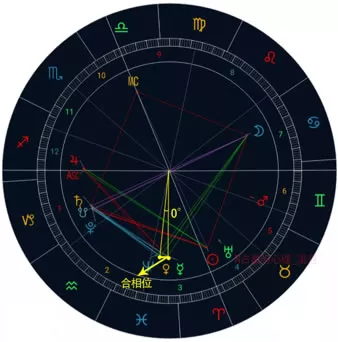
0-Degree Aspect (Conjunction)
This major aspect occurs when planets are conjunct. When planets of similar nature are conjunct, their positive qualities are amplified. For example, in a natal chart, a conjunction between Jupiter and Venus can boost luck and ease. When planets of very different natures are conjunct, the energies may clash. For instance, a conjunction between fiery Mars and cool Saturn can temper excesses yet also create friction and discord.
The conjunction has a strong influence in daily forecasts and in relationship analysis when comparing two charts. The allowable orb for this aspect is 8 to 12 degrees.
30-Degree Aspect (Semi-Sextile)
Although considered a minor aspect, it carries roughly half the strength of a 60-degree sextile and is quite important in financial matters.
A semi-sextile suggests potential benefits around finances. When comparing two natal charts, a 30-degree link indicates the two people can assist each other in certain areas, though minor disputes may arise. The allowable orb for this aspect is 2 degrees.
45-Degree Aspect (Semi-Square)
This is a minor aspect, possessing about half the intensity of a 90-degree square, yet it is noteworthy in financial matters.
A semi-square points to potential difficulties with money—especially expenses. In synastry, a semi-square indicates minor friction between two individuals. The allowable orb for this aspect is 2 to 4 degrees.
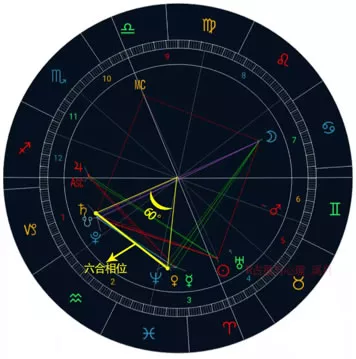
60-Degree Aspect (Sextile)
This is a major, harmonious aspect and is especially meaningful for couples and friends.
A harmonious sextile indicates that with effort, success is achievable. In a natal chart, many sextiles suggest someone who can make steady progress through hard work. In a composite chart, this aspect implies that two people can complement each other well.
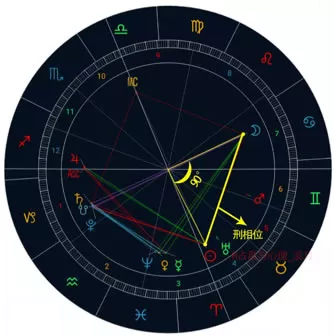
90-Degree Aspect (Square)
This challenging aspect indicates obstacles and disharmony. In a natal chart, many squares suggest that the basic personality contains tensions and contradictions, and the person may at times send mixed signals or work at cross-purposes.
In romantic synastry, a 90-degree connection is not entirely negative. There is a common exception involving Venus and Mars: if a man’s Venus squares a woman’s Mars—or a woman’s Venus squares a man’s Mars—it can indicate strong sexual chemistry (though not necessarily love).
For daily forecasts, a square points to difficulties to resolve or unfavorable conditions. Unless circumstances are especially severe, these tend to be temporary. The allowable orb for this aspect is 5 to 8 degrees.
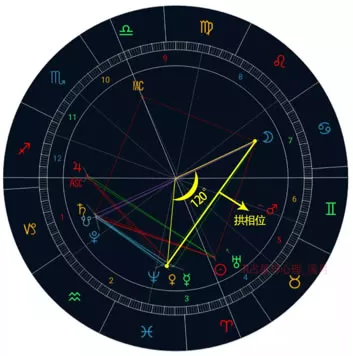
120-Degree Aspect (Trine)
This harmonious aspect indicates that things can flow smoothly. In a natal chart, numerous trines can form a large triangle—often called a grand trine—suggesting natural talent and ease; with effort and persistence, this can lead to notable achievements.
In a composite chart, a 120-degree aspect usually reflects complementary elements (such as fire and air, or water and earth), indicating harmony in certain areas and easy communication.
In daily forecasts, a trine suggests plans can proceed smoothly and that support or good fortune may arrive. The allowable orb for this aspect is 4 to 8 degrees.
135-Degree Aspect (Sesquiquadrate)
This aspect resembles the 45-degree semi-square and is also considered minor. It represents a somewhat uncoordinated angle, indicating unease or anxiety, often due to delays or snags. However, in the charts of charismatic politicians, it can be quite significant.
In synastry or daily forecasts, this aspect suggests that any unease or tension is temporary; in relationships, communication can ease conflicts. The allowable orb for this aspect is 2 degrees.
150-Degree Aspect (Inconjunct)
This minor aspect represents imbalance, somewhat akin to the 30-degree semi-sextile, but it is especially important in health-related interpretation.
In a natal chart, if this aspect appears in the second, sixth, eighth, or eleventh houses, pay special attention to health issues indicated by the signs and planets involved. In a composite chart, a 150-degree connection between two individuals can point to unmet desires or an unequal, fated-feeling dynamic. The allowable orb for this aspect is 2 degrees.
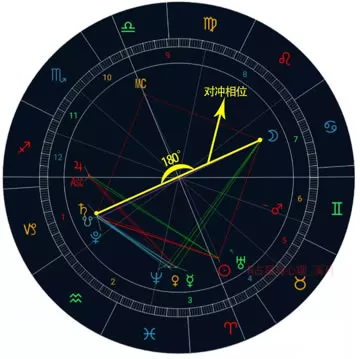
180-Degree Aspect (Opposition)
This is a major aspect, second only to the conjunction, occurring when two planets are in opposition. It creates tension and polarization; finding balance and integration is key to resolving it.
In a natal chart, this aspect indicates the need to seek balance in interactions with others, as extremes can lead to failure. In a composite chart, two outcomes are common: powerful attraction (especially romantically) or strong mutual aversion. The best way to handle an opposition is open communication aimed at dynamic balance. The allowable orb for this aspect is 6 to 12 degrees.