Understanding the Birth Chart: A Guide to Astrology Fundamentals
Image source: Pixabay
1. The Natal Chart
The natal chart primarily includes the birth chart (also known as the natal chart), the transit chart, and the synastry chart. Among these, the birth chart serves as the foundation. It's a snapshot of the sky at the exact moment and location of your birth, centering on your position in time and space. The chart captures the positions of personal or object-related elements at birth, including time, longitude and latitude, zodiac signs, the Sun, Moon, Mercury, Venus, Mars, Jupiter, Saturn, Uranus, Neptune, Pluto, and minor planets, along with the various aspects (angles or degrees) formed between them. With this information, you can derive innate and acquired factors, personality traits, finances, marriage, career, and more.
To calculate your own birth chart, you'll need your exact birth time and location.
2. Birth Chart (Natal Chart)
2.1 The Meaning of the Birth Chart
In English, it's called the Birth Chart (or Birth Horoscope), translated here as the birth chart (also known as the natal chart). It's an indispensable tool when doing an astrology reading for an individual.
- Starting Point: Astrology uses the movements of celestial bodies as a tool to measure events, but how to pinpoint a state in the ever-moving cosmos that relates to a person's life is a profound question. In modern astrology, the concept of a starting point is adopted: the positions of celestial bodies at the instant a person's life begins are linked to that individual. Simply put, the state of the heavens at birth represents the person.
- From Three-Dimensional to Two-Dimensional Space: The world we live in is three-dimensional, so recording celestial states should ideally be done in 3D to stay accurate. However, astrologers can't create a universe model for every person, so they use projection to extract key elements, mapping the 3D state onto a 2D plane. That's what you see in a birth chart.
2.2 Contents of the Birth Chart
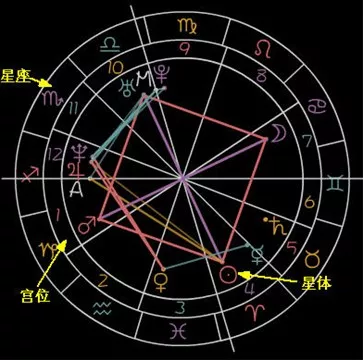
The contents of a birth chart can be likened to a photograph taken in outer space at the moment of birth, capturing only the positions of the celestial bodies.
Celestial Bodies
There are countless stars in the sky, but in astrology, the main ones used are the Sun, Moon, and the major planets in our solar system. Sometimes, minor planets and asteroids like Chiron or Juno are included. Each has distinct meanings. To find which zodiac sign and house a planet falls into, draw a line from the chart's center through the planet; the sign and house it crosses indicate its placement. Below is a brief introduction to the symbols and meanings of the ten primary solar system bodies (beginners can ignore the minor ones):
 Sun (Sun): The Sun's symbol is a circle with a dot in the center, which can also be seen as a small circle. This central dot represents the Sun's core self. The symbol embodies a force, a spiritual center.
The Sun symbolizes all yang energy, representing our vision. It signifies spirit, will, consciousness, reputation, and image. Its role in the chart is extremely important as it's the most influential body on Earth, with its zodiac transit also exerting significant effects. The sign and house it occupies, along with aspects to other planets, are the first things people check when reading a chart.
Radiating light in four directions, the Sun rules Leo and is exalted in Aries; it's in detriment in Aquarius and falls in Libra. Its influences include the primary way of expressing oneself, leadership and success, affecting life principles, inspiring will, building faith, and governing intent.
 Moon (Moon): The Moon's symbol is a crescent, constantly changing from incomplete to full and back. It represents inner emotions and needs, implying a search to fill lacks and achieve wholeness. The left side signifies the past, so the missing part on the left means things lost in life's journey become our needs.
Reflecting the Sun's light, the Moon rules Cancer. It's exalted in Taurus, in detriment in Capricorn, and falls in Scorpio. The Moon's influences include emotional fluctuations, material life principles, receptive abilities, and persistence. Its house position shows where emotions are easily triggered.
As a yin planet, the Moon represents the physical body and material form, with crucial influence in the chart. It's Earth's closest celestial body, orbiting the zodiac quickly. The waxing and waning Moon supports our instincts, emotions, cycles, changes, feelings, habits, reflexive actions, and behaviors. In terms of people, it represents females like mothers, sisters, and women.
 Mercury (Merc): Related to intellect and change, Mercury's symbol is the most complex among personal planets: a soul's crescent moon above, a material cross below, connected by a spiritual circle. The upward crescent also symbolizes pursuit.
Mercury is the closest planet to the Sun, classified as a "personal planet" in the chart, with rapid zodiac motion. It never strays more than 28 degrees from the Sun, often considered neutral in gender, representing general direct perception, consciousness, and effects. It also drives knowledge, language expression. In people, it represents neutrals, females or males; or close relatives like siblings, children, parents.
The changeable Mercury supports rationality, language expression, intelligence, observation, craftsmanship, reasoning, communication, vision, and sensory awareness. Its house shows the best way to express in that area. It rules Gemini and Virgo, exalted in Aquarius, in detriment in Sagittarius and Pisces, falls in Leo.
 Venus (Venu): Venus's symbol lacks Mercury's upper crescent, with material cross energy lifting the spiritual circle. It's a "pure" symbol, composed of two basic elements without distortion.
Venus is Earth's closest planet, faster in zodiac motion than Earth, a "personal planet." It never exceeds 46 degrees from the Sun. As a feminine, yin planet, it represents loving behaviors and values, social skills, and value views. In people, it signifies women or yin qualities. The harmonious Venus supports art, culture, aesthetics, wealth, partners, beauty, charm, good taste, injury, sweets and sugar, colors, harmony, poetry, painting, jewelry, singing, theater, and music. It affects success, reputation, health, money, and social life.
Venus rules Taurus and Libra. Exalted in Pisces, detriment in Scorpio and Aries, falls in Virgo. Its house shows the best expression in that life area.
 Mars (Mars): Mars consists of a spiritual and power circle below plus a deformed cross—an arrowhead—pointing right to the future. The altered cross, missing one side, signifies dynamic change. Mars: change and collision.
Mars is the closest planet to Earth beyond it, a "personal planet." As a masculine, yang planet, it represents wildness, courage, authority, construction, work, strife, competition, and death. Its essence is yang, hot, and dry, signifying action, aggressive drive, motivation. In people, it represents males or the young.
Mars's house is where you exert full effort. It rules Aries and Scorpio. Exalted in Capricorn, detriment in Libra and Taurus, falls in Cancer.
The Sun and Moon are luminaries, basically full circles. Personal planets Mercury, Venus, Mars also include complete circles. But generational planets Jupiter and Saturn are primarily structured by the material cross, reflecting their real-world importance.
 Jupiter (Jupi): Jupiter is a material cross with a soul's crescent in the upper left—spiritual pursuit on a material foundation.
Jupiter is the chief god "Zeus" in Greek mythology, a "non-personal planet" with huge astrological influence. It takes about 12 years to orbit the zodiac, one year per sign. As a feminine, yin planet, it represents health, leisure, large enterprises, higher intellect, optimism, height, longevity, morality, expansion, and indulgence.
Due to its evident effects, a person's annual fortune is largely determined by it, especially the "solar return year." Anciently called the Year Star, or commonly "solar return." "Afflicted Solar Return" in astrology means conflicts or adverse aspects between natal Jupiter and transiting Jupiter. The changeable Jupiter supports higher education, philosophical reasoning, tolerance, ideals, dreams. Its house is where luck and opportunities lie, and safe relaxation areas.
Jupiter rules Sagittarius and Pisces. Exalted in Cancer, detriment in Gemini, falls in Capricorn.
 Saturn (Satu): It's a material cross with a soul's crescent below right, hidden under the cross, matching end-of-season imagery.
Saturn is also a "non-personal planet." It takes about 30 years to orbit the zodiac, 2.5 years per sign. As a masculine, yang planet, it represents truth, conflict, solidification, wisdom principles. Influences include personality, single-mindedness, competitive spirit, sensory pressures. Like forms, discipline, responsibility, organization, wildness, business ability, limits, sorrow, delay. Its house is where security feels most lacking, needing utmost compensation.
Saturn rules Capricorn and Aquarius. Exalted in Libra, detriment in Cancer, falls in Aries.
Jupiter and Saturn tell stories of soul crescents and material crosses. The outer planets' symbols are simpler than the inner ones, expressing deeper meanings.
 Uranus (Uran): Uranus's base is a spiritual and power circle, crossed by a material cross connecting two opposite new moons. From spiritual power acting on the material level, the back-to-back new moons signal seeking different viewpoints, other perspectives. Both new moons face outward, searching external meanings and ways. Uranus's eccentricity is evident here.
Uranus is a "transpersonal planet," discovered in 1781, taking about 84 years to orbit the zodiac, 7 years per sign. As a masculine, yang planet, it represents freedom drive, dissatisfaction with divinity. Inclined to modernism, humanism, bohemian style, worship of the strange, self-centeredness, utopian.
Uranus's sign position highlights era differences, common fate for those born in the same period, influencing individuals across eras. Its sign has historical era meaning, greater than personal character or thought impacts. Though its position shows pursuit of self and personality, hidden motivations behind desires and goals, the house meaning is more important. From its house, see how one expresses direct abilities and affinity for unusual things.
Uranus rules Aquarius. Exalted in Scorpio, detriment in Leo, falls in Taurus.
 Neptune (Nept): Neptune has two material crosses with a spiritual crescent in between. Another upward crescent, seeking higher things. The soul new moon wedged upward between materials lacks a power circle for support.
Neptune, discovered in 1846, is a "transpersonal planet." It takes about 164 years to orbit the zodiac, 14 years per sign, double Uranus's. As a feminine, yin planet, it represents spiritual drive or escape drive. When in signs, it specially influences eras or groups, less so individuals. Its house shows pursuit of ideals, or tendencies toward self-deception or deceiving others.
Neptune rules Pisces. Exaltation undetermined; detriment in Virgo; fall undetermined.
 Pluto (Plut): Pluto's high point is a power circle, base a material cross, soul crescent pointing skyward. The core power circle marks Pluto's contained force, exploding within the soul new moon.
Pluto, discovered in 1930, moves slowest among bodies, taking about 246 years to orbit the zodiac. Due to elliptical orbit, time per sign varies from 12 to 30 years, a "transpersonal planet." Symbolizes humanity's subconscious given physical power, generally opposite the Sun's force. As a masculine, yang planet, it represents destructive or reformative drive, fusion, dark development, birth, regeneration, downfall.
Like Uranus and Neptune, Pluto's sign stay impacts eras more than individuals, the least related modern planet to personal life. Its sign positions often hold strong historical importance, bringing root-level great changes, dramatic shifts to human life and civilization, even affecting personal traditional views. Its suppressed power, once released, thoroughly changes the past; these changes create new life or cause destruction. How individuals are affected shows in Pluto's house. Its aspects are life's most complex areas, needing solo resolution.
Pluto rules Scorpio. Exaltation undetermined; detriment in Taurus; fall undetermined.
Zodiac Signs
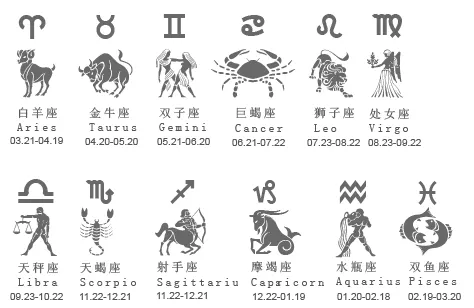
Starting from the vernal equinox, the zodiac is divided into twelve equal parts, shown on the chart's outer circle. The 360-degree ecliptic is distributed across the 12 zodiac signs, each occupying 30 degrees. The end position (tail) of one sign is the start (head) of the next. Each sign has its symbol. Signs are the background for planetary motion, but each carries unique qualities; when a planet falls into a sign, it takes on that sign's traits.
- Aries: Fire sign, represents self-awareness. Activity, belligerence. Inclination toward new experiences.
- Taurus: Earth sign, represents warmth, possessiveness. Pursuit of sensory pleasures.
- Gemini: Air sign, represents lightness, intellect. Desire to verbalize.
- Cancer: Water sign, represents maternal instincts, easy closeness. Desire to protect and nurture.
- Leo: Fire sign, represents dignity, vitality, creativity. Desire to express self.
- Virgo: Earth sign, represents discernment, analysis. Desire to serve.
- Libra: Air sign, represents sociability, harmony. Desire for balance.
- Scorpio: Water sign, represents exploration, persistence, depth. Desire to immerse in deep emotions.
- Sagittarius: Fire sign, represents longing for freedom, distance. Desire to pursue ideals.
- Capricorn: Earth sign, represents self-management, responsibility, conservatism. Desire to accomplish things.
- Aquarius: Air sign, represents fixedness. Desire for independence and freedom in all matters.
- Pisces: Water sign, represents compassion, emotionalization. Desire to be in certain atmospheres.
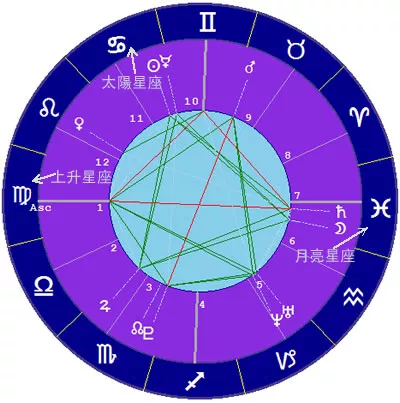
From an astrological perspective, to understand a person's signs, don't just look at the Sun sign; at minimum, check three: the rising sign, Sun sign, and Moon sign. In astrology, the rising sign's importance even surpasses the commonly discussed Sun sign.
Rising Sign
The rising sign is the zodiac sign ascending on the eastern horizon at birth. In your chart, it represents the environment at birth—family, social surroundings—shaping your outer self. Thus, from the rising sign, you can infer possible childhood economic conditions and upbringing, forming the "mask" you wear facing others. This "mask" affects your appearance, demeanor, physique; determines how others perceive you, how you think you'll be accepted; and leads your first defense mechanism in situations, easily showing the sign's flaws or leveraging its strengths.
Sun Sign
There are many articles on Sun signs, but few highlight its true meaning in astrology. The Sun is the solar system's only light source; even the Moon shines by reflected sunlight. Thus, in astrology, the Sun symbolizes all yang energy, the outward personality, like males, fathers, husbands, bosses. In Western psychology, it represents spirit, will, consciousness. It also signifies external reputation and image.
Moon Sign
Since the Sun sign doesn't handle mom-related matters, who does? The Moon sign! In astrology, the Moon's meaning somewhat parallels the Taiyin star in Ziwei Doushu. Basically, it's yin energy, so inner self, subconscious, emotions, mothers, sisters, family—all governed by the Moon. In Western psychology, the inner personality scope is mostly Moon-managed in astrology.
In summary, the rising sign is the most visible public "mask." So, first impressions usually show rising traits; as friendships or collaborations form, the Sun's self-expression emerges. The Moon often requires familiarity, even cohabitation, to feel the emotional state and responses.
Cardinal Points
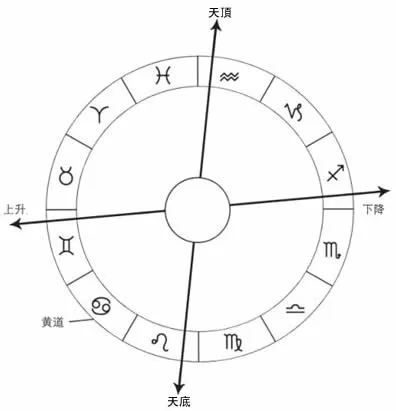
Refers to Ascendant (Asc), Descendant (Des), Midheaven (MC), and Imum Coeli (IC). These are points projected onto the ecliptic using optical principles at a specific time and place, each with different meanings.
From the observer's Earth view, at any moment, a specific sign rises from the eastern horizon; the opposite sign (180°) sets in the west. The degree of the easternmost sign is the ascending degree (Ascending Degree); that sign is the Ascendant or Rising Sign. Astronomically, the Ascendant is the ecliptic's intersection with the horizon, sky meeting earth. Opposite is the Descendant, the westernmost sign. The line connecting them is the horizon axis.
Similarly, for Earth observers, at any moment, a sign's special degree is "highest" above the meridian line, the southernmost visible point. Called Midheaven (Medium Coeli, MC: "middle of the sky"). Opposite is Imum Coeli (IC: "lowest point of the sky"). Their axis is the meridian axis.
Houses
Using cardinal points as foundation, the ecliptic is divided into twelve sectors—the chart's inner pie slices numbered 1 to 12, indicating houses. In house systems, house sizes vary by birth longitude/latitude. Houses represent life's different parts, dividing into twelve life areas.
- 1st House: Personality, physical condition, appearance, mannerisms, general health, vitality, first impressions.
- 2nd House: Possessions, money-handling talent, values, senses [five senses], pursuit of financial security.
- 3rd House: Intellect, learning ability, siblings, left/right hands, short trips, short writing, early education, mechanical skills, language ability, psychological adaptability.
- 4th House: Family, foundational environment, home, emotions, subconscious, heritage, real estate, inheritance, later life, parents.
- 5th House: Creativity, expression, pleasure, love, art, leisure, gifts, speculative fortune, gambling, parties.
- 6th House: Health, service [paid work], subordinates, short illnesses, diet, tools, pets, non-automatic labor.
- 7th House: Marriage, partners, shareholders, interpersonal relations, close friends, public enemies, contracts, bridges, contracts, legal, lawsuits.
- 8th House: Others' money [not earned by self], whether others buy your goods, banks, marriage partner's money, sex, death, mysteries, insurance, taxes.
- 9th House: Long trips, philosophy, religion, humanism, social welfare, higher education, great wisdom, cosmology, publishing.
- 10th House: Status, reputation, honors, being boss, image, ambition, parents.
- 11th House: Friends, social views, like-minded, groups, book clubs, wishes, ideals, dreams [social consciousness, saving humanity's future], choirs, parties, others' children [adverse times may involve kidnapping].
- 12th House: Limits, hidden enemies, seclusion, behind-scenes work, inner self, life's conclusion, unpaid service.
Aspects
Aspects (Aspects) refer to angles formed between planets in the zodiac chart. Planetary aspects can show where the chart owner's personality gains full, positive expression; or reveal psychological pressure and tension. No absolute good or bad; modern astrologers believe challenging aspects provide impetus and progress, especially when integrated with other chart planets.
Additionally, if birth time is accurate, aspects between planets and Asc (ASC) or MC should be considered; if not, ignore them. Asc and MC are cusps of 1st and 10th houses, heavily time-influenced. If a planet has no angular relation to others, it's an unaspected planet.
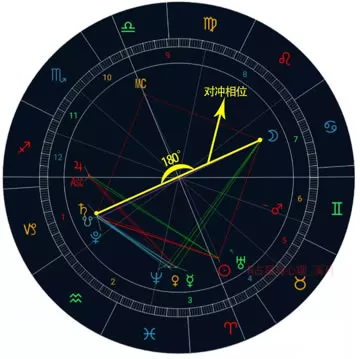
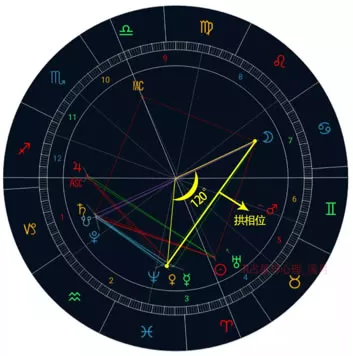
Exact conjunction means planet at exact degree/minute on ecliptic; exact "opposition" 180 degrees apart; exact "trine" 120 degrees. Exact aspects are rare; astrologers use "orbs"—allowances slightly more or less than exact degrees.
Aspects divide into major and minor. Major: conjunction, opposition, trine, square, sextile, quincunx. Minor: semisextile, semiquadrate, etc.
Generally, possible situations:
Aspect (Aspects) Angle (Degrees) Orb (Allowance)
Conjunction 0° relationship 8-12°
Semi-Sextile 30° relationship 2°
Semi-Square 45° relationship 2-4°
Sextile 60° relationship 2-7°
Square 90° relationship 5-8°
Trine 120° relationship 4-8°
Sesquiquadrate 135° relationship 2°
Quincunx 150° relationship 2°
Opposition 180° relationship 6-12°
In the figure below, the Moon and Saturn form a 180° angle, an opposition. The angle is formed by lines from the two planets to the chart center.
In the figure below, Moon and Venus at 120°, forming a trine (also 120° aspect).
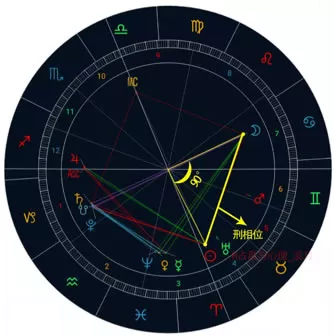
In the figure below, Moon and Sun at 90°, forming a square.
In the figure below, Venus and Saturn at 60°, forming a sextile.
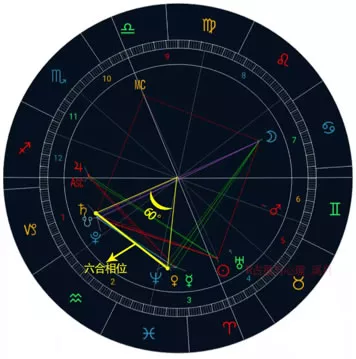
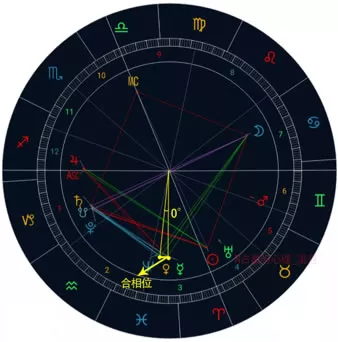
In the figure below, Venus and Mercury at 0°, forming a conjunction, connected by a short horizontal line in charts. Friends might wonder why 0° planets aren't fully overlapping: due to orbs (modern astrology) or planetary light orbs (traditional), recognized within a range. No-orb aspects are exact aspects.
3. Other Resources
Though the above five elements are covered, beginners may still not know how to interpret. Below are eight resources to help understand the birth chart.
- Ruling Planet: In a birth chart, it's the planet ruling the rising sign's zodiac. E.g., if rising in Aries, ruler is Mars. The chart's ruling planet—whichever it is, its sign and house—is vitally important. The table lists rulers for twelve rising signs; match yours to find it.
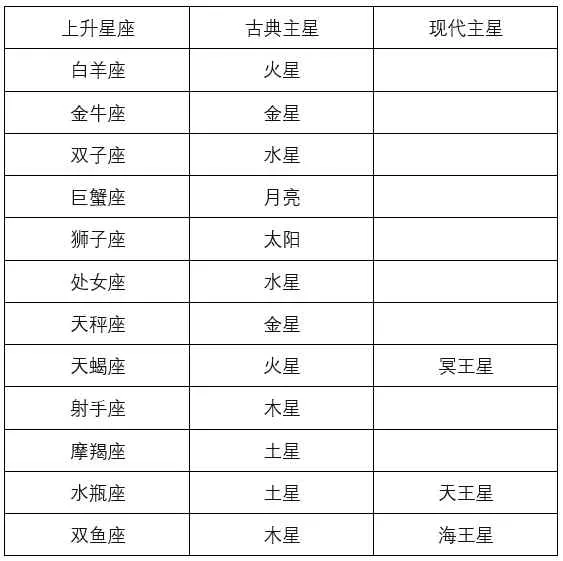
- Ruling Planet's House: Usually indicates life focus or most important area. E.g., rising Aries, ruler Mars in Libra in 7th house: relationships or marriage become life center.
- Rising Planet: Planets within 8 degrees of Ascendant (usually above), called rising planets. They influence rising qualities. A rising planet is more important than one in a sign, especially if different signs.
- Angular Planets: Planets within 8 degrees of angles, also called angular. Rising is one type, but especially important, so often separate. More planets at an angle mean greater need for what it represents.
- Yin-Yang: Though semitones are replaced by quadrants, charts usually mark planets' yin/yang in signs. More in yang signs: outgoing; more yin: introverted.
- Elements: Mark planets' elements (fire, earth, air, water) in signs to see main inclination, very useful for personality analysis. Sometimes include rising and MC signs for accuracy.
- Modalities: Mark planets' modalities (cardinal, fixed, mutable) in signs to understand inner drives. Strong cardinal: influential; fixed: stubborn; mutable: adaptable.
- Aspects Table: For beginners, all aspects on chart can overwhelm; aspect tables listing them make it manageable. Even experienced astrologers use them for analysis.