Demystifying Astrological Houses: How Planets and Signs Shape Your Life's Blueprint

Every corner of my soul is dedicated to different deities.
——Fernando Pessoa
My two classmates were born just under an hour apart, both with their Sun in Aries. Yet their personalities seemed as different as if they were 12 signs apart on the zodiac wheel. One embodied the classic Aries traits: passionate and straightforward, thriving on social connections and friendships. The other was slow to warm up, avoided confrontations, and preferred solitude. How could two people with the same Sun sign be so vastly different? Later, when I examined their natal charts, I saw that while most placements were similar, their Suns in Aries fell into different houses—one in the 1st House, the other in the 12th. That explained why, despite sharing the Aries Sun, their personalities appeared completely opposite.
In a natal chart, houses are just as crucial as planets and signs. They determine how planetary energies manifest and in which life areas a sign can best express itself. When planets land in different houses, their interpretations shift. A Sun in Aries in the 1st House, which represents the self, aligns closely with the Sun's core energy (primarily personality and self-worth), making it easier to showcase classic Aries traits. But a Sun in Aries in the 12th House, associated with the hidden, subconscious, and secrets, sees the Sun's energy more subdued or internalized.
Similarly, signs in different houses lead to varied expressions. Our birth chart symbolizes our innate tendencies for expressing desires and needs. It's like a seed containing the blueprint for the person we'll become. The natal chart reveals the seed's qualities and the general patterns of its growth.
Planets, signs, and houses together form the complete natal chart. Connecting these three elements through in-depth study allows for a more comprehensive and accurate reading of this "life instruction manual." It helps decode the self, revealing how to realize your potential in the most astrologically aligned way, avoiding unnecessary detours.
This time, we'll dive into planets and signs falling into houses to clarify six key questions about houses. Mastering houses will enable a fuller analysis of the chart.
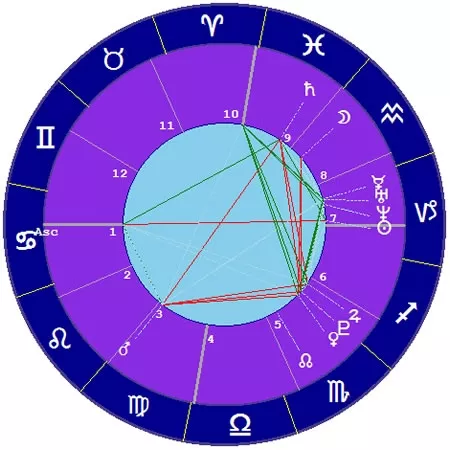
1. What Are Houses?
The 12 houses each carry unique meanings and names. For instance, the 1st House is also called the Ascendant or Rising Sign House, representing personality and life force; the 2nd House is the House of Wealth, symbolizing earning potential and values, and so on. Each house influences different life areas. This is similar to planets and signs—when all three interconnect, what reactions arise?
Planets embody energies themselves. The sign a planet falls into shows how we express that energy. For example, the Sun in Virgo manifests through focus on details and practical problem-solving to achieve self-realization. Houses represent environments, translated as "house" in English, referring to dwellings or rooms. A planet falling into a house "moves in" to that space, indicating the life area where that energy will play out. For instance, Sun in the 6th House means the Sun's values and self-confidence may express through work or service to others.
Signs interacting with planets in houses add another layer. House dynamics are often far more complex than planet-sign interactions in some respects.
Are All Houses the Same Size?
First off, there are multiple house systems. The main ones are Equal House and Quadrant systems. In Equal House, all 12 houses are uniform at 30 degrees each. In Quadrant systems (unless born at the equator), the 12 houses in the chart vary in size—especially at higher latitudes. The most familiar is Placidus, currently the most commonly used. (Note: When reading this article, use this as your foundation for exploring house meanings.)
Some houses span up to 60 degrees, while others might cover just 15 degrees or less.
Does a Larger House Mean It's More Important?
To some extent, yes. Compared to smaller houses, transiting planets spend more time in larger ones, triggering those life areas more persistently. However, a smaller house, especially with multiple planets inside, remains highly significant. Even without planets, if the house cusp sign's ruler has key aspects or placements, it emphasizes that life area. Plus, planets transiting small houses do so quickly but with greater intensity and focus, making the house's themes more pronounced and rapid.
What If a House Is Too Large or Too Small?
In Quadrant systems, varying house sizes mean a large house can span three signs, while a small one might lie entirely within one. A large house can fully "enclose" a sign—we call this the sign being intercepted. Conversely, a sign can fully enclose a house, making the house intercepted.
Is an Intercepted Sign (Fully Within a House) Less Important Than the Cusp Sign (Sign on the House Cusp)?
Generally, the cusp sign holds more weight, but intercepted signs still influence the house's affairs. Planets falling into intercepted signs have effects comparable to those in non-intercepted signs. Specific impacts will be explored later. However, some astrologers claim that intercepted signs internalize or turn inward their qualities. Personally, I haven't observed this.
Next, we'll detail how to interpret planets and signs in houses.
2. How to Interpret Planets in Houses?
When one or more planets fall into a specific house, what does it indicate? Interpreting planets in houses follows three basic principles. For clarity, we'll use the Sun in the 4th House as an example.
1. When a planet is in a house, its functions and activities find their most natural expression in the life experiences that house represents. The sign it's in further explains how those activities unfold. Sun in the 4th House desires growth in the family realm: being valued by relatives, establishing a secure home base, or working in real estate.
2. Conversely, the life area symbolized by that house receives its most natural handling and response through the activity type represented by the planet there. The 4th House signifies one's roots; Sun energy expresses the self. People with Sun in the 4th House warmly build and nurture their personal foundations.
3. Planets in a house also reveal innate expectations for prototypical experiences in that life area or level. This is our internal drive to perceive or process in that domain—it's with us from birth, like a prenatal landscape for that sphere. For example, strong Sun in the 4th House craves security; their goals involve experiencing family or belonging, seeking roots and origins.
3. How to Interpret Signs in Houses?
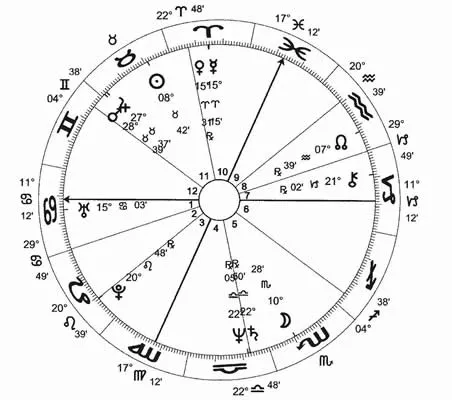
Sign placements on house cusps are more complex than planet placements.
First, each house cusp (starting point) falls at a specific degree in a specific sign. As in the example chart, the 1st House cusp is at 11 degrees Cancer, 2nd at 29 degrees Cancer, 3rd at 20 degrees Leo, and so on.
Thus, we combine Cancer's meaning with the 1st House's. Cancer's qualities also affect the 2nd House since its cusp is in Cancer too. Though Cancer spans only one degree in the 2nd, as the cusp sign, it gets emphasized. Leo's qualities apply to the 3rd House.
Looking closer, signs appear in houses in multiple ways:
Type One: Even if not the cusp sign, part of a sign can still fall into a house. In the example, the 2nd House cusp is Cancer, but Leo occupies most of it. So the 2nd House is influenced by both Cancer and Leo. Typically, the cusp sign's influence outweighs the in-house sign, even if the latter covers more area.
Type Two: If two adjacent house cusps share the same sign, in systems like Quadrant, interception occurs. In the example, Cancer intercepts the 1st House.
Simultaneously, another sign might be intercepted by a house—its entire span lies within that house. This means the house starts with one sign as cusp, fully contains intermediate signs, and ends in another. Thus, the house is influenced by three signs, but the cusp remains most important.
In the example, Cancer and Capricorn are cusp signs for two houses each: Cancer for 1st and 2nd (1st intercepted), Capricorn for 7th and 8th (7th intercepted). This reveals intercepted signs elsewhere. The 5th House cusp is Libra at 23°; Scorpio is fully in the 5th, with the end in early Sagittarius—Scorpio is intercepted. Similar situations occur in the opposite 11th House and with Taurus intercepted. Principles for signs in houses mirror those for planets, but remember: cusp signs are more important than those falling inside.
Interpreting signs in houses also follows three basic principles:
- When a sign is on a house cusp, it finds its most natural expression in the life experiences that house represents.
- A sign on a house indicates the chart owner's best way to realize potential in that life area.
- A sign on a house reveals the chart owner's prototypical energy type for experiencing that life domain.

4. What Is a House Ruler?
House rulers are another key element in analyzing planets and signs in houses, linking planets, signs, and houses. When a planet is in a house, connect it to the house where its ruling sign falls.
In the example, Venus is in the 10th House. As ruler of Taurus and Libra (also house rulers), it connects to their houses: Libra relates to the 4th House (at 23 degrees there) and 5th House (cusp at Libra 23°); Taurus is intercepted in the 11th. Through rulership of Libra and Taurus, Venus in the 10th links the 4th (home), 5th (children), and 11th (groups).
Thus, this person's career involves: working from home (4th/10th), running organizations (11th) that help parents better connect with children (5th) through Venusian harmony.
Overall, a planet influences:
- Its own house, like Venus in the 10th;
- The house where its ruling sign is the cusp, like the 5th with Libra cusp;
- Houses where its ruling signs fall (even if not cusps), like Taurus and Libra in 4th, 5th, 11th.
Influence strength generally follows this order.
Additionally, planet-in-house meanings resemble those of its ruling sign in houses. If your Cancer is on the 8th House cusp or inside, reference Moon in the 8th for more on this placement. If you have Pisces in the 5th, check Neptune in the 5th—you'll see their expressions in that house are strikingly similar.

5. What If a House Has Multiple or No Planets?
Planetary influence on houses also depends on the number falling into them.
What If a House Has Many Planets?
A house might contain multiple planets—some are quite "crowded" with three, four, or more. Here, each planet's principles, drives, desires, and motivations play out in that life area. If their natures conflict, like expansive Jupiter with cautious, restrictive Saturn, that domain faces greater tension and complexity. Houses with two or more planets are especially vital for the chart owner's life planning and goals.
Moreover, other planets aspecting those in the house alter their influence. For example, Venus in the 7th might ease entering relationships. But if Saturn in the 4th squares it, Venus's expression is constrained by Saturn's qualities.
I sometimes distinguish planets in houses with harmonious aspects from those with challenging ones. Remember, even with difficult aspects, more effort integrates the energies constructively—not necessarily negatively.
What If a House Has No Planets?
Houses can be "planet-packed" or "starless," called empty houses. "What does an empty house mean?" is a common question from astrology beginners.
Some students worry about empty houses: "My 5th is empty—does that mean no children?" "Empty 3rd—no ideas?" "Empty 2nd—can't make money?"
With only 10 planets and 12 houses, some must be empty. This doesn't mean nothing happens there or it's unimportant. Strictly, no house is truly empty. Even without planets, signs are present, influencing the area. So, first step for empty houses: Link the signs in that house to its life themes.
Second: Find the cusp sign's ruler—its house, sign, and aspects. This yields much info.
Third: For in-house signs (if different from cusp), check their rulers' houses, signs, and aspects.
In the example, the 6th House is empty. Following these steps reveals plenty.
Its cusp is Sagittarius: From one angle, the chart owner develops Sagittarius-like professional skills (6th House), like broadening others' horizons.
Sagittarius's ruler Jupiter is in the collective-oriented 11th House. Later, they apply these skills in group settings (6th ruler in 11th).
Jupiter in Taurus conjuncts Mars, suiting leadership (Mars) in building stable organizations (Taurus).
But note Capricorn is also in the 6th. So its ruler Saturn's placement affects career too. Saturn in Libra is near the 4th-5th cusp, suggesting home-based work. Its proximity to the 5th cusp links to children, so work (6th) may involve kids.
This aligns closely with earlier deductions from Venus in the 10th.
Chart emphases appear in various ways; the above is the "three-step rule." Houses with multiple planets are naturally key, but don't overlook empty ones' importance—especially if the cusp sign's ruler is a focal point like a bucket handle or engine in patterns; that life area will be prominent.
Empty houses might include missing elements in T-squares, amplifying their impact on the chart owner's spiritual balance.
6. How Does One Planet Influence Two Houses?
Usually, when a planet is at the end degrees of a house, near the next cusp line, its influence can be felt in both houses' domains. If the planet's sign matches the next house's cusp sign, extend consideration up to five degrees. House themes naturally flow sequentially. A planet at a house's end near the next cusp highlights connections between them.
For example, Venus at the end of the 6th near the 7th cusp might mean falling in love with and marrying someone met at work (6th/7th). Uranus between 10th and 11th could turn career changes (10th) into friendships or group ties (11th).
We often face charts from imprecise birth times where planets near cusps might shift houses due to time differences.
Similarly, different house systems cause variations—a planet near a cusp in one might be mid-house in another. Thus, many astrologers view mid-house planets as most reliable, their position in the domain solidly fixed.