Mars Boy: A Pact for Rebirth and Everlasting Joy on Mars
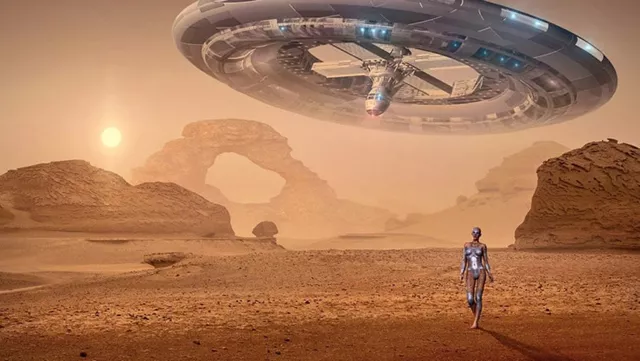
“Before I prepared for my reincarnation, many Martian 'humanoids' saw me off, aware of the challenges I would face on Earth. I made a crucial decision to come here to ensure the eternal happiness of my planet's future. My purpose is to fulfill my destiny,” said Boriska Kipriyanovich, the "Martian Boy."
Boriska Kipriyanovich, widely recognized as the "Martian Boy" from Russia, has captured the attention of many internet users. Now an adult, his capacity to absorb knowledge continues to baffle scientists. Although he was featured in numerous media interviews, he almost vanished from the public eye after 2007. In 2019, an interview about him unexpectedly resurfaced online, posted by a user known as "Kunlun Heroine." This interview was conducted by a Chinese UFO researcher in October 2018 in Russia, who requested to remain anonymous. The insights gained are invaluable and will be shared in segments.
Conversation Transcript from Moscow on October 18, 2018, at 5 PM: (Part One)
Interviewer: “Hello, we finally meet. Thank you for coming.”
Boriska: “I'm glad to meet you too. It feels like we've known each other for a long time, even though this is our first meeting.”
Interviewer: “Really? Thank you for saying that; it's like we're reconnecting.”
Boriska: “Let me ask you first. You're the visitor here in Russia, and I'm the host, so I should start with my questions.”
Interviewer: “As the guest, I defer to you. Please, go ahead.”
Boriska: “Why did you come to find me? I've been quiet for a long time, and no one in Russia has sought me out. What's the reason?”
Interviewer: “Well, in China, people are intrigued by your story of reincarnation from Mars. They are curious about your thoughts or eager to hear your stories and find inspiration. That's why I was sent to find you, and here we are today.”
Boriska: “I understand. I know that the historical records left by your organization and your efforts to advance Chinese society will hold great significance in the future. You will be remembered by history. I didn't expect anyone to seek me out; this isn't recorded in history. What prompted our meeting today?”
Interviewer: “I'm a bit confused by what you've said about our organization's impact on the future. We investigate UFO incidents and research cases, but we don't have such a far-reaching influence, especially as a grassroots organization. As for seeking you out, it was simply fate; there’s no national or organizational agenda behind this meeting, I assure you.”
Boriska: “I believe you, and I trust in history. Alright, I have no more questions now; you can ask yours, but please avoid repeating topics we’ve already covered.”
Interviewer: “Okay, your earlier question caught me by surprise, and I’m unsure what to ask you now. Let me think. I see in the materials that you claim to have reincarnated from Mars; could you tell me about what it's like there, such as the environment, culture, and social structure?”
Contract - Limits on Bringing Martian Memories to Earth
Boriska: “Certainly, no one has asked me these kinds of questions before. Journalists and officials usually focus on technology, war, and space maps. Now that I’m older, I’ve forgotten a lot. It turns out that prior to my reincarnation, I entered into an agreement with the reincarnation manager that I couldn't bring all my Martian memories to Earth. Only 2% were allowed, and I had to forget them by age ten. Sometimes, these memories come back in dreams, and I write them down immediately upon waking; that’s how I’m able to answer these questions today.”
“Life on Mars is just fragmented memories for me now. I recall that before I reincarnated, many Martian 'humanoids' saw me off, knowing the challenges I’d face on Earth. I made a pivotal decision to come here for my planet's everlasting happiness. My aim is to fulfill my destiny. Mars is an ancient civilization. I'll describe it in terms familiar to humans, though it may not capture everything I mean, okay?”
Interviewer: “Alright, go ahead. I’m starting to get intrigued.”
Boriska: “To us, Mars is not merely a planet; it is a complex structure composed of various spatial dimensions and time fields, incorporating different horizontal and vertical spaces—all of which we collectively term as Mars. This civilization isn’t defined by nationhood or ethnicity, but I will use those terms for simplicity, as explaining each concept would take a long time and each term carries numerous implications that Earth languages cannot express.”
Boriska: “Mars essentially operates as a society governed by a council of elders, with no governments or political systems. The elder system is central, where one doesn’t become an elder through war, strength, or political elections but through 'morality' or technological advancement. So, what does 'morality' mean in our context? It’s about selfless contribution. Those who contribute selflessly to others, to society, and to a better future are considered elders.”
“There is also a promotion model based on 'technology' or technical advances. For instance, if a Martian 'humanoid' invented a technology akin to a mobile phone and shared it selflessly with society, bringing convenience to everyone, that individual would elevate their status. Continued breakthroughs would bring them closer to becoming an elder, with their technological progress aligning with their 'moral' contributions. Mars’s overall technological development follows this model, as does the Martian elder system.”
“Now, looking at Earth, technology also progresses, with advancements in the internet, airplanes, and cars. However, this society revolves around individuals or nations accumulating wealth for personal, collective interests, or self-preservation. Humans go to any lengths for money while still pursuing technological advancement. Isn’t this just paving the way for future interplanetary conflicts? The fundamental mindsets and lifestyles of Martian 'humanoids' and Earth 'humans' are at odds and contradictory.”
Boriska was born on January 11, 1996, in Volzhsky, a town in the northern Volgograd region of Russia. His mother, Nadezhda, works as a doctor, and his father is a retired military officer. His mother recounted that Boriska was able to lift his head within weeks of birth, talk within months, and read, write, and draw by age two. Remarkably, they never taught him astronomy, yet he could describe Mars, planetary systems, and extraterrestrial cultures. In March 2004, the Russian newspaper "Pravda" reported that at seven years old, Boriska claimed to be from Mars, demonstrating astonishing talents and extraordinary abilities. (Next article)