Harmonizing Celestial Bodies with Human Acupuncture Meridians and Points
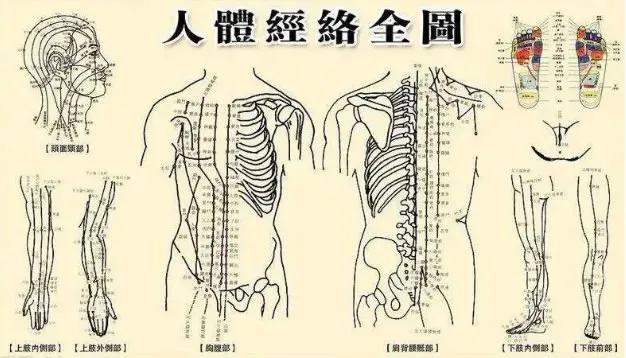
Chinese Daoism highlights the harmony between heaven and humanity, positing that humans and the universe form an interconnected whole. The human body is seen as a miniature universe, with acupoints spread across it, mirroring the structured arrangement of celestial bodies. This represents a microcosm reflecting the universe's form.
The Earth has its system of latitude and longitude, while the human body features meridians. Just as there are 365 days in a year, the body has 365 acupoints. Celestial bodies in the universe are dynamic; their changes can impact climate, environment, and various universal aspects. Similarly, changes in acupoints can directly affect a person's intellect, thought processes, and physical abilities, thereby influencing their destiny and surrounding environment.
Acupoints are well-known among many Chinese, especially fans of martial arts novels, where masters are often depicted as skilled in acupoint striking. Terms like "laughing acupoint," "itching acupoint," and "fixed acupoint" suggest that a mere touch at different points can lead to immediate effects. But are acupoints truly that magical?
Acupoints, technically known as "shu points," refer to specific regions along the body's meridians. These areas, where meridians intersect, are often rich in nerve endings and blood vessels, uniquely rooted in Chinese culture and traditional medicine, and are utilized in practices like acupuncture, massage, or acupressure.
Acupoints are evenly distributed throughout the body with varying sizes. Their smallest diameter is usually about 3 millimeters, while the largest measures up to 6 millimeters. They contain a substance with high gelatin content, appearing bright and white, raised compared to normal areas, and elastic.
Recognized for their sensitivity, acupoints are reactive to external stimuli, prompting traditional Chinese medicine practices like acupoint pressing, massage, and manipulation to expand dominant acupoints. This helps unblock meridians and ensures a smooth flow of qi and blood, promoting healing. Essentially, this utilizes acupoints’ capacity to absorb unique substances from cosmic energy, boosting the body's immune function. Enhancing acupoint functionality increases airflow, amplifying qi and blood volume in the meridians, ensuring free flow.
Each acupoint has distinct physiological functions and impacts. Some long-closed acupoints can, once activated, trigger psychological repression and depression. This happens because these acupoints produce substances that affect pigmentation and induce psychological shifts, slowing the nervous system, leading to feelings of psychological pressure. Such psychological factors can directly cause physiological changes, impacting overall health.
Some commonly closed acupoints include: Shenfeng, Chengjiang, Qimen, Mingmen, Yamen, Chengqi, Qiangjian, and Zigong. Conditions like heart disease, cerebral thrombosis, and schizophrenia often relate to these acupoints. These acupoints are typically difficult to open, but it varies between individuals. If open, acupoint therapy can alleviate related ailments.
Conversely, certain acupoints, when open, stimulate brain nerve hormones, inducing excitement and altering personality. For instance, those with an open "Shentai" acupoint tend to be open to new ideas, social activities, friendly, and sincere, making them approachable. This explains the strong emotional reactions elicited by touching certain acupoints. In martial arts, the "fixed body technique" stems from stimulating particular acupoints, influencing nerve responses to their effects, resulting in temporary rigidity.
Clearly, the state and function of acupoints uniquely and subtly impact health and emotions, potentially leading to the extraordinary abilities often associated with them.
Many perceive special abilities as mysterious, closely tied to the opening of acupoints. Some people develop special abilities through specific training or experiences that alter the structure and openness of their acupoints, resulting in phenomena like clairvoyance, remote viewing, precognition, and advanced diagnostics.
While meridians and acupoints are not visible to the naked eye, modern science often dismisses what cannot be seen or touched. However, exploring human life sciences' mysteries might reveal that random events, sudden movements, or accidental impacts could instantly open special acupoints, allowing the human body to connect with cosmic information. This connection can rapidly receive drifting information clusters from the universe, unlocking the subconscious and enabling the emergence of special abilities.
Ancient Chinese scholars deeply understood the correspondence between the universe and human acupoints, often naming many after celestial bodies. Today, inheritors of this ancient culture continue studying acupoints, uncovering even more astonishing secrets.
Chinese Daoism highlights the unity between heaven and humanity, suggesting that humans and the universe form an integrated whole. The human body is likened to a small universe, with acupoints distributed throughout, resembling the orderly arrangement of celestial bodies, serving as a microcosm of the universe's form.
In modern times, researchers explore human acupoints from life sciences perspectives, discovering acupoints’ vast potential for special abilities, with varying functionalities based on individual traits.
To develop the "Heavenly Eye" ability, researchers found that simultaneous opening of the Tianmu and Yuzhen acupoints is needed, activating brain retinal lines and the pineal gland to form a "three-point plane," enabling imaging functionality. Some individuals unexpectedly develop "Heavenly Eye" abilities after head trauma, inadvertently opening previously closed acupoints.
The "Heavenly Ear" ability demands the simultaneous opening of Shenyu, Yuzhen, Dazhui, and Tinghui acupoints, facilitating distant and micro-sound wave transmission. When open, these acupoints enhance eardrum vibrations, amplifying cosmic sound wave information and enabling perception of distant sounds.
The "Prediction" ability involves capturing advanced universal information in advance. The Shen藏, Shen延, Chengguang, and Zhongting acupoints must be open, with the Lingtai and Shenxing acupoints in a semi-open or fully open state.
The "Telepathy" ability requires Shentang, Shendao, Hunmen, Yanggang, and Yutang acupoints to be open together. These acupoints enhance a person's capacity to absorb and perceive external information, influencing thought and sensory nerves, thus enabling prediction, sensing, and understanding others’ mental activities.
The "Divine Foot" ability occurs when Shangchen, Baihui, Lingtai, Shendao, Zigong, Tiantu, Zhongji, Lingshu, and Yongquan acupoints are open, allowing nerves to condense, absorb, and digest external energy, achieving a light and invigorated state with supernatural capability.
Fate is often perceived as predetermined, but life science researchers have found that unique fate trajectories can sometimes be influenced by bodily physiological phenomena, as certain acupoints affect emotions and thinking. For example, opening the Huagai acupoint can induce depression symptoms, altering one's fate.
Some may have overly closed acupoints, preventing the timely reception of external information and new ideas. Ailments like stubbornness and poor fortune relate to closed Lingshu, Baihui, and Yongquan acupoints.
Others might inadvertently open acupoints like Qingling and Naohu, which should remain closed. When open, they cause brain nerves to operate beyond main nerve control, leading to incoherent speech and chaotic energy fields, altering fate.
Some acupoints, like Jima and Qimen, absorb excessive external pathogenic energies when open, weakening the energy field and failing to block negative information transmission, causing unfavorable outcomes.
Conversely, acupoints like Yongquan, Baihui, and Laogong, when open, may initiate a cycle of health, strengthening the body's biological field and positively influencing fate.
Therefore, learning to self-regulate acupoints—opening and closing them as necessary—can help adjust one's fate trajectory.
Today's rapid knowledge advancement, aided by computers, shortens renewal cycles. Humans have embedded various commands and software into computers to achieve desired outcomes. The human body functions similarly to a computer system; methods and commands activating the body resemble executing software functions.
The human body is an intelligent system and command control panel. Studying acupoints and expanding their functions is akin to inputting command codes, continuously providing information to the brain's central control unit. Through brain cells' alternating transformations, humans gain skills to replicate, update, and recombine culture.
Research indicates each acupoint has unique codes, correlating with a universal system. For instance, in physics, the Touwei acupoint combined with the Chengguang acupoint provides insights into satellites, spacecraft, and aerospace.
Thus, studying human acupoints may become a key aspect of deciphering high technology.