Cells Magnified 3,000 Times Reveal Structures Resembling a Miniature Universe
Humans have long been fascinated with understanding the size of the universe, but its vastness is beyond our comprehension. So, just how enormous is it? Scientists estimate that the observable universe stretches approximately 93 billion light-years across. A journey across this expanse at the speed of light would take an astonishing 93 billion years. If we liken humans to bacteria on Earth, then the universe is like the Milky Way galaxy. Just as bacteria cannot fathom the workings of the human body, let alone the enormity of the Milky Way, humans, as small components within the universe, are unlikely to ever fully grasp its true nature.
Since the dawn of space exploration in the 1950s, humanity has endeavored for 70 years to unravel the universe's size mysteries. Despite employing various methods throughout these decades, a definitive answer remains out of reach. Currently, all knowledge about the universe's actual size largely remains speculative and does not accurately reflect its true dimensions. After 70 years of exploration without clear answers, perhaps it's time to consider that our approach might be flawed. It's often said that choosing the right path is more crucial than sheer effort; if the direction is correct, even minimal effort can lead to success. Conversely, if the path is wrong, no amount of work will produce meaningful results. It seems that humanity may have hit a roadblock with its approach to exploring the universe. For example, humans have persistently studied the universe's size from a macroscopic viewpoint. Since this strategy hasn't yielded answers, could we benefit from shifting our focus to a microscopic perspective?
The image below is an artist's conceptual rendering of the observable universe on a logarithmic scale. It features the Sun at the center, encircled by the planets of the solar system, the Kuiper Belt, the Oort Cloud, Proxima Centauri, the Orion Arm, the Milky Way galaxy, the Andromeda galaxy, nearby galaxies, cosmic filaments, cosmic microwave background radiation, and the invisible leftovers of the Big Bang at the outer edge.
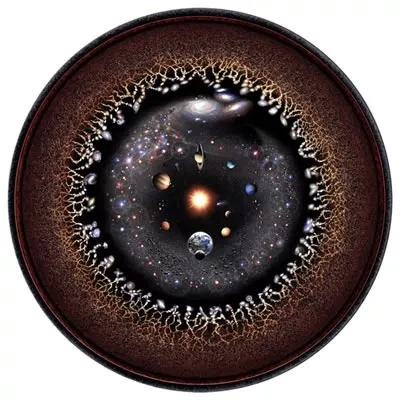
Artist's conceptual representation of the observable universe on a logarithmic scale
A physicist once remarked that there are no definitive boundaries between the macroscopic and microscopic worlds; the microscopic elements exist within the macroscopic world, and the macroscopic world is a concrete expression of microscopic phenomena. In this sense, the true size of the universe might be hidden within a tiny cell. But why suggest that the universe's size is concealed within cells? When scientists magnify human cells 3,000 times, they find an incredibly intricate structure, akin to a miniature universe. At this point, skepticism is natural—how can a tiny cell be compared to the vast universe? Yet, it is indeed possible that a cell's complexity might rival that of the universe. Why is that the case?
In school, we're taught that a cell's internal structure primarily consists of cytoplasm, a nucleus, a cell wall, a cell membrane, and mitochondria. However, this is just the most basic outline; its interior architecture is billions of times more complex. Without exploring additional structures, consider the most critical component of a cell: DNA. Each cell houses 46 chromosomes, which in turn consist of 3 billion base pairs. These 3 billion base pairs are arranged in a specific order to form a simple cell. Each base pair must occupy its exact position; if even one is out of place, the cell might mutate or lose its vitality.

A typical prokaryotic cell structure
Scientists estimate that to wholly grasp the secrets of the 3 billion base pairs in a single cell, it would take tens of thousands of scientists working tirelessly for billions of years, consuming hundreds of billions of dollars, and even then, success is not guaranteed. This is due to the ever-changing nature of cellular structures; even a slight change can make previous research obsolete. Thus, theoretically, humanity may never fully unlock a cell's secrets, let alone create a living cell. This complexity also explains why humans have found it challenging to conquer cancer and achieve immortality—cells are simply too intricate.
Clearly, the complexity of cells can match that of the universe. Since cells' internal structures are as elaborate as the universe, this implies that there may be no clear boundaries between microscopic and macroscopic worlds. What does this suggest for humanity? It implies that we should redirect our explorations toward the microscopic world. If humans can unlock the mysteries of the microscopic realm, such as cellular structures, the riddles of the larger universe may also be unraveled. After all, the microscopic and macroscopic worlds are closely linked, perhaps even seamlessly connected. The microscopic world provides a window to understanding the macroscopic world; once we open the innermost window of the microscopic world, the total truth of the macroscopic world might unfold before us.