Katy A.’s Palmistry Analysis: A Beginner’s Guide
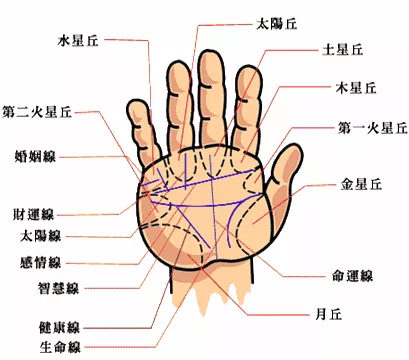
There are four primary lines: Heart Line, Head Line, Life Line, and Fate Line. Other, smaller lines have different meanings depending on where they appear (for example, on the Sun Mount, the Venus Mount, etc.).
Traditional palmistry emphasizes fine details and upward-trending lines; modern palmistry often says, "the left hand represents what is innate, while the right hand represents what is acquired."
The line that runs horizontally from beneath the little finger toward the index finger is the "Heart Line," which reflects one's emotions and feelings. The line that runs horizontally from between the index finger and thumb toward the little finger is the "Head Line," which reflects a person's career potential and mental outlook. The line that starts between the index finger and thumb and curves down toward the base of the palm (the Mount of Venus) is the "Life Line," which reflects health and major life events. The vertical line that runs through the center of the palm (and may or may not intersect the Heart and Head Lines) is the "Fate Line," which reflects a person's fortune. In addition, there are lines such as the Marriage Line, Children Line, Peach Blossom Line, and Nobleman Line found elsewhere on the palm.
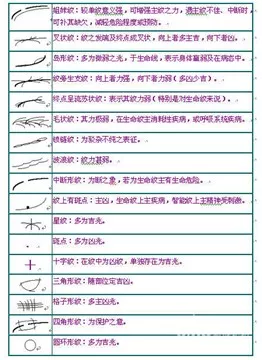
Line Patterns
As with an astrological chart, individual lines can carry specific meanings. However, to say anything reliable about future fate, it's important to consider the four major lines together. According to modern approaches, one should also compare the left and right hands (similar to a comparative zodiac chart), which makes the analysis more complex.
Line qualities vary—chain-like, hair-like, broken, fish-like, and more—each with distinct implications that are hard to summarize briefly. Generally, the most favorable lines are smooth, deep, and long. Even so, where a line ends matters a great deal; longer isn't always better, and shorter isn't necessarily worse.