What Is "Fan Gu" in Physiognomy, and Are People with These Traits Good-Natured?
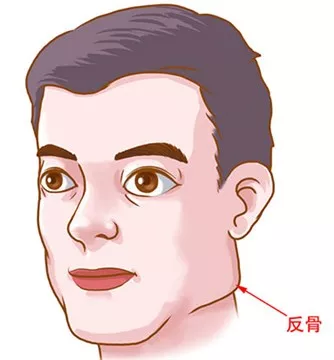
In the physiognomy training, we explore the concept of "反骨" (fan gu). So, where is the "反骨" located in terms of physiognomy? Many might incorrectly believe it's the protruding bone at the back of the head, the occipital bone. This area, where the bladder meridian runs, is associated with quick thinking but is not the "反骨." The true position is on the zygomatic bone, or cheekbone. There's an old saying in physiognomy: "A hooked nose and broad cheekbones should not be trifled with," where "broad cheekbones" indicate "反骨."
1. The Exact Location of "反骨"
According to Master Liu Heng, "反骨" symbolizes actions that betray principles and oaths, violating social ethics and trust. The true position of "反骨" is in the cheek area and manifests in three ways: the first is a pointed zygomatic bone, essentially lacking a cheekbone, as seen in many contemporary artists, known as a "cone face" or historically as a "fox spirit face" (symbolizing selfishness and untrustworthiness); the second is the "国" (guo) face, which in physiognomy indicates someone fit for an official position; the third is an outwardly protruding zygomatic bone, with overly developed cheekbones that bulge outwards, creating a "风" (feng) face, similar to an upside-down pear, representing the classic "反骨."
2. The Major Drawback of "反骨" Physiognomy: Destructive Power
Individuals with "反骨" physiognomy tend to be stubborn and possess significant destructive power. Master Liu Heng notes that those with broad cheekbones can withstand hardships without losing hope. Their protruding cheekbones enable them to endure pressures others cannot handle, demonstrating a tenacious, stubborn nature. They struggle to accept others' suggestions, remain fixed in their views, and often believe their approach is the only correct one. Their personalities can be domineering and unreasonable, and they are prone to suspicion and doubting others' intentions in social interactions.
3. The Major Advantage of "反骨" Physiognomy: Sharing Hardships
The strength of "反骨" physiognomy lies in its ability to endure hardships and withstand various challenges, making individuals unlikely to give up easily. Unlike those with a cone face who may abandon friends in tough times, those with "反骨" physiognomy can share both happiness and sorrow, standing by one another during difficult times, though they may struggle to enjoy prosperity together.
4. The Untrustfulness of Many with "反骨" Physiognomy
The term "反" (fan) in "反骨" often denotes a tendency toward ingratitude, ruthlessness, and a strong desire for revenge. If you offend them, they are likely to retaliate severely. While you might do countless good things for them, a single offense can prompt them to seek revenge relentlessly. Their belief that "a gentleman's revenge is never too late" often leads to enduring hatred and grievances. It's advisable to keep your distance from such individuals. In a professional setting, they might incite others to quit before they resign, leaving their boss isolated. In relationships, breakups may lead to prolonged acts of revenge, based on the belief that if they can't have it, no one should.
5. Notable Historical Figures with "反骨" Traits
A prominent historical example of "反骨" is Wei Yan from the Three Kingdoms era. Zhuge Liang foresaw Wei Yan's betrayal and cautioned his advisors to watch him closely. After Zhuge Liang's death, Wei Yan did rebel. His army eventually disbanded due to guilt, and he fled to Hanzhong with his son, only to be chased by Ma Dai. Capturing Wei Yan, Yang Yi remarked, "This fool actually dared to rebel?" Consequently, Wei Yan and his family met a tragic end, illustrating the perilous consequences of "反骨" physiognomy.