Liu Heng's Facial Features Analysis: Understanding the Heavenly Court
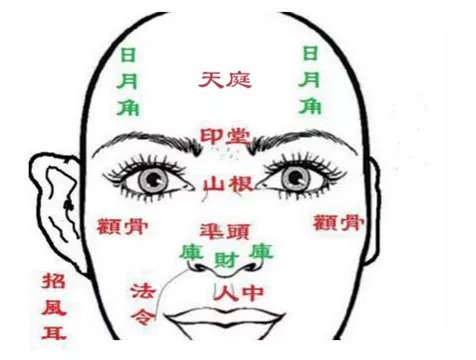
Where is the "Heavenly Court" located, and what should be avoided in a career?
In folklore, there's a saying: "A full Heavenly Court leads to official positions, while a square Earthly Pavilion holds great power." So, what exactly is the "Heavenly Court" and where is it located on a person's face? Our physiognomy is primarily divided into twelve palaces, with the Heavenly Court representing the Palace of Official Wealth. What aspect of our destiny does the Heavenly Court influence? The Heavenly Court aligns with the Earthly Pavilion; it governs nobility and humility, while the Earthly Pavilion governs wealth and poverty; it dictates honor and disgrace, while the Earthly Pavilion controls gains and losses.
Where is the Heavenly Court located?
The Heavenly Court is situated on the forehead, specifically between the hairline and the brow bone. The hairline, also called the "Mars," marks the edge of the Heavenly Court, while the brow bone defines its boundary. The hairline corresponds to the father, while the brow bone represents the son.
What are the "Three Courts" in physiognomy?
Ancient practices divide the face into "Three Courts": the Upper Court (forehead), the Middle Court (including eyebrows, eyes, nose, and cheekbones), and the Lower Court (including jawbone, chin, and mouth). According to Teacher Liu Heng, the Upper Court relates to early fortune and generally represents a predetermined destiny; the Middle Court involves the efforts and abilities of middle age, reflecting personal aspirations; and the Lower Court pertains to late-life fortune, indicating reliance on destiny and wealth.
What areas are included in the Heavenly Court?
From the standpoint of traditional physiognomy, the forehead is divided into several regions: Mars, Tianzhong, Sikong, Zhongzheng, Rijiang, Yuejiang, Biancheng, Qiuling, Shanlin, and Fujiao. What do these terms mean, and how are they classified?
Many of these names refer to different areas of the forehead, each described from various life perspectives. From a social standpoint, Sikong and Zhongzheng denote social status; in a family context, Rijiang and Yuejiang refer to the father and mother, respectively; Mars describes the hairline; Biancheng refers to the temples; Qiuling denotes the back of the head; and Fujiao refers to the M-shaped hairline.
What should be avoided in the Heavenly Court?
A low and narrow forehead is a significant taboo, indicating a low hairline and an uncertain future; avoid chaotic lines, especially the "wild goose" pattern, which signifies hard work and struggle; avoid sloped foreheads, as unevenness suggests a lack of social status; avoid malignant moles, as they can affect one's future; avoid dark tones on the forehead, as darkness indicates poor current fortune; avoid scars, as they suggest low social standing or loss of reputation; avoid interruptions in the "Three Talents" lines; and avoid uneven hairlines, as they can signify early misfortune in marriage.
Ideal characteristics for a fortunate Heavenly Court include: a full and broad Heavenly Court, a rounded forehead, no chaotic lines, no mixed patterns, no malignant moles, no depressions, no low hairline, no deep cheek hollows, no sharpness or excessive protrusion, no dullness or obscurity, and no malignant moles or scars.
The Heavenly Court and career status
A broad and slightly rounded Heavenly Court represents the most ideal forehead in physiognomy. The Heavenly Court indicates a person's career level; a full and broad Heavenly Court suggests high social status and the potential to stand out in a group; a well-rounded Heavenly Court suggests early success and good fortune in youth.
The Heavenly Court and family status
The Heavenly Court represents the father and mother, referred to as Rijiang and Yuejiang. A low and narrow Heavenly Court indicates challenges in early fortune and that the parents may have limited social achievements, often stemming from humble beginnings; a full and rounded Heavenly Court suggests healthy parents with certain social achievements, often from a scholarly family or having influential parents in the community.