Will a Forehead Scar Impact My Career?
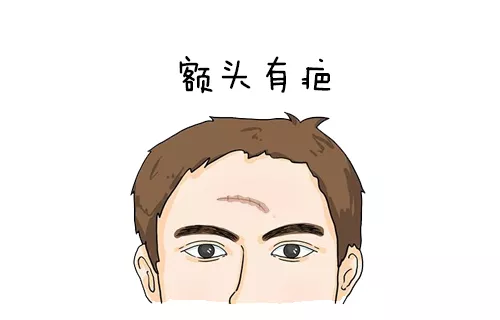
Physiognomy pertains to the forehead, often referred to as the "Heavenly Court" in traditional belief systems, signifying a person's honor and wealth. This area, also known as the "Palace of Official Luck," is divided into several regions, including Mars, Central Heaven, Si Kong, Central Justice, Sun Angle, Moon Angle, Border City, Hills, Forests, and Auxiliary Angle. What significance do scars on different forehead areas hold? Teacher Liu Heng will share his expertise in physiognomy to explain further.
I. Scars on the Forehead
- Marks such as scars, patterns, a narrow or short forehead, or irregular lines on the forehead, as well as any damage, are seen as indicators of a life marked by poverty. Individuals with forehead damage might even face imprisonment. The forehead reflects not only career prospects but also a person's luck in youth, particularly from ages 15 to 30. Those with forehead scars often exhibit a proud and rebellious nature from a young age, frequently clashing with parents and elders.
- Forehead scars may signal significant changes or events within the family, suggesting poor early luck, such as the early loss of a parent or divorce. These circumstances can cultivate somewhat extreme personalities, leading to impulsive decisions. If the scars are coupled with poorly defined facial features, this can adversely affect interpersonal relationships and future career paths. Hence, Teacher Liu Heng advises individuals with such features to dedicate themselves to learning, improving their mindset, and adjusting their perspective on people and situations. Starting from a humble beginning and advancing step by step can gradually enhance their lives.
- Scars in the Migration Palace—located above the outer ends of the eyebrows near the hairline, including areas like Tian Cang, Gao Guang, Yi Ma, and Border Land—affect luck related to promotions, travel, and relocations. Therefore, those with scars in this area should steer clear of excessive travel or dangerous activities, as these might lead to misfortunes in distant places.
- Scars that slope into the eyebrows signal weak ties with parents or siblings, and might bring harm to them. Severe scars could even result in imprisonment, unless other facial features are exceptionally favorable, which could lessen the impact. Otherwise, legal disputes may endanger personal safety.
II. The Forehead Should Be Symmetrical
In physiognomy, the forehead is vital, often dubbed the "sky," and should ideally be smooth and undamaged, with no irregularities or markings, appearing round and full. Chaotic lines, whether Y-shaped, zigzag, or crossed, are considered unfavorable, suggesting poor fortune and a life of toil and hardships. A slanted forehead signals low status and a lack of societal standing, posing a potential burden at home.
III. In Physiognomy, the South is Linked to the Chin, and the North to the Forehead
In this Five Elements framework, the South is associated with fire, and the North with water. Thus, in physiognomy, Northern individuals are perceived as possessing depth and inner qualities, while their weaknesses may include dullness. Southern individuals are seen as thoughtful, with the benefits of cleverness and quick-wittedness but may also exhibit cunning and volatility. According to Teacher Liu Heng, Northern individuals with a substantial chin tend to be practical. When assessing Northern people, focus on the forehead: a Northern person with a good forehead likely possesses significant intelligence and stands out among peers. Conversely, assessing Southern individuals entails examining the chin: generally, Southern people have similar intelligence, but those with a strong chin are more likely to succeed and lead prosperous lives.
IV. Men Focus on Career, Women Focus on Family
After considering regional differences, we turn to gender-specific perspectives. Despite modern gender equality, traditional roles persist, with men typically viewed as providers and women as homemakers. No matter how hard women work in their careers, they often return to family roles, reflecting deep-seated beliefs that men focus on careers while women prioritize families. Therefore, Teacher Liu Heng notes that in physiognomy, men value the sky (forehead), while women emphasize the earth (chin). A man with a broad forehead can offset a woman's lack of insight and wisdom, just as a woman with a strong chin can ensure a well-ordered home and obedient children.
V. Asymmetrical Forehead
A prominent and thick forehead can signal potential for promotions and wealth. However, an asymmetrical forehead is interpreted as a sign of poverty in physiognomy, indicating possible estrangement from parents during youth or instability in the parents' marriage, which could lead to separation. A high, full forehead bone suggests success and eloquence, while a prosperous Tian Cang combined with raised Sun and Moon angles indicates smooth career advancement, and a pronounced Central Justice bone suggests abundance.
VI. A Full and Rounded Forehead is Auspicious
Successful individuals often have foreheads that are flat, full, and rounded, which symbolizes resilience and high social standing. In contrast, any unevenness, scars, or other adverse signs suggest poor fortune.
VII. The Forehead Represents Career Luck
In physiognomy, the forehead symbolizes a person’s career and official success potential. A low and narrow forehead, especially with a low hairline, is typically unfavorable for future career prospects. In contrast, a broad and prominent forehead, combined with a high nose and thick, fleshy ears, suggests someone skilled in leadership roles, capable of making excellent decisions and staying calm in challenging situations. Teacher Liu Heng believes that a well-proportioned forehead is indicative of a highly capable and responsible individual.