Liu Heng's Facial Analysis: A Noticeable Nose Slant Suggests Untrustworthy Intentions
Physiognomy suggests that the nose represents the self, the forehead determines one's future, the mouth signifies wealth and fortune, and the cheekbones reflect authority. In traditional physiognomy, the nose is known as the "Palace of Wealth," indicating not only the ability to acquire and hold onto wealth but also representing family and women. Among ancient physiognomy texts, "Ma Yi Shen Xiang" is the most widely circulated; however, its complex language makes it difficult to understand without specialized knowledge and the ability to interpret classical texts. Liu Heng has compiled various physiognomy literature, offering reasonable annotations, and has studied alongside colleagues in physiognomy from the I Ching.
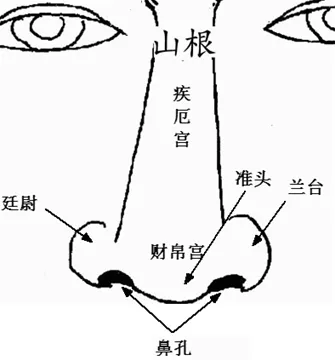
The space between the two inner corners of the eyes is called the "Mountain Root"; the lower part of the nose is referred to as the "Nasal Tip" (or "Nasal Apex"), and the midpoint between the Nasal Tip and the Mountain Root is known as "Longevity." The two sides of the Nasal Tip are called "Lan Tai" on the right and "Ting Wei" on the left (collectively known as "Lan Ting").
Note by Liu Heng: The portion of the nose bridge between the two inner eye corners is the Mountain Root, which marks the start of the nose. The lower end is called the "Nasal Tip," also known as the Nasal Apex. The protruding section of the nose bridge is referred to as "Upper Longevity," while the sides of the nose bridge are also called "Upper Longevity." On the Nasal Tip, the left side is referred to as Lan Tai, and the right side as Ting Wei. Illustrated in the diagram below:
Types of Unfavorable Noses:
A crooked nose bridge signifies midlife challenges. A nose bridge lacking structure may lead to premature death. A nose with exposed bones, small Lan Ting, and a pointed Nasal Tip suggests suspicion and cruelty. An exposed Nasal Tip resembling an eagle's beak indicates a person of great malice. A nose with visible nostrils, known as "Exposed Nostril Nose," suggests someone who will damage their family's legacy. A sunken Mountain Root, a flat nose, a crooked bridge, a pointed Nasal Tip, exposed nostrils, and a prominent Longevity characterize an unfavorable nose. A flat, broad nose often indicates poverty. A pointed and hooked Nasal Tip implies a sinister nature, whereas a crooked or protruding bridge usually brings misfortune.
Note by Liu Heng: A slanted or highly protruding nose bridge indicates a person who deceives and harbors evil thoughts, often facing setbacks in midlife. A structureless nose bridge suggests a lack of independence, leading to midlife struggles. A nose with sharp, exposed bones often associates with cruelty, while a pointed, small Nasal Tip denotes suspicion and a lack of generosity. A bow-like curved bridge with an eagle-beak-like Nasal Tip and small nostrils is a classic hooked nose, frequently linked with treachery and malice (Note by Liu Heng: Avoid those with hooked noses and prominent jaws). A thin, pointed Nasal Tip with exposed nostrils indicates a person who will squander family wealth and face instability. A flat, low bridge without structure and a meatless Nasal Tip often signify poverty. A hooked Nasal Tip suggests sinister intentions. An unevenly protruded bridge indicates deceit, heralding many life challenges.
"Ma Yi" physiognomy states: A fleshy Nasal Tip indicates greed and indulgence, but if there's no malice at heart, it suggests kindness. A crooked nose mirrors a crooked heart, while a broad face with a long nose portrays someone skilled in cunning.
Note by Liu Heng: A hooked Nasal Tip, sharp and thin like an eagle's beak curving inward toward the face's center, shows a greedy, selfish individual with a narrow mind. A thick, rounded Nasal Tip suggests a person with strong inclusivity and often attracts help in their endeavors. A noticeably slanted bridge indicates a person with impure intentions, inclined to seek personal gain at others' expense. A long face resembling a donkey or horse with a long nose typically denotes a cunning, manipulative individual frequently lacking children or having children who do not succeed.