Assessing Home Feng Shui Through Facial Features
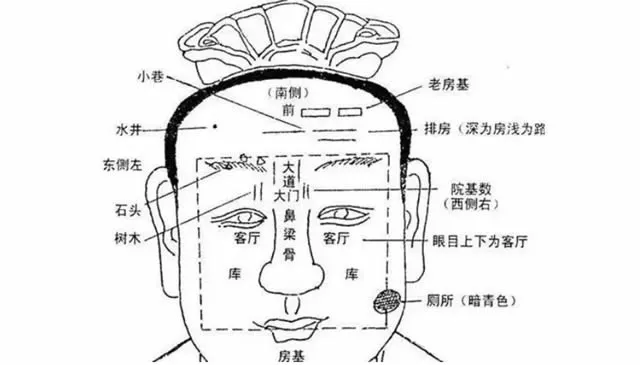
Every person has unique facial characteristics, and a face can be compared to a courtyard. The forehead symbolizes the south (front) of the courtyard, while the base of the forehead stands for the north (back). The left side represents the east, and the right side represents the west. The area from the eyebrows down to the mouth can be considered the interior of the courtyard, with the rest being the exterior. The space between the eyebrows acts as the main entrance, and the number of vertical lines there reflects the number of foundations within the courtyard. One vertical line signifies one foundation, and two lines signify two foundations. Thick lines imply that the courtyard's buildings are complete, whereas thin lines suggest unfinished structures or merely laid foundations. If the vertical lines are forked, it indicates changes have been made to the entrance.
Vertical lines above or below the eyebrows represent trees. Lines above the eyebrows indicate trees outside the courtyard, while lines below the eyebrows or beside the nose indicate trees within it. Thick lines signify large trees, and thin lines represent small ones.
Triangular or square shapes between or above the eyebrows signify stones. Horizontal lines on the forehead, if thick and deep, denote a row of houses in front of the entrance, while thin and shallow lines suggest roads (bright lines represent roads; dark lines, ditches). Pits on the forehead mirror irregularities in the courtyard ground. A low area between the eyebrows and entrance suggests the forehead represents the sky or, alternatively, a house's ceiling. A dark forehead indicates a low ceiling, which can cause a sense of oppression, while a high forehead suggests a high ceiling. Visible veins between the eyebrows imply strained interpersonal relationships.
The nose serves as the house's beam, and the nose wings are akin to storage rooms. A high nose suggests a spacious and bright home, whereas full nose wings are seen as a sign of wealth. The size of the nose wings can reflect a family's wealth, while a sunken nose suggests a low courtyard, possibly leading to heart issues. The philtrum symbolizes the drainage system; a mole on the philtrum suggests blockage or rupture. The mouth represents the dining area, and beneath the mouth is considered the house's foundation. Dark or bluish facial areas indicate the toilet's location.
Courtyard shapes vary in height, length, and width. A long face hints at a courtyard stretching from north to south, linking to a longer lifespan for men. A short face suggests a small, compact courtyard and a shorter lifespan for men. Pits at the house's base may imply a second wife, with the mother's lifespan possibly shortened. A high left cheekbone is thought to indicate more boys, and a high right cheekbone, more girls. The left symbolizes the dragon, the right the tiger, the south the vermilion bird, and the north the black tortoise. Directional harmony is important; a house facing south is auspicious. A face shaped like "甲" suggests wealth that doesn't accumulate, while a "山" shape indicates abundant finances. A "国" shape implies smooth financial luck, and a "申" shape suggests good financial fortune in middle age. An alley opposite the main entrance may lead to financial and population losses. A large tree or window facing a door (representing the eyes) might invite illness and financial issues. Ideally, the area around the face should be smooth; any pits may foretell family troubles, two disasters within three years, or family or livestock injuries.
From a facial perspective, the left side signifies the father and the right, the mother. The size of nasolabial folds reflects family size. Long and wide folds suggest prosperity, whereas the opposite implies less prosperity. Symmetrical and equal-length nasolabial folds suggest a stable primary residence. A south-north main entrance orientation indicates well-proportioned children's features. Asymmetrical folds suggest life in a side room, with an east-west entrance leading to uneven features in children.
Residences should be chosen with the main house in mind. Beyond eyebrows, the overall eyebrow shape should be considered. Thick, well-defined eyebrows suggest a well-built courtyard and house; faint ones imply incompleteness. Beautiful, shiny eyebrows denote a flourishing ancestral home, while defects or moles suggest lack. Red thread-like marks signal a divided ancestral home. High brow ridges may indicate police involvement within the family. A low forehead suggests financial struggles, and eye corner lines imply a need for caution regarding second marriages. Sunken middle teeth might indicate a family member's tragic death or disability, possibly tied to a house that's higher on both ends and lower in the center.
Protruding middle teeth may suggest an unexpected family member passing, possibly due to the middle being high and both ends low. High cheekbones might suggest family members seeking marriage proposals. Lip spots might indicate poisoning within the family. Vertical lines descending from eye corners might suggest a tragic death (left for men, right for women); swollen eyes can imply the same. A single line on the philtrum or internal packaging may indicate an adopted child. A full forehead with a narrow base could mean not inheriting the father's estate (marriage proposals or being pursued). A short chin might imply marital difficulties or remarriage challenges. These insights should be shared cautiously and not recklessly for self-preservation. These methods analyze residential properties.
Image and text: Uncle Zhou Yi's Physiognomy