Using Facial Features and Complexion to Diagnose Diseases

Purplish-red complexion
A purplish tone in the four key areas—the space between the eyebrows, the tip of the nose, and both cheekbones—suggests vitality; a bluish cast suggests deficiency.
When the skin takes on a bluish tone, it often signals early cyanosis. This usually stems from low oxygen in the blood, which can result from poor cardiac circulation, injury to the respiratory organs, or changes in the blood itself. The bluish color most often appears on the lips, but can also be seen on the fingernails, toenails, ears, cheeks, and the tip of the nose.
Dark brown complexion
If the skin is black like a bird’s feather, it suggests life; if it resembles coal or an oily black, it suggests death.
The skin and mucous membranes (such as the oral mucosa) can sometimes turn dark brown, which warrants special attention. This change may indicate conditions such as kidney disease, liver cirrhosis, or cancer; in specific cases it can result from silver poisoning. With cirrhosis, even the backs of the hands, forearms, and neck may take on this color, which deepens as the illness progresses.
Yellow complexion
If the skin is yellow like crab roe or apricots, it suggests life; if it is the color of earth, it suggests death.
Among Chinese people, the natural skin tone is typically yellowish-white, so yellowing may go unnoticed unless one looks closely. Yellowing of the skin, mucous membranes, and the whites of the eyes is caused by elevated bilirubin in the blood—jaundice—and is generally a sign of liver dysfunction. This yellowing is best observed in daylight, as artificial lighting can make it hard to detect.
Pale complexion
If the skin is jade-green, it suggests life; if it resembles indigo or grass-green, it suggests death. If the skin is glossy white, it suggests life; if it is bone-white, it suggests death; if it is snow-white, it suggests life; if it looks grimy and dust-white, it suggests death.
An unusually white skin tone often relates to melanin. When the skin turns abnormally white, it is usually obvious. Vitiligo is often congenital, but depigmented patches can also appear suddenly due to reduced melanin.
A pale complexion can appear with anemia, mental stress, exhaustion, or after major disappointments and setbacks. The pallor of anemia is often overlooked.
Flushed complexion
If the face is as red as a rooster’s comb, it suggests life; if it is as dark red as clotted blood, it suggests death.
A flushed face can occur with fever, embarrassment, anger, or excitement, with fever being the most significant cause. Signs include facial flushing and moist, bright eyes, caused by increased blood flow to the skin. Polycythemia can produce a similar appearance, though the complexion tends to be a darker red. A bright red face with pinpoint blue spots in the pores and red streaks indicates a critical condition.
A blackish-yellow complexion suggests a disorder of water balance; a red complexion with blue spots, together with pale lips and yellow eyes, indicates a risk of stroke. Dry skin and weak blood suggest death within a year. A red, peach-blossom hue points to tuberculosis and can be fatal; it is also seen with childhood malnutrition. A patient lying down indicates life; a healthy person lying down indicates death. Someone with a chronically dark complexion who suddenly looks bright may be nearing death. A sudden change from bright to dark also signals impending death. A seriously ill patient who suddenly appears healthy is likely near death—this is the “last flicker of light.” When a patient’s dark, dull complexion suddenly turns radiant, it is a “return of light.”
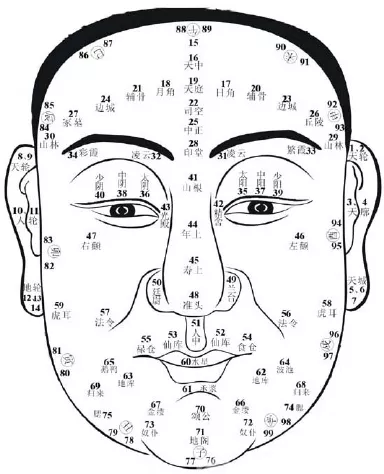
The five orifices: The ears, eyes, nose, mouth, and tongue. If they appear black, death is imminent within three days; only a moist tongue suggests life. If all five features are yellow, it indicates death from spleen disease.
The forehead: A bright yellow like brass indicates life; a yellow like a crab’s belly indicates death. A black like water or iron indicates life; a black like dust or wet ash indicates death. A white like frost or silver indicates life; a white like stone powder or withered bone indicates death. A green like willow leaves indicates life; a blue like indigo indicates death. A red like gemstones or red flowers indicates life; a red like flames indicates death.
The temple: A pale white, pale yellow, or black hue indicates severe illness; a bright hue indicates recovery; a dark or drooping forehead indicates impending death.
The center of the forehead: A white line extending down to the space between the eyebrows indicates a risk of death; if the center of the forehead, the earth’s corner, and the year mark appear smoky or liver-colored, they indicate unforeseen dangers.
The temples: A black like crow feathers indicates life; a dispersing black also indicates life (the temples are at the outer ends of the eyebrows). A dark, smoky hue at the temples, the life gate, or the tip of the nose suggests severe illness; an indigo-dark or speckled black hue indicates a hard-to-treat disease.
The horse’s station: A yellow hue indicates life; a bluish-black hue indicates anxiety; a smoky black or dull bluish hue indicates severe illness.
The space between the eyebrows: A bright yellow indicates the patient will not die; a pale white that connects to the tip of the nose indicates impending death. A red at the space between the eyebrows with a blue at the life gate suggests stroke risk. A blue extending from the hairline to the space between the eyebrows indicates death within sixty days; if the hue reaches the bridge of the nose, death within a month; if it reaches the philtrum, death within seven days; a full-face involvement indicates death within the day. If the space between the eyebrows, the tip of the nose, and both cheekbones all appear black, death is imminent within three days. If the space between the eyebrows turns white and extends into the ears and nose, and there are black hues at the ear gates, death is certain.
The mountain forest: A dark green hue in the mountain forest indicates severe illness; if the hair stands on end and the roots are dry, it indicates death within half a month.
The eyebrows: A purple hue with a yellow glow indicates life. Eyebrows shaped like willow leaves with dim eyes and dark circles suggest a cold condition or a color-related illness. If the eyebrows turn white first, it indicates a deficiency of liver blood. If the eyebrows connect and there are dark circles around the eyes, there is a risk of severe illness; a bright appearance at the tip of the nose reduces the risk.
The root of the nose: A yellow hue indicates life. The root of the nose and the year mark are sites where disease shows; they should look bright rather than dark. If they remain persistently dark and indistinct, it points to chronic illness. Frequent dark blue-black at the root of the nose signals imminent death. A dark, chaotic pattern at the root indicates multiple illnesses. If the root and tip of the nose appear dark and the cheekbones are blue, with dusty ears and dim eyes, it suggests a life of unrest.
The year mark: A yellow glow indicates life. If the year mark connects to both cheekbones with fire-like red spots, it indicates multiple illnesses or hemorrhoids. A black spot on the year mark the size of a finger indicates death. If the nose emits cold air, it indicates death. A slight reddish hue at the year mark indicates spleen and stomach disease risk. A red year mark indicates the risk of sores. If the year mark, the tip of the nose, and the wings of the nose appear dark red and form lines or beads, it indicates illness due to promiscuity. If the year mark appears dark or pale like indigo, death is certain. If the year mark connects with the dark areas under the eyes and the wings of the nose, it signals a risk of death.
The eyes: Bright eyes indicate life; clear, bright pupils mean that even with a pale face there may be no serious harm. If a patient has been ill a long time but still has spirit in the eyes, survival is likely. If the eyes suddenly droop and look downward, death is imminent. Closed eyes that lack color indicate loss of spirit; an open mouth with a leaning body indicates death. Fixed eyes with a dazed spirit suggest mental disorder. Gray, moist eye sockets indicate uterine issues. Dark circles under the eyes indicate gynecological problems. If blackness covers both eyes, it indicates severe illness. If the whites of the eyes are yellow and moist, it indicates life. Crow’s feet, including the corners of the eyes, with a yellow hue indicate life.
The ears: The area in front of the ears is called the life gate; if a white, purple-black, or blue-black hue connects the life gate to the year mark, death is near. If blackness invades like mud, death is certain. A bluish hue inside the ears suggests blood disorders. Moles near the ear indicate hemorrhoids. Dark red or dark areas on both ears indicate kidney disease. If the ears, cheeks, and earth’s corner appear black like dust, or if a white hue crosses from the left ear to the right, death is imminent.
The tip of the nose: A yellow, moist, and bright tip indicates safety; a yellow on the wings of the nose indicates life. If the color at the year mark opens to disaster, danger is distant. The nose is the central feature of the face. Observing the upper, lower, left, and right can reveal diseases of the internal organs, making it the most important feature. If the entire nose is black, the wings look dark, or the tip is black and dry, death is near. If the nose turns bright red from heavy drinking, this is not a good sign—it may indicate alcoholic hepatitis or cirrhosis, and can also suggest alcohol poisoning. If the entire nose is pale and the tip is purple with purple spots, there is a risk of lung or liver disease. A red tip indicates lung disease. Moles or spots on the nose indicate a risk of death from blood diseases.
The cheekbones: Yellow cheekbones with a translucent red indicate life; painted red indicates kidney pain. If the cheekbones connect to the year mark with a red hue, there is a risk of severe illness. If the left cheekbone is yellow-white in spring, it indicates risk of death; if the right cheekbone is red in autumn, it indicates death. If both cheekbones are red, a heavyset person is likely to develop boils or sores; a thin person may have tuberculosis.
The philtrum: A black hue indicates kidney syndrome and uremia; black at the philtrum with pale white indicates death. Alternating blue and black at the philtrum indicates lung and kidney disease. Dark green at the philtrum indicates severe cholecystitis or biliary colic. A pale philtrum with cold sweat indicates bronchiectasis or pulmonary tuberculosis with hemoptysis. A dull, lifeless philtrum suggests prostatitis in men and cervical inflammation or ovarian cysts in women.
The nasolabial folds: Red-brown nasolabial folds indicate death due to alcohol or overindulgence.
The mouth: The mouth is the center of life. If both corners are bluish-black, it is ominous and the patient is difficult to treat. Bluish-black at the corners of the mouth should be avoided in spring and summer, but not in autumn and winter; it should not appear in large patches, though scattered specks are acceptable. It should not be bright like lacquer, nor muddy; however, if there is a small point of white light in the murk, survival is indicated. Blue corners of the mouth indicate a difficult condition. Dry, white corners indicate death within seven days. A black mouth with skewed eyes indicates madness or mental illness. Blue lips with a black tongue carry a high risk of death. Lips that stay red for a long time are hard to treat. Even if the complexion looks good, pale lips indicate illness. Blackness around the cheeks and mouth corners points to internal organ problems and a risk of death. Teeth grinding during sleep indicates mental instability or digestive issues. Sleeping with an open mouth suggests some obstruction in the respiratory tract. A loud voice indicates life; a short, hoarse voice indicates death. A sudden shift to a hoarse voice indicates severe illness; a dry voice indicates death.
The chin: A yellow-red hue indicates life; a red hue suggests abdominal disease.
The earth’s corner: A yellow-red hue indicates life; a black, blue-black, or a black earth’s corner connecting to the cheeks indicates death within six months. A bluish-white hue on the cheeks indicates death. A dark, dust-like look under the chin signals a risk of death within a hundred days. A red hue on the throat indicates imminent death. If all thirteen areas are dark and red, there is a risk of death.
Body type: A plump person with a healthy complexion suggests life; a thin person who is not emaciated also suggests life.