How to Read Facial Complexion for Recent Fortunes
The Buddha taught: The future cannot be grasped, and neither can the past; the present moment is what truly matters. The conditions of today are the seeds for tomorrow. Thus, the present is immediate—it is the now.
From the standpoint of fate, the innumerable present moments form the future. Therefore, understanding destiny hinges on the now, and current circumstances should be approached with care.
How do we discern our current circumstances? Some seek guidance through divination or omens, while others monitor their biological rhythms. Yet, the most dependable signs come from observing changes in our own bodies, as human beings are a reflection of nature. Our bodies mirror shifts occurring both in nature and society; every change leaves a mark. Physiological and psychological indicators are always present. Each individual acts as both a sensor and a generator.
A person's fortunes evolve with the changing seasons, about every 15 or 30 days, and these shifts are visible in one's body, first and foremost as changes in complexion. To observe recent fortunes, paying attention to the complexion is key. There's no need for a natal chart or guessing omens; biological rhythms are sufficient. A simple glance in the mirror offers a convenient, economical, and highly reliable method—hence, traditional Chinese medicine often begins by examining a person's complexion.
A person's complexion not only reflects their physiological and psychological states but also influences them further, affecting their overall fortune. Regarding facial features, variations in color on different areas of the body symbolize different fortunes. Here's how:
- Green signifies worries. A deep green suggests ongoing troubles; a very deep shade indicates worsening issues; a lighter green points to emerging concerns, while fading green means issues are resolving.
- White indicates mourning. A strong white color suggests significant loss; very strong means it is imminent; faint white indicates minor severity or that it hasn’t occurred yet; fading implies a relative is in mourning and requires attention.
- Black signifies death and burial. A deep black denotes prisoners or serious illness; very deep signifies death due to severe illness; a fading black suggests possible recovery.
- Red suggests disturbances or unrest. A strong red may imply death in captivity; vibrant shades indicate looming legal issues; faint red denotes verbal disputes or minor punishments; fading red suggests improvement.
- Yellow signifies celebrations. A strong yellow implies significant joyful events; urgent yellow indicates imminence; a faint yellow suggests minor joys; fading yellow suggests diminishing celebrations.
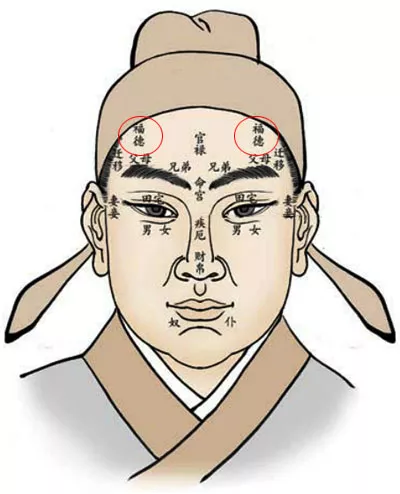
Different colors in specific facial regions have distinct significations regarding fortune, specifically outlined as follows:
1. Travel Star
Known as the hairline on the forehead, the Travel Star represents travel and relocation matters. Bright yellow here favors long journeys or moving homes; purple energy suggests the presence of noble people. A dull or gray-black tone warns against travel or relocation, particularly long trips that may lead to disasters.
2. Yintang (Hall of Impression)
Located between the eyebrows, Yintang is associated with one's spirit. A green hue suggests noble children; red turning purple indicates joyous events; red warns of fire hazards; white implies misfortune within a month; black indicates nearby illness; yellow forecasts joyous events; purple indicates unexpected wealth.
3. Eye Corners
This area often relates to relationships. Green here signifies potential water-related disasters; red suggests recent calamities; white implies ominous events, warranting caution regarding relationships' negative impacts.
4. Outer Corners of the Eyes
Known as "Jianmen," this area signifies romance. A faint red here signals approaching good news—singles may meet partners, relationships may lead to marriage. A dull, gray-black hue highlights potential romantic conflicts or third-party issues. Purple may suggest professional advancement; red could imply the birth of a noble child.
5. Nose Tip
The nose tip reflects financial prospects. A bright yellow suggests incoming financial luck; dark and dull colors warn of financial losses, crises, potential deception, or legal issues.
6. Learning Palace
This broad area indicates one's academic or reputational status. Green suggests laziness; white indicates a lack of knowledge; black suggests lack of academic achievement; yellow indicates intelligence and eagerness to learn, foretelling academic success.
7. Cheeks
Found below the cheekbones, cheeks signify family matters. Green suggests sibling or spousal discord; red indicates family worries; white suggests mourning potential; black signifies financial loss; yellow indicates blessings; gray implies parental misfortunes; purple suggests unexpected wealth.
8. Philtrum
Situated between the vertical lines below the nose, the philtrum connects to the physical body. A dark bluish color signals illness, potentially from disobedient children or anxiety. Women might experience gynecological issues; men should watch for reproductive concerns. If accompanied by dark purple lips, it's advised to beware and avoid swimming, as water troubles are possible.
For other facial areas, readers can draw similar conclusions—I won't detail them all here.
In conclusion, regardless of the area, dullness, dryness, or dark gray indicates the need for caution, especially regarding health; yellow and brightness signify approaching good tidings, urging one to seize the opportunity; red suggests potential for conflict; purple suggests influential connections; and white portends possible shocking or unfortunate events.
Crucially, pay attention to luster; the correct color with a bright shine generally indicates safety. Problems arise when incorrect colors are coupled with dullness and darkness.