The Power Star and “Eating God Controls Seven Killings” in BaZi
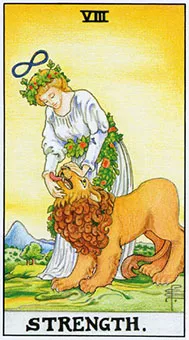
In the Strength card of the Rider-Waite Tarot, a goddess gently soothes a lion, softly closing its jaws. Though the lion could easily overpower her, it settles under her love and tenderness.
An infinity symbol above her head signifies boundless strength. Yet her power is not brute force, but inner resilience infused with compassion and acceptance. With a compassionate gaze, she uses her seemingly delicate hands to gently close the lion's mouth, effortlessly taming the king of beasts.
The compassion in the goddess's eyes seems to meet the lion's wildness with empathy, and the king of beasts becomes gentle and approachable under her calm, benevolent gaze. Perhaps a heart full of tolerance is the truest source of strength. The floral crown on her head and the floral belt around her waist symbolize noble purity and a gentle yet resilient power. She is fearless, embodying unwavering courage, confidence, and patience. She radiates dignified gentleness, reminding us to overcome our inner beast—our fears, anger, and impulses—with these admirable qualities. The Chinese sayings "to overcome the hard with the soft" and "using four ounces to deflect a thousand pounds" resonate with the message of this Strength card.
In Chinese Bazi astrology, one of the Ten Gods is "Seven Killings," also known as "Pian Guan," which represents a force that can overcome the Day Master. Seven Killings is considered the most aggressive star among the Ten Gods in Bazi. Traditional Bazi practitioners liken having Seven Killings in one's chart to being accompanied by a fierce beast: if you can control it, you can command the world and overawe all directions, but if you cannot, it may harm both yourself and others.
In the Yin-Yang school of Bazi, one should "distinguish Yin and Yang, observe decline and growth, understand changes, discern truth from falsehood, determine the useful god, and clarify likes and dislikes." Therefore, once the useful god is determined, if Seven Killings is established as the governing or useful god, it can reflect the character of the Day Master and its positive qualities become more apparent. However, if Seven Killings is a restrictive god, it signifies a powerful external threat to the Day Master, mingling with the energy of the governing god or harming supportive elements. The key, then, is how to "control" this fierce beast.
In astrological terminology, the concept most closely related to control is called "制" (zhi). According to the principle of the Five Elements, what can restrain Seven Killings is "Shen" (Food God), hence the saying "Food God controls Killings," which then transforms into "Power." In other words, by establishing the Food God as the useful god, one can use it to subdue Seven Killings and convert it into one's own power. From the perspective of Yin-Yang Bazi theory, the fate of the Food God controlling Killings is considered "noble" rather than "rich."
However, the Food God is regarded as the gentlest star among the Ten Gods in the Four Pillars of Bazi. Generally speaking, those for whom the Food God is the useful god tend to be refined, gentle, and tolerant. Thus, we can liken the Food God to the goddess in the Tarot Strength card, and Seven Killings to the fierce lion. The gentle Food God must govern the aggressive Seven Killings; brute force against brute force will not work. Like the goddess in the Strength card, it overcomes the strong with softness, subdues violence with virtue, and uses quiet authority to tame and control the fierce beast of the restrictive god, Seven Killings.
On the surface, Western Tarot cards and the Chinese Four Pillars Bazi may seem unrelated, yet the profound philosophies expressed by the "Strength" card and by "Food God controlling Killings" reveal a shared meaning.