The Hidden Secrets of Playing Cards: Iconic Faces of the Jack, Queen, and King!

Playing cards are a beloved pastime worldwide. They are said to embody cosmic laws and secrets, identifiable in the Jack, Queen, and King, which represent historical and cultural figures from the West. Historical accounts present different origin theories for playing cards. Some suggest they came from leaf games that spread from China during the Southern Song Dynasty of the 12th and 13th centuries. Another common belief is that they evolved from Tarot cards. It's likely that early playing cards made their way to Europe from Egypt in the late 14th century.
The 52 playing cards are said to mirror the 52 weeks of the year; the four suits stand for the four seasons, with each suit containing 13 cards, matching the 13 weeks in a season. Since a day has both light and dark periods, the suits are represented in two colors.
The letters on playing cards carry special meanings. For instance, "A" stands for "Ace," symbolizing the top trump card capable of changing outcomes. "K" signifies "King," "Q" means "Queen," and "J" stands for "Jack," or the court's servant.
The three face cards—K, Q, and J—total 12, symbolizing the 12 months of the year. Beyond the 52 cards, there are two jokers. The larger joker represents the sun, symbolizing daytime, and is red, while the smaller joker represents the moon, indicating nighttime, and is black.
If "J" is 11, "Q" is 12, "K" is 13, and the small joker is counted as 1, then the total value of the 53 cards becomes 365, representing the 365 days in a year. Adding 1 point for the big joker accounts for leap years. Another interpretation views both jokers as half points, still summing to 365 days.
The Meaning of the Four Suits
Each suit in a deck of cards symbolizes a season, reflecting spring, summer, autumn, and winter. Each season has 91 days, so 1+2+3+4+5+6+7+8+9+10+J+Q+K=91. The total from 1 through K equals 91, representing the number of days in a season. Multiplying 91 by four seasons gives 364, one day short of a full year.
The Meaning of the Numbers in Playing Cards
In divination, the meanings of numbers vary by suit and number differences.
- A represents the sun, signifying ambition, aggression, and a creative, proactive masculine personality.
- 2 symbolizes the moon, embodying inclusiveness, imagination, aesthetic sense, and coordination, typical of a feminine personality.
- 3 signifies Jupiter, representing justice, duty, authority, unity, and leadership.
- 4 symbolizes Uranus, indicating rebelliousness from differing opinions, idealistic obligations, nonconformity, and disagreements.
- 5 signifies Mercury, representing a questing and adventurous nature, characterized by a strong will.
- 6 denotes Venus, embodying charm, extensive social networks, and strong interpersonal skills.
- 7 signifies Neptune, indicating thoughtfulness, a love for travel, and a thirst for knowledge and research.
- 8 symbolizes Saturn, representing loneliness, extremism, and a focus on personal success and happiness, reflecting an egoistic personality.
- 9 signifies Mars, embodying fiery passion, extraordinary courage, and strong aggression, characteristic of a formidable personality.
The Notable Figures on J, Q, K
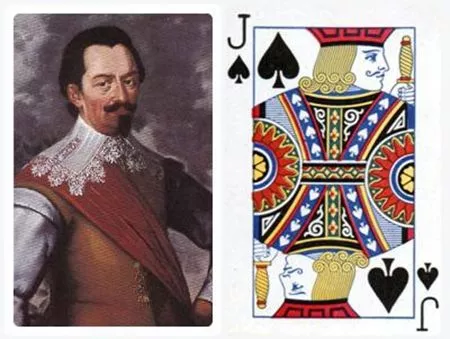
Jack of Spades: Ogier, one of Charlemagne's twelve knights in the medieval epic "The Song of Roland," blessed by six fairies, was a Danish prince. He achieved great military feats but tragically died in battle in the Pyrenees. He is depicted holding a sword at his side, sheathed.
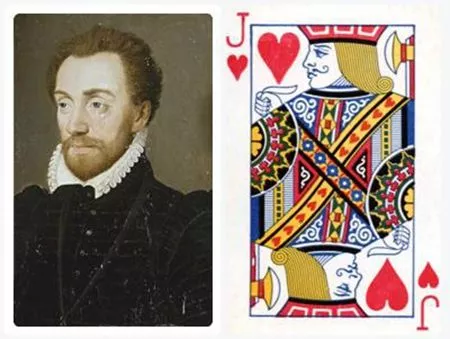
Jack of Hearts: La Hire, a companion of Charles VII, was a French commander during the Hundred Years' War and a key ally of Joan of Arc. His name means "anger" in Old French. His famous quote is, "What you want La Hire to do for you, you must do for him; if you are La Hire, you are God." He is depicted with a battle axe behind him, holding a white ribbon.
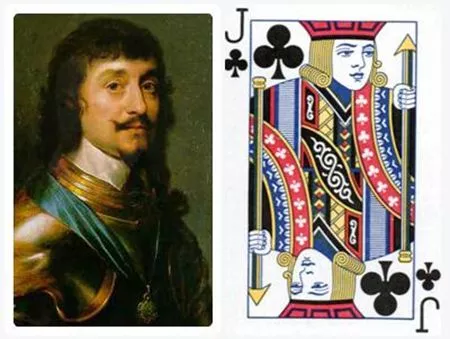
Jack of Clubs: Lancelot, the first knight of King Arthur's Round Table, whose affair with Queen Guinevere sparked a war with King Arthur, killed all knights sent by Arthur to pursue him. He is depicted as refined yet brave, the best warrior, and always willing to help. Ultimately, to preserve his honor, he did not end up with the queen but returned her to Arthur and chose a life of hermitage. In the cards, he is depicted holding a spear, consistent with historical records.
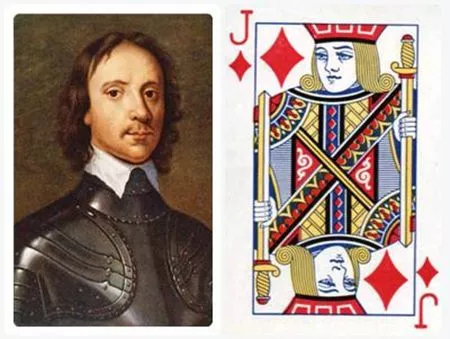
Jack of Diamonds: Roland, Charlemagne's companion, is celebrated as a hero in the French epic "The Song of Roland" and is the leader of the Twelve Paladins. Another interpretation links him to Hector, the Trojan hero from the epic "Iliad," known as "the wall of Troy," who died dueling Achilles.
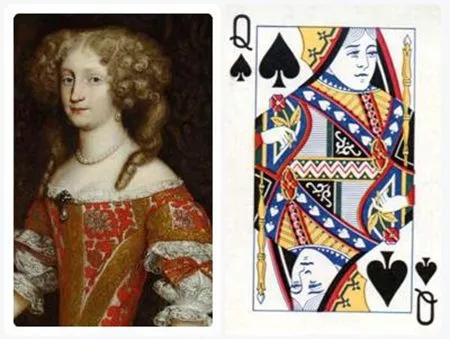
Queen of Spades: Athena, the goddess of wisdom and justice in Greek mythology, is one of the twelve Olympian gods of Greece.
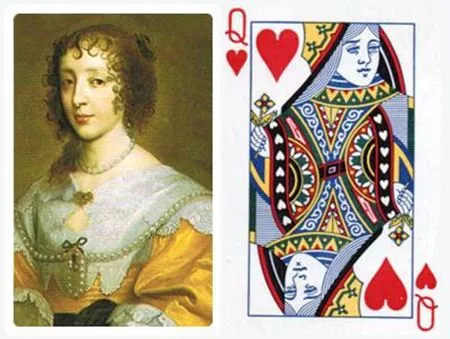
Queen of Hearts: Elizabeth, the queen of Henry VII, whose marriage marked the end of the Wars of the Roses. She was the eldest daughter of King Edward IV of England and Queen Elizabeth Woodville.
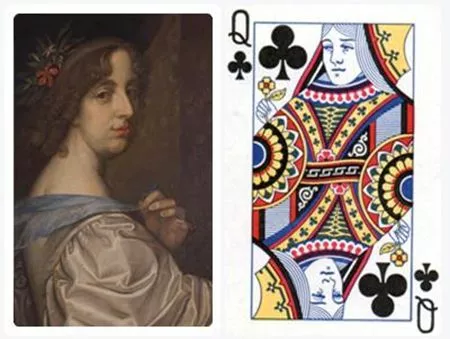
Queen of Clubs: Anne of the Lancaster family in England, symbolized by the red rose, while the York family was symbolized by the white rose. After the Wars of the Roses, the Tudor dynasty united both roses under the English throne. Thus, this queen is depicted holding a rose.
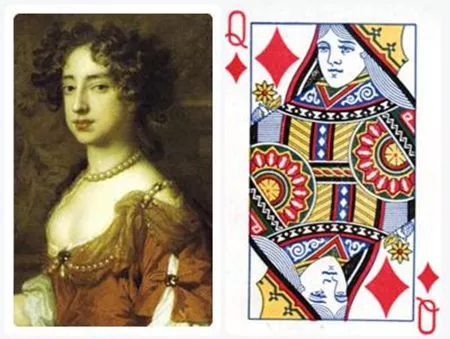
Queen of Diamonds: Rachel, as recounted in the Book of Genesis, was Jacob's second and most adored wife, and the mother of Joseph and Benjamin.
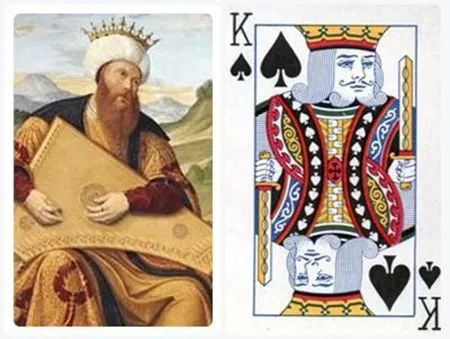
King of Spades: King David, the second king of the united Kingdom of Israel around 1000 BC, is known as the father of Solomon. Renowned for his musical and poetic talents, the Bible claims Jesus as a descendant of David. He is often depicted playing the harp, thus the King of Spades is traditionally shown with a harp in its design, with his hair styled outward.
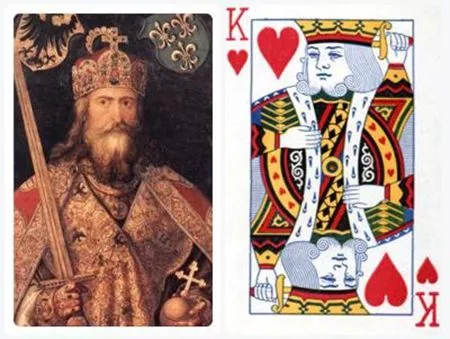
King of Hearts: Charlemagne, the King of the Franks, later crowned "Emperor of the Romans," waged over 50 wars during his 14-year reign, controlling much of Europe and tasked with defending the Christian world under angelic guidance. The first artist to carve his likeness into wood mistakenly shaved off his mustache, leading to his portrayal as the only mustache-less King of Hearts, with inward-styled hair and a sword raised behind his head.
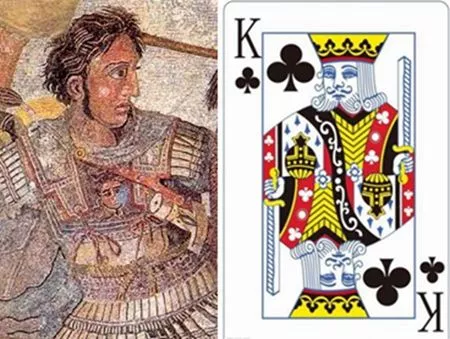
King of Clubs: Alexander the Great, King of Macedonia, son of Philip II, rose to the throne at the age of 20. His world conquest began with dominance over Greece, followed by victory over the Persian Empire. He forged a vast empire that spanned from Western Europe to the Indus River Basin, from the first Nile waterfall to Babylon. He is often shown wearing jewelry adorned with crosses, a trait of the King of Clubs, with his hair styled outward.
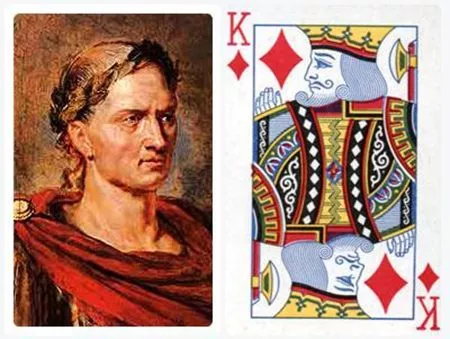
King of Diamonds: Julius Caesar, the lifelong dictator of the Roman Republic, descended from a noble line. He held roles such as financial officer, high priest, and consul. A brilliant strategist and leader of ancient Rome, he steered the Roman Republic towards becoming an empire. Caesar, depicted in profile on Roman coins, is the only King shown in profile on the cards, holding a battle axe.