Understanding Seasonal Lines in Palmistry
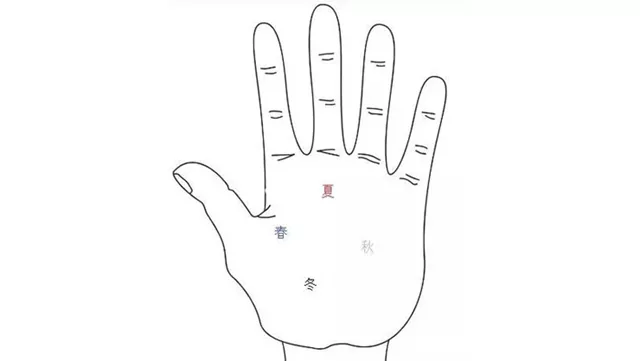
Physiognomy encompasses both inherent and learned traits, and it varies in form and appearance. The hands symbolize the principles of Yin and Yang, as well as the Three Powers, encompassing the secrets of the Five Elements in Tai Chi. Each hand contains its own Tai Chi. The left and right hands represent Yin and Yang; the palms and fingers separate Yin and Yang; the front and back distinguish Yin and Yang; the lines and complexion differentiate Yin and Yang; and both form and spirit distinguish Yin and Yang. The patterns and whorls of fingerprints also engage in the interplay of Yin and Yang.
The four fingers are each divided into three parts, representing the Three Powers; the designs of Heaven, Earth, and Humanity also signify the Three Powers. Each line can reveal the past, present, and future, which is a core concept of the Three Powers. The five fingers align with the Five Elements, defining the four cardinal directions: East, West, South, and North, and correspond to the four seasons: Spring, Summer, Autumn, and Winter. The complexion is influenced by the Five Elements, determining prosperity, growth, rest, and limits. The mounts of the palm are similarly categorized by the Five Elements, each carrying its own meaning. Among the fingers, the thumb symbolizes Earth, the index finger symbolizes Wood, the middle finger represents Fire, the ring finger signifies Metal, and the little finger stands for Water. Apart from Earth, the other Four Elements follow the Three Powers' principles, indicating phases of growth, prosperity, and decline. Earth is only divided into Yin and Yang (Tai Yin and Yang).
Descriptions of seasonal lines may appear in physiognomy texts. These seasonal lines actually refer to the palm's color or complexion, not a specific line. Palm complexion is an integral aspect of palmistry.
Specifically, the palm's complexion changes with the seasons. Ancient texts state: “In Spring, it is green; in Summer, it is red; in Autumn, it is slightly white; in Winter, it is dark at the base of the fingers. If in Autumn it is red, in Winter it is yellow, in Spring it is pale, and in Summer it is dark, this suggests an unusual complexion.” Such deviations hint at potential challenges and obstacles in one's life, impacting personal growth. This analysis hinges on the palm's complexion and the interplay of the Five Elements, rather than on the lines themselves.
Metal is associated with white, Wood with green, Water with black, Fire with red, and Earth with yellow. For example, if in Spring the palm is predominantly white, representing Metal, and green signifies Wood, with Metal overpowering Wood, it forebodes unfavorable fortunes and suggests caution. Therefore, the seasonal lines mainly reflect the palm's complexion and provide a key basis for assessing recent fortunes.