Palmistry Insights for the Year Ahead
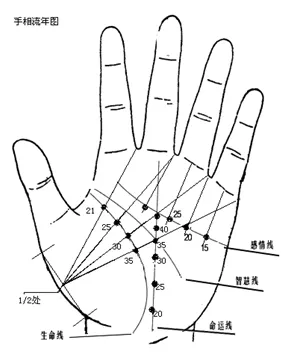
When reading palms, many practitioners examine the palm lines—such as the life line, wisdom line, emotion line, fate line, success line, and health line—looking at their depth, length, clarity, arrangement, characteristics, and position. From this, they offer insights into a person’s current situation. Experienced readers may even estimate the years someone married or had children, and their assessments can sometimes be surprisingly specific. There’s no hidden secret behind this; it’s based on interpreting the palm’s annual cycles.
In palmistry, annual cycles are generally mapped from a line’s starting point to its endpoint. For example, the life line begins between the index finger and the thumb; that starting point represents childhood. From there, the line can be divided into stages of roughly 5–7 years, extending to around ages 70–80. When calculating these cycles, think in approximate terms rather than pinpointing an exact year or month. For shorter lines, treat the line as representing the full life course—the segments are simply proportionally shorter.
When timing events using palmistry, the primary focus is on the life line, fate line, and emotion line; the other lines are less central.
- Life Line: It begins between the index finger and the thumb, with ages progressing from childhood forward along the line. In the image above, the point marked 18 indicates the start of adulthood. Another rough gauge is to place your index finger vertically below the starting point; a distance of one index-finger width corresponds to about age 21.
- Fate Line: It starts at the wrist (around age 1) and runs toward the base of the middle finger. Where the fate line crosses the wisdom line is about age 35; where it crosses the emotion line is about age 50. The midpoint between those two intersections is about age 40, with other ages divided proportionally.
- Emotion Line: It begins at the outer edge below the little finger, indicating about age 20 for males and 18 for females. The midpoint beneath the little finger marks roughly age 25 for males and 23 for females; other ages can be estimated in the same way.
In addition, certain distinctive markings on the palm carry their own meanings and can suggest different favorable or unfavorable indications.
- A star marking generally points to good fortune and, during that phase of life, suggests a happy, stable marriage.
- An island (eye-shaped) marking signifies physical weakness.
- Spots are considered inauspicious, indicating emotional distress related to marital difficulties.
- A cross at the center of a line usually signals misfortune, but if it appears alone, it can indicate good luck.
- Whether a triangle is favorable or not depends on its location; when it appears at a line’s starting point, it is considered auspicious.
- A grid pattern is viewed as inauspicious, suggesting someone may miss out on good relationships due to impulsive choices or momentary temptations.
- A square suggests protection, implying one can get through challenges safely.
- A circular mark is generally considered auspicious.
- A pointed shape facing upward is favorable, while one pointing downward is unfavorable.
- Fringing indicates weakness or depleted energy.