Katie A.'s Palmistry Analysis: The Heart Line
The Heart Line, also called the Love Line, can signify six things:
(1) The inner emotional life during childhood;
(2) Social life and interpersonal relationships;
(3) Romantic life;
(4) Married life;
(5) Emotional life in old age;
(6) Matters related to the heart.
The Heart Line can reflect the ebb and flow of joy, anger, sorrow, and happiness in childhood, as well as your relationships with parents, siblings, relatives, classmates, and friends. It can also indicate the strength of affection between partners or spouses and the fortunes or difficulties of marriage. As one of the key lines in palmistry, it’s often more telling than the Marriage Line. While many people think marital luck is shown only by the Marriage Line, the Heart Line is considered even more important because it reflects the quality of feelings between spouses (or opposite-sex partners) and periods of separation or reunion.
When the Life Line or Head Line runs straight without branches, it’s generally seen as favorable. The Heart Line is different: a few branches or offshoots are considered a good sign. In short, a well-formed Heart Line suggests emotions—joy, anger, sorrow, and happiness—are vividly expressed, pointing to a colorful, joyful life. A perfectly straight Heart Line with no branches may indicate a more monotonous, dull emotional life. However, too many branches or a tangle of lines can signal excessive complexity.
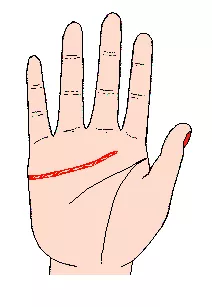
The classic Heart Line starts at the outer edge of the palm below the little finger and runs horizontally between the Mount of Jupiter and the Mount of Saturn. Its endpoint typically lies beneath the middle or index finger and may connect with the Head Line. In palmistry, these different endpoints carry different meanings.
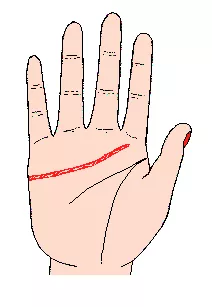
1. Long Heart Line
A Heart Line that reaches the center of the Mount of Jupiter is considered very long. This suggests someone who places great value on feelings, has a soft heart, and is easily influenced—often feeling abandoned for no clear reason. If the Head Line is strong, however, it points to a warm yet straightforward personality that remains rational, tolerant, and kind, leaving a good impression on others. Women with this marking are loyal in love, charming during courtship, and faithful after marriage.
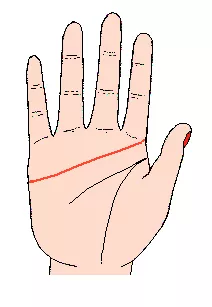
Characteristics of a "Good Wife and Loving Mother"
If the Heart Line ends at or crosses the horizontal crease at the base of the index finger, this pattern is quite common. Men with this marking are easily captivated by a woman’s talents or beauty—often romantic types who may prefer partners who take the lead. If the Head Line is also weak, they may be overly compliant with women. Women with this marking tend to be devoted in love, making them delightful partners or good wives—spouses of such women are considered fortunate.
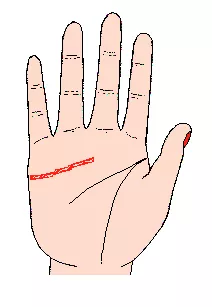
2. Short Heart Line
Those with a very short Heart Line tend to be emotionally detached, which can be hard on both themselves and others.
A relatively straight Heart Line that ends under the middle finger is considered short and suggests placing less emphasis on romance, a narrower outlook, jealousy, and infatuation. With delicate, thin hands, this can indicate indifference toward the opposite sex, often leading to unhappy outcomes. By contrast, if the palm is fleshy, the person can clearly separate love from work—fully enjoying leisure but being decisive and focused on the job, without obsessing over the opposite sex. Women with this palm type should avoid becoming overly absorbed in romance; instead, developing skills and focusing on work rather than staying at home can help prevent conflict.
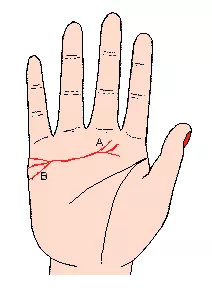
3. Forked Heart Line
Short upward branches from the Heart Line indicate the sprouting of love—signs that a lover may appear (mark A). A fork at the end of the Heart Line suggests someone who values emotions but is also practical, easily swayed by feelings, and with strong sexual desire, often prone to erotic fantasies when alone. If the starting point of the Heart Line splits into two or three branches (mark B), those without such markings may be socially awkward and unremarkable, while those with clear branches are sociable, humorous, and entertaining—often with a talent for writing—hence this is also called the Humor Line. This marking often appears on softer palms, though it can be faint or obscured.
A fine Heart Line is clean, continuous, deep, and slightly curved, ending below the index finger or between the index and middle fingers. A trident-like fork at the end is even better (mark A), indicating a caring, responsible person who values relationships and is well-liked socially.
If one prong of the terminal fork turns downward, it’s unfavorable and may also affect the Marriage Line.
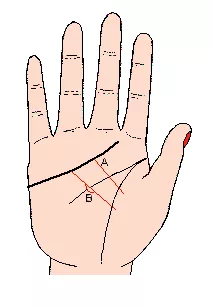
4. Branches of the Heart Line
Downward branches from the Heart Line that intersect the Life Line (mark A) point to psychological instability and an unhappy childhood home, leading to long-term pessimism. They also suggest unforgettable romantic experiences throughout life, with the timing estimated by where the branch meets the Life Line. This marking indicates a first love unlikely to become a lifelong partner—love may be experienced without lasting union. If an island appears on the Heart Line where it crosses the Life Line, it suggests a complicated love triangle (mark B), implying extramarital involvement.
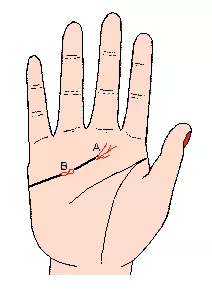
5. Weak Branch Lines
Short, faint branches at the end of the Heart Line (mark A) indicate a high valuation of emotion, practicality, and sexual desire; because these three are hard to satisfy at once, distress can result. Men with this pattern may be left by partners they support financially, leading to deep disappointment and anger—traditionally termed a “female misfortune” palm. For women, it suggests being taken advantage of and then abandoned by men. If there is an island below the ring and little fingers (mark B), it points to emotional volatility; even with age, feelings remain childlike and immature, with a tendency to form ties easily and enjoy flirting. Because their emotions are complicated, their careers may suffer, limiting lifelong achievement.
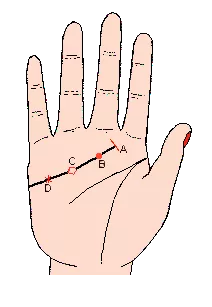
6. Other Small Details
- A short horizontal line at the end of the Heart Line (mark A) indicates that a relationship will not return to its former state after a breakup;
- Faint red spots on the Heart Line (mark B) signal emotional torment or potential arguments;
- An island on the Heart Line below the ring finger suggests low vitality or poor eyesight. Note: Spots on the Heart Line (including their color) may fade and reappear.
- A star on the Heart Line (mark D) indicates conflicts arising from love or disagreements; if the Marriage Line also shows negative signs, disputes between spouses are likely.
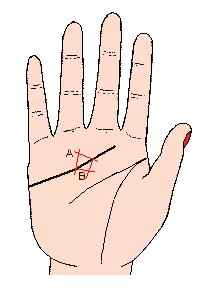
Danger Signals
An upward-pointing triangle on the Heart Line (mark A) suggests a tendency toward infidelity or disloyalty in love—often attracting married people and becoming involved as a third party. A downward-pointing triangle (mark B) implies a higher risk of third-party interference; if it forms a square, it indicates frequent, unnecessary emotional entanglements that cause distress, leading to periods of depression and even occasional suicidal thoughts, though fear prevents action—akin to recognizing harm yet feeling unable to resist.
7. Career Line Below the Heart Line
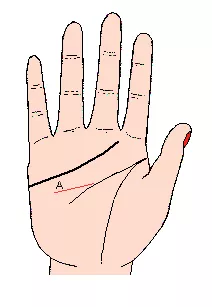
A thick line running horizontally and parallel beneath the Heart Line (originating at the negative Mars area—the far left side of the palm) indicates an energetic, career-oriented woman if found on a female palm, hence the nickname “Career Line.” For men, this marking makes it easier to find work and gain popularity. However, if its starting point (mark A) lies between the ring and little fingers, it becomes a broken Heart Line, pointing to infidelity and a tendency toward affairs.
Secret Lines—Indicating "Peach Blossom," "Affairs," and "Infidelity"
(1) If the end of the Head Line forks, regardless of gender, it indicates insincerity in love and a tendency toward irrational behavior or fanciful daydreaming.
(2) If the Heart Line forks below the ring finger and connects to the Head Line, it creates a strong, involuntary pull toward temptation; this connecting branch is called the “Secret Line.”
Do not jump to the conclusion that a “Secret Line” automatically means affairs or infidelity; it must be considered alongside other markings. If the Head Line and Life Line are intertwined from the start, with islands or other chaotic lines entangled, this can point to childhood factors that foster indecisiveness—an unbright early life that later leads to overthinking and excessive sentimentality.
(3) These factors may contribute to the emergence of a Secret Line. If you notice the “Secret Line” gradually developing—extending from the Heart Line toward the Head Line—be extremely cautious.