Four Key Areas to Focus On in Palmistry
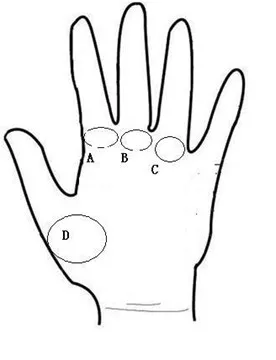
When it comes to palmistry, even non-experts recognize a few major lines: the life line, the wisdom (head) line, the heart line, the marriage line, and the career line. Most people know the life line relates to health and vitality, while the wisdom line points to learning and intelligence. Many assume these lines alone determine a good or bad reading. In fact, that’s a misconception—the overall quality of a palm reading depends not only on the lines but also on several key areas of the hand, including:
1. The Wealth Palace in Palmistry
Which part of the hand is the Wealth Palace? It’s the area labeled A in the diagram—the small mound at the base of the index finger. As the name suggests, it relates to wealth, income (both steady and windfall), and earnings potential. A favorable Wealth Palace is full and raised—high and fleshy rather than flat. Unfavorable signs include a sunken area or horizontal lines cutting across it. People with a well-developed Wealth Palace tend to encounter strong money-making opportunities throughout life. If it is flat or hollow, the person may be less suited to business; when they do have funds, they’re better off investing in real estate. This is one of the key areas that shapes an overall reading.
2. The Official Palace in Palmistry
Which area is the Official Palace? It appears at the position marked B in the diagram. This area reflects prospects in reputable institutions—government agencies, established companies, and large organizations. A well-developed Official Palace suggests potential for civil service; even outside government, it points to stable jobs with good benefits and roles carrying authority or responsibility. When this area is full rather than sunken, it also tends to correlate with higher education, solid academic performance, and helpful mentors. Conversely, if this area is hollow, the person may be less suited to leadership, face setbacks in education, and encounter obstructive or antagonistic individuals.
3. The Children Palace in Palmistry
The position marked C in the diagram is the Children Palace. It relates to children and descendants. It doesn’t need to be especially pronounced—few people have a very developed Children Palace. As long as there are no horizontal lines cutting through it, it’s generally considered favorable. When well-formed, it can also indicate particular talents or specialized skills, which is why people in the arts often show a distinct Children Palace.
4. The Property Palace in Palmistry
Many people are familiar with the Property Palace in face reading (between the eyebrows and eyes), but fewer know about the Property Palace in palmistry. In palmistry, it’s located at the position marked D in the diagram, corresponding to the mound at the base of the thumb. This area reflects a person’s housing and real estate over the course of life. To gauge living conditions, this is the place to examine. If it is full, fleshy, and raised, the person is likely to buy a home early, invest in property, and own real estate. Those engaged in practical, hands-on businesses often have a well-developed, rosy Property Palace. Conversely, if this area is thin or flat, it may signal difficulty in acquiring property or significant delays.
Many people overlook these key areas when reading palms, assuming only the lines matter. In reality, the four areas above play a crucial role in the overall quality of a palm reading and can even influence how high one rises in life, so they shouldn’t be underestimated.