Are People with Forked Life Lines Prone to Setbacks in Fortune?
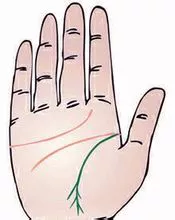
The "life line" is a term used in Western palmistry, whereas in Chinese palmistry, it is known as the "earth line." It is one of the three major lines found on the human palm. It starts at the midpoint between the base of the index finger and the thumb (serving as the boundary between the Zhen and Xun areas) and then encircles the entire mount of Venus in a parabolic arc extending towards the wrist. The life line not only reveals a person's life expectancy, health, potential illnesses, and unexpected events, but it can also shed light on basic personality traits.
Generally, individuals with a long, deep, clear, and uninterrupted life line that appears light red are believed to have good health, strong physiques, and long lifespans. Conversely, a short, broken, chain-like, or cross-marked life line is considered unfavorable, indicating a higher probability of illness or injury. So, what do the branches of the life line signify?
1. Branching at the Starting Point of the Life Line
- If there is a branch at the starting point of the life line, it suggests that the individual experienced many illnesses in childhood, faced academic setbacks, struggled to achieve success in their career during youth, often encountered interference from petty individuals, and may also endure unhappiness in marriage.
- If a life line has a branch at the starting point with many fine lines, it indicates that the person is naturally curious, has a vivid imagination from a young age, is intelligent and quick-witted, and has strong learning abilities, but may tend to be somewhat arrogant and self-righteous.
- If a life line has a branch at the starting point that extends upward, it signifies a cheerful and lively personality, a diligent and serious approach to tasks, a desire for self-improvement, and a strong thirst for knowledge, leading to future accomplishments and recognition.
- If the starting point of the life line branches and the end points toward the mount of the Moon, it indicates a sensitive nature, a love for freedom, high aspirations, and a tendency to become lost in a dream world, leading to thoughts of escaping reality and valuing the spiritual over the material.
2. Branching at the End of the Life Line
- If there is a branch at the end of the life line, it suggests marital unhappiness and a likelihood of changes in marriage during middle age, potentially leading to loneliness in old age due to children being distant. Individuals with this palmistry might be better suited for late marriages to ensure a stable and happy family life.
- If the end of the life line has a branch with one branch extending downward toward the wrist, it indicates vigor in old age, increasing wealth, and rising status. People with this palmistry often find success later in their careers.
- If the end of the life line splits into two branching lines, it signifies "two birds flying away," which might indicate the division of the family into separate households or the intention to live abroad.
- If the end of the life line branches and one side has several fine lines, it suggests the possibility of issues arising from a chaotic private life, leading to hormonal imbalances. Self-awareness and caution are advised.
- If the end of the life line branches and both sides have several fine lines, it indicates not only marital unhappiness and potential mid-life changes but also suggests poor physical health, fatigue, and susceptibility to age-related illnesses. Therefore, individuals with this palmistry should act within their limits and prepare in advance to avoid difficulties in later life.
- If the end of the life line has a spaced-apart branch, it suggests that exploring beyond one's local area can lead to greater opportunities, as staying confined to a small city might limit financial growth.
- If the end of the life line branches to the left, it indicates possible instability in middle age, often requiring relocation for career opportunities, but conditions may improve in old age, allowing for enjoyment of family life despite some fatigue but without health issues.
- If there is a branching line on the right side of the end of the life line, commonly known as the Mars line, it serves a supportive health function. Individuals with this palmistry are energetic and resilient, recovering quickly from minor ailments, but they may experience mental stress due to an overattachment to relationships.
- If the end of the life line has multiple branches, it indicates a gradual depletion of physical strength, leading to exhaustion in middle age and increased loneliness and mental stress in old age. Health may decline, necessitating greater attention to self-care.
- If the end of the life line has a cross-shaped branch, individuals with this palmistry often face misfortunes and health challenges, leading to emotional detachment from others. They may tend to avoid group activities and neglect daily routines, resulting in hormonal imbalances and health issues.
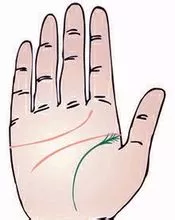
- If the end of the life line resembles a tassel, it serves as a warning to guard against age-related illnesses.