Jin Zizai’s Secrets of Face Reading: The Nose Edition
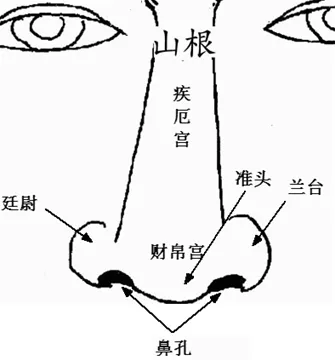
The nose—comprising the root, bridge, tip, and wings—is a key feature in physiognomy. It contains two primary zones: the bridge is read as the area of misfortune, while the tip is read as the area of wealth. Centered on the face, it symbolizes stability and is associated with Saturn, corresponding to the spleen and stomach. It reflects the kindness of one’s heart, the uniqueness of one’s character, and the ease of one’s financial luck. Below are quick, reliable rules of thumb you can read at a glance:
1. The Root of the Nose
The root of the nose lies between the eyes, linking the forehead and the bridge and forming a vital connection between the upper and lower face.
Three Key Insights—Effective at a Glance
First, the height of the root. A high root indicates strong self-esteem, which can tip into self-importance; a low root suggests weaker self-esteem and can foster feelings of inferiority. Those with a low root should be cautious about financial losses at the age of 41.
Second, the color of the root. A warm yellow, slightly moist tone is ideal and signals smooth progress. A dark or bluish cast is unfavorable, often pointing to hidden health issues and significant internal stress.
Third, the thickness of the root. A thick, sturdy root is preferable, indicating vitality and energy. A narrow, weak root suggests poorer health. The root also corresponds to the throat and respiratory system; if it is too thin or has horizontal lines, throat inflammation may occur.
Jin Anxian Answers Your Questions
1. What does a mole on the root of the nose signify?
A mole on the root is unfavorable for marriage, suggesting a man may bring harm to his wife or a woman to her husband. Late marriage is advised.
2. Can augmenting the root change one's fortune?
Augmenting the root cannot change one’s fate, but it can shift one’s mindset. Becoming more attractive can boost confidence. However, financial losses may still occur at the age of 41.
2. The Bridge of the Nose
The bridge of the nose runs from the root to the tip and is often regarded as the area of misfortune.
Three Key Insights—Effective at a Glance
First, a bump on the bridge. People with a bump on the bridge tend to be impulsive and quick-tempered, losing their temper over small matters, yet they are highly dedicated to their tasks. Marital relationships may suffer, leading to disputes—especially around ages 44 and 45—when divorce or major relationship changes should be approached with caution.
Second, a sunken bridge. A sunken bridge often signals poor marriage prospects. Men may lack decisiveness and end up with a dominant partner, while women may be drawn to men they admire, resulting in marriages that feel difficult and unsatisfying.
Third, key signs on the bridge. Generally, the bridge is read as the area of misfortune; dark spots or moles here may indicate family or health issues. It also reflects marriage matters: dark moles can point to arguments or even divorce.
Jin Anxian Answers Your Questions
1. If the bridge has been accidentally broken once, is it serious?
Any facial injury that occurs later in life should be interpreted together with BaZi, not judged in isolation.
2. What does it mean if there is a bony protrusion on the bridge, resembling a bump?
This is commonly called a “bump nose,” and the simplest reading is a troubled marriage.
3. The Tip of the Nose
The tip of the nose, also known as the “准头,” is the primary wealth area on the face.
Three Key Insights—Effective at a Glance
First, the size of the tip. The tip represents the self; a larger tip indicates a more self-centered, stubborn person, while a smaller tip suggests a more flexible personality. It also reflects the heart: those with a fuller tip are considered peaceful and kind, while a pointed tip may suggest the opposite.
Second, the color of the tip. The color is crucial. A warm yellow, slightly moist tone indicates good financial luck, while a red tone suggests financial loss. If there are spots, it may signal emotional strain and potential conflicts. A darkened tip calls for caution to avoid misfortune.
Third, the firmness of the tip. Firmness is best assessed by touch. A soft tip corresponds to weaker financial luck than a firm one.
Jin Anxian Answers Your Questions
1. What does a mole on the tip signify?
A mole on the tip indicates lifelong depletion, suggesting a person may be easily deceived in financial matters and suffer ongoing losses.
2. Is a “rosacea nose” the worst type of nose?
This is incorrect. People with rosacea can still have good fortune, but their earnings may be drained by unexpected expenses—a different concept from simply having bad luck.
4. The Wings of the Nose
The wings of the nose, also called the left and right “golden armor,” are referred to as “Lan Tai Ting Wei.”
Three Key Insights—Effective at a Glance
First, the thickness of the wings. Thick wings indicate someone good at saving with hidden reserves of wealth. Thin wings suggest poor financial management.
Second, moles on the wings. Moles on the wings are said to bring financial loss, especially around ages 49 and 50, when the damage may be severe.
Third, exposed nostrils. Exposed nostrils indicate a generous nature, suggesting windfalls but also unexpected expenses. Such individuals may also face marital difficulties.
Jin Anxian Answers Your Questions
1. What does it mean if the wings and tip are the same size?
When the tip and wings are of equal size, it is called a “garlic nose,” suggesting women may have poor marriage prospects and cannot rely on their husbands.
Summary
Please consider the following points carefully, as they are important.
The nose matters because it represents the wealth area, which is essential for sustaining life; thus, its quality closely relates to one’s fortune. However, this is not absolute. A good nose points to wealth but does not necessarily imply nobility.
Put simply, wealth refers to money, while nobility refers to status. Ancient wisdom often says “small wealth is seen in the nose, while great wealth is seen in the eyes.” Historically, the eyes were associated with academic success and social standing, while the nose reflects the capacity to accumulate wealth.
People often say someone with a large nose is likely to be wealthy. This notion doesn’t hold up to scrutiny: a large nose mainly indicates stubbornness. Only when paired with full cheekbones, a strong bridge, and a healthy yellowish glow can we say a person is likely to be wealthy. If someone has a large nose but a low root and flat cheeks, they may be isolated and not wealthy—in fact, they may be poor.
If a person has a large nose, a full face, small yet spirited eyes, and a prominent chin, they are likely to be very wealthy. Conversely, if they have a large nose and big, dull eyes, even if they have money, they may be gullible and easily deceived.
Therefore, any facial feature should be considered together with the others; interpretations will vary. Please remember the principle of “not judging in isolation,” and keep the characteristics of each feature in mind to make comprehensive assessments.
Exclusive Contribution: Jin Anxian