Jin Zizai's Secrets of Face Reading: Ears
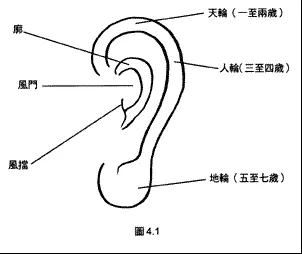
The ears connect to the brain and are linked with the kidney meridian. Traditional methods divide them into three parts: the Heavenly Wheel, the Human Wheel, and the Earthly Wheel. In the Five Elements, they correspond to the planets of metal and wood, with the left ear representing Venus and the right ear representing Jupiter. This area is the Auditory Palace, also known as the Hall of Intelligence. In the hundred-year flow system, the period influenced is from ages 1 to 14. The key insights are as follows:
1. Outline Section
The “outline” refers to the outer rim of the ear, while the “kuo” is the protruding ridge inside. A clear outline indicates a well-formed ear. The outermost rim is the Heavenly Wheel, the middle ridge is the Human Wheel, and the bottom—the earlobe—is the Earthly Wheel.
Eight Great Secrets, Instantly Effective
First, the Heavenly Wheel corresponds to ages 1–2, the Human Wheel to ages 3–4, and the Earthly Wheel to ages 5–7. Any damage or irregularity in these areas suggests major family changes or serious health issues during those ages.
Second, the ideal ear shape resembles the Big Dipper, indicating intelligence, kindness, and deep reserves of good fortune.
Third, if the ears aren’t visible from the front, it raises questions about family background. If the ear sits close to the back of the head and has a bright, lustrous color, it points to good fortune in youth and a prosperous family. Otherwise, it should not be read as auspicious.
Fourth, if the outline is irregular—meaning the ridge protrudes—classical texts can be severe, but in practice it points to a curious, rebellious, and bold nature; don’t rush to judge it as inauspicious.
Fifth, people with “wind-catching” ears tend to think innovatively and unconventionally, often becoming inventors.
Sixth, those with irregular ear shapes should be cautious about starting businesses; they may have many plans but achieve little.
Seventh, if the ears are different sizes and the tips are pointed like a fairy’s, emotional turbulence may affect their career.
Eighth, thin ears suggest weaker financial luck; thick ears point to abundant wealth; hard ears indicate a stubborn temperament.
Jin Anxian Answers Your Questions
1. What does it mean if the ears are hard or soft?
Hard ears indicate robust health and a stubborn personality, while soft ears suggest the opposite.
2. Is there a distinction between male left and female right?
Opinions vary. I favor the Hong Kong method, where certain parts and readings follow the old “male left, female right” rule, but it’s not absolute.
2. Earlobe Section
The earlobe represents the Earthly Wheel. It is considered a repository of past-life wealth. Three shapes often indicate three general personality types.
Six Great Secrets, Instantly Effective
First, a pointed earlobe indicates a thinking type—someone who digs deeply into matters.
Second, a round earlobe indicates a pleasure-seeking type who knows how to enjoy life.
Third, the absence of an earlobe indicates an active type who works hard and finds joy in doing.
Fourth, if the earlobe points toward the mouth, it suggests strong financial luck in middle age.
Fifth, the thicker the earlobe, the greater the potential wealth; confirm it by touch.
Sixth, if the earlobe hangs like a bead, it indicates abundant wealth.
Jin Anxian Answers Your Questions
1. Does piercing the earlobe affect wealth?
It may affect kidney energy (qi), which could have implications in old age.
2. Does having no earlobe mean no money?
Not necessarily; those without earlobes can be athletic types, such as martial arts stars.
3. Ear Color Section
Although ears come in many shapes, color matters most—some even say it outweighs shape. Hence the old saying: “Even with a good shape, if the color isn’t bright, it’s not favorable.”
Three Great Secrets, Instantly Effective
First, if the ears are whiter than the face, they should also be lustrous and bright. Such people tend to be exceptionally intelligent, attract many benefactors, and achieve more with less effort. If the ear shape is also good, good fortune begins from a young age.
Second, rosy ears are common and generally neutral, but they suggest recent luck is smooth. The least favorable is a purplish-red tone, indicating many plans but little success.
Third, if the ears look dusty, gray, or dirty, it signals declining luck and kidney deficiency, leading to low energy.
Jin Anxian Answers Your Questions
1. Does “whiter than the face” refer to a specific ear shape?
“Whiter than the face” refers to any ear that is lighter than the complexion of the face, regardless of shape.
2. What should one do if the ear color is poor?
The simplest way is to rub and massage the ears frequently while nourishing the kidneys. The color will improve, and luck will follow.
4. Mole Section
The ear has many parts, and different areas can show different moles and even hair.
Five Great Secrets, Instantly Effective
First, a mole on the ear rim indicates intelligence.
Second, a mole along the outer contour of the ear indicates longevity.
Third, a mole on the earlobe indicates wealth.
Fourth, a mole on the back of the ear indicates virtue and filial piety.
Fifth, hair growing inside the ear indicates a long life.
Jin Anxian Answers Your Questions
1. Is there any significance to the height of the ears?
Ears higher than the eyebrows are considered high, while those lower than the eyebrows are low. High ears indicate a prosperous youth with no worries about food and clothing.
Jin Anxian's Summary
The significance of the ears lies in how they reflect a person’s childhood and help infer adult behavior. It isn’t about snap judgments based on appearance; physiognomy is not that simple.
I always emphasize that physiognomy shouldn’t be judged in isolation; it must be assessed holistically.
Many people believe the ears only influence someone up to age 14, but that view is mistaken. Any feature can affect one’s entire life. For example, in midlife, the ears remain important. Those who achieve great success in middle age often have prominent noses, high cheekbones, and well-shaped ears; lacking any of these can hinder wealth.
Also, people often make hasty, harsh judgments based on superficial looks, which can create heavy psychological burdens. For instance, saying “paper-thin ears lead to poverty and early death” or “thin ears pointing forward mean selling off land.” In truth, it’s not that extreme. Once you understand the principles of ear analysis and summarize the related personality traits, you can combine them with other features for accurate readings. For example, “wind-catching” ears suggest bold, innovative thinking; paired with a pointed chin, this can indicate idealism, while a square chin may point to industry leadership.
Ultimately, my repeated summaries are meant to guide readers toward the right mindset for studying physiognomy—away from rigid formulas that cause misreadings and, in the end, no results.
Exclusive Contribution: Jin Zizai