Exploring the Many Forms: The Relationship and Evolution of Qi and Form in Physiognomy
The Practice of Physiognomy is Seldom Discussed.
Indeed, when it comes to physiognomy, I haven't written much about it, primarily because I haven't studied it in great depth or breadth. Consequently, I cannot speak on the subject comprehensively or precisely. However, I've always had a deep affection and strong interest in physiognomy. Unfortunately, due to life’s demands, I haven't been able to devote time and energy to it, allowing it to fade into the background. Yet, I believe that understanding one principle can lead to understanding many others. So today, I would like to share my understanding of the relationship between energy and form based on my experiences over the past few years, discussing the principles, truths, and foundations of physiognomy. While my insights may not be definitive, I hope to record them for future validation.
There Are Many Forms, But They All Reflect Energy.
I believe that the methods of physiognomy are similar to the principles of geomancy. Just as one seeks energy flows in a landscape, the formations of dragons, peaks, sands, and waters are all tangible entities. By observing where the energy flows, rises, gathers, and moves, one can perceive changes in energy—whether it is vibrant or declining, concentrated or dispersed, intense or subtle. This is the true secret of geomancy: discerning energy through form. Similarly, in physiognomy, one first observes the form, then delves into facial features, the six organs, listens to sounds, detects scents, and examines colors, all of which involve observing tangible entities and parts.
Therefore, I believe that those who understand the energy in feng shui can naturally comprehend the energy in physiognomy; those skilled in physiognomy can also grasp the true principles of feng shui. The two are fundamentally the same in principle, method, and system. Feng shui examines the changes in the energy of landscapes, while physiognomy assesses the qualities and fortunes of individuals.
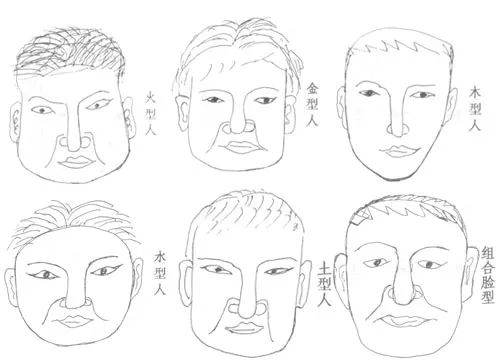
For example, there are many forms, such as the five elements: metal, wood, water, fire, and earth, which represent pure forms. However, the creation of the heavens and earth always maintains balance; you exist within me, and I exist within you. Thus, within metal, there are elements of metal, wood, water, fire, and earth; within wood, there are also elements of metal, wood, water, fire, and earth, and so on. Therefore, a person with a metal form often exhibits characteristics of wood, while a person with a wood form may display traits of earth. This is the transformation of forms. Because of this transformation, countless unique forms arise. Thus, there are indeed more than a hundred forms, but regardless of how many forms exist, they all reflect energy. How is this so? I personally believe that wherever there is a definite form, corresponding energy naturally exists. How should this be understood? For instance, a sharp form represents fire; its essence is fiery, and sharpness is the form associated with fire. Therefore, rising, surging, rushing, darting, and floating are the energies of fire. Similarly, a curved form represents water; its essence is watery, and curvature is the form of water. Hence, coldness, descending, penetrating, flowing, containing, and connecting are the energies of water. In other words, these energies define the nature of fire and water, respectively.
Therefore, the many forms are essentially manifestations of energy, which is both the principle of geomancy and the foundation of physiognomy.
Understanding Form is Merely to Discern Energy; Discernment of Energy is for Understanding the Fortunes of Form.
I believe that everything in the world is interconnected, as stated in philosophy. In fact, even intangible energy is interconnected. Isn't there a saying that fortune depends on misfortune and misfortune relies on fortune? This perfectly illustrates that the relationships between things, between good and bad, are indeed closely intertwined, much like the interdependence of yin and yang. Similarly, form and energy are also interdependent.
It is precisely because things are interconnected that knowing the essence of form allows one to discern the nature of energy. One should not think that only form and substance are real; energy is equally tangible. It is just that the intangible is not visible to the eye, which leads to the perception that it is insubstantial. This is not the case; energy, like the principles of form, continuously influences our lives. Therefore, the understanding of form in physiognomy is merely to discern energy; the essence, shape, and changes of form are to comprehend the existence of energy, its quality, and its fortunes. Thus, form exists to serve energy.
Likewise, observing changes in energy can also reveal the fortunes, qualities, and outcomes of forms. This is a reciprocal relationship, an inseparable unity. For example, in physiognomy, if one observes a person's face exhibiting a bright red hue, that red color represents form. Based on this bright red hue, one can infer that the energy of fire is present and has reached its peak, indicating that this energy is indeed fiery. Consequently, one can deduce a series of matters related to fire, including fortunes and outcomes, based on the presence of this fiery energy and its intensity, thus determining the fortunes and qualities of the person, object, or situation represented by the area exhibiting the red hue.
So, do you see that this principle is indeed interconnected? It truly is. When you diligently, attentively, and earnestly study one discipline, and apply your enlightened thinking, perspective, and experience to learn another, it becomes effortless and intuitive. However, this requires perseverance, willpower, consistency, and determination. Unfortunately, I have seen some individuals in recent years who, in pursuit of profit, rush headlong into challenges, focusing solely on immediate gains, forgetting that the foundation of a tall building lies in its base, and the towering tree relies on its roots. In reality, it is easy to discern whether a person has truly mastered a discipline or not; genuine knowledge does not come from obscurity but is always rooted in the principle of "simplicity is the ultimate sophistication."