Analyzing Youthful Luck and Academic Success Through Forehead Features

Facial Features and the Five Mountains
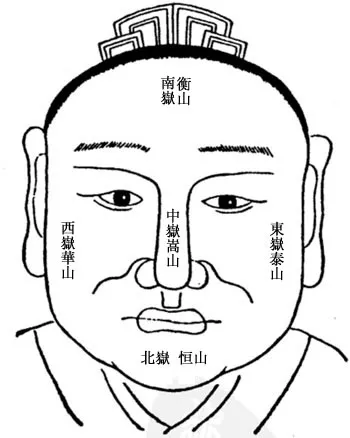
In physiognomy, the key bones of a person's head are mainly the forehead, the left and right cheekbones, the nose bridge, and the chin. Imagine this or look in a mirror, and you'll notice that these areas occupy the upper, lower, left, and right parts of the face, akin to cardinal directions. These five areas are known as the Five Mountains in physiognomy.
- The forehead corresponds to the Southern Mountain, Hengshan.
- The chin aligns with the Northern Mountain, Hengshan.
- The nose represents the Central Mountain, Songshan.
- The left cheek is the Eastern Mountain, Taishan.
- The right cheek is the Western Mountain, Huashan.
Below is a diagram illustrating the Five Mountains:
Jiangnan Yilin's Interpretation
It's important to note that in physiognomy, metaphors are frequently used. The term Five Mountains is figurative and doesn't directly refer to the actual mountains. Similarly, rivers, the sun, and the moon are used metaphorically in physiognomy, to be explored in detail later.
Grasping the five main facial bone areas lays a foundational framework. When learning any subject, it helps to first grasp the overall structure, understand how parts relate generally, and then examine the details within this structure.
Classical Chinese books on physiognomy are known for their conciseness and depth. A single phrase or sentence can encapsulate a key concept in physiognomy. In this article, Jiangnan Yilin particularly explores views on the forehead, which represent just a few points within forehead physiognomy.
When diving into physiognomy, it's vital to remember: the face is divided into various small regions, each signifying different aspects. The form and color of these areas correlate to a person's fortune regarding different life aspects over time.
About the Forehead
In conclusion, Jiangnan Yilin emphasizes that the forehead signifies youth fortune and intelligence. An ideal forehead is high, broad, full, and fleshy, symbolizing intelligence, charm, and often a favorable young life, typically attracting noble support.
A high, broad, full, and fleshy forehead might sound abstract, right?
Here's a physiognomic metaphor: "The forehead resembles a covering liver." Simply put, the forehead should appear like a piece of pig liver. If you've seen a complete pig liver, thick and plump, you'll understand this metaphor; it represents the ideal forehead shape. I wonder if having such a high, broad, and rounded head suggests a slightly larger brain capacity than average?
However, many people's foreheads are somewhat low and narrow with thinner flesh, indicating some shortcomings that need balance from other facial areas.
In traditional sayings, experienced elders note that children with rounded, prominent foreheads often excel academically. This belief holds some validity. In physiognomy, roundedness, thickness, and fleshiness are prized, whereas sharp, thin, bony features are less favorable.
In Jiangnan Yilin's hometown, a child's pronounced front or back head is termed a "bulging head," meaning protruding. Such children are believed to excel in studies. As a child, Jiangnan Yilin was often called "bulging head" by relatives and elders. Last year, Jiangnan measured a head circumference of about 61 centimeters, typically buying large hats. As a nickname, "bulging head" was bothersome, and some adults even flicked Yilin's forehead. A shaved head on a "bulging head" can appear unattractive.
Yet, if a forehead is excessively protruding, large, and fleshy, downsides exist. Such individuals may be sharp-witted and highly intelligent but also overly active and restless, struggling to remain still. Their curiosity and boldness might lead to trouble without proper guidance.
Another common observation about foreheads is that a low or narrow hairline often suggests late-developing wisdom. Without compensating features elsewhere, this may hinder academic success.
Interested in gauging youth fortune for yourself or a child? Observe the forehead: is it protruding and fleshy, broad or narrow? Is the hairline too low? Significant moles or scars on the forehead can also be negative indicators.