Essentials of Facial Features: The Five Sense Organs
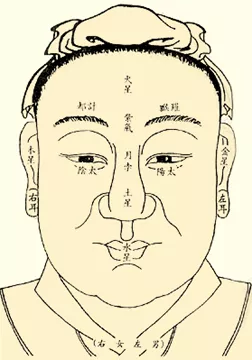
1. Facial Features
When we talk about facial features, most people think of the five essentials: the eyes, ears, nose, eyebrows, and mouth. In traditional physiognomy, each has its role: the eyes observe, the ears listen, the nose judges, the eyebrows guard longevity, and the mouth communicates. These five features are considered highly influential. Ideally, they should be balanced and symmetrical, well-formed, and healthy in color. By contrast, slanted eyes are said to signal inconsistency; a crooked nose, questionable integrity; a skewed mouth, insincerity; irregular eyebrows, a cold disposition; and uneven ears, stubbornness—none of which are viewed favorably.
1. Eyes
The eyes are considered the most important of the five. Bright eyes with clear whites suggest purity and intelligence, reflecting a lively spirit rather than a shifty look that hints at insecurity.
2. Ears
Ears should be even—neither higher nor lower—and look vibrant. This is taken to indicate good health, strong learning ability, and early success. Crooked, indistinct, or dull-colored ears, by contrast, are thought to point to poor health, a harder life, and limited luck.
3. Nose
The nose is seen as the center of character. A straight, well-defined nose suggests fairness, a sense of justice, good health, and prosperity. A crooked nose implies a more withdrawn nature and potential hidden ailments, which are said to undermine financial luck.
4. Eyebrows
Eyebrows should be smooth, fine, lustrous, dark, and well shaped, with tails that meet, and they should sit a comfortable distance from the eyes. Good eyebrows point to harmonious relationships, a gentle, courteous temperament, and proper conduct. Unruly, coarse, oily, broken, or splayed brows are considered unfavorable, suggesting a rougher nature that finds it hard to advance.
5. Mouth
The mouth should close neatly, be well defined and rosy, and the voice clear and strong. These traits are said to reflect good character, a prosperous life, and consistency between words and deeds. An often-open, poorly defined, dull-colored mouth, paired with a weak or hoarse voice, suggests a lax character and inconsistent behavior—signs of a petty disposition.
Some may think that the four rivers, five mountains, and five features are repetitive, but each focuses on different aspects. The four rivers typically assess a person's talent and innate fortune, which are more about inner cultivation; the five mountains look at wealth and power, which are more tangible; while the five features assess adaptability, reputation, and temperament, which are outward expressions.
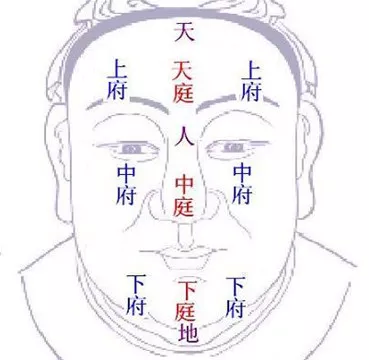
2. The Six Palaces in Physiognomy
In physiognomy, the six palaces are grouped into three sections—upper, middle, and lower—often called the "three palaces." Because they refer to the areas beside the forehead, cheekbones, and chin, there are six parts in total. Ideally, key areas show prominent bone structure with ample flesh, reflecting a good balance of yin and yang. The face’s upper, middle, and lower sections are said to correspond to stages of life: the upper to early years, the middle to midlife, and the lower to later years. A "full" upper palace—prominent sides of the forehead rather than sunken—suggests a strong start, favorable family background, and usually good schooling, often leading to early success. Likewise, a full middle palace signals a prosperous midlife, while a full lower palace points to a worry-free old age and comfortable living.
Put simply, the upper palace (beside the forehead) represents liquid assets; the middle palace (the cheekbones) reflects the drive to create wealth, execution, and investment decisions; and the lower palace (beside the chin) represents real estate and other tangible assets. The state of these three palaces is said to reveal when prosperity arrives and why.
The five features should align with the six palaces—what physiognomy calls the pairing of "officials and palaces." Good features without good palaces are like an official without a residence: displaced and rootless, hardly a high-ranking figure. Good palaces without good features are like a residence without status: how can one steward wealth without proper standing?
In practice, some people have strong features but weak palaces: they show ability and enjoy a good name, yet their income is modest. Others have weaker features but strong palaces: they may lack visible status yet earn well—like running a roadside stall or small business—living comfortably but without real authority.