The Moon Palace and Constellations: Unveiling the Mysteries Behind Ancient Star Patterns
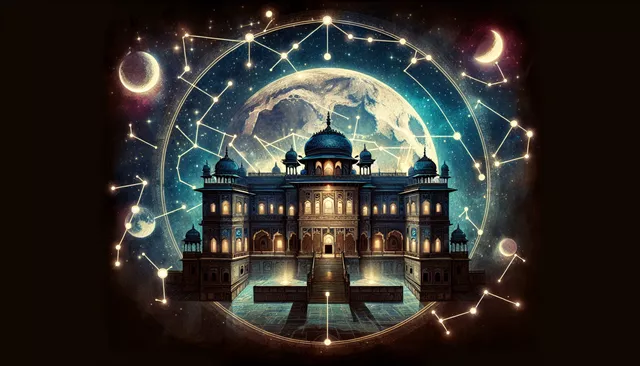
The vast sky is filled with countless stars. For ages, people have gazed at the night sky with endless imagination and reverence for the infinite sea of stars. In ancient times, constellations not only served as navigational markers for guiding journeys but were also regarded as embodiments of celestial deities, believed to possess mysterious powers. The Moon Palace, a radiant presence in the night sky, is intricately connected to the constellations, giving rise to numerous enchanting myths and legends.
Ancient texts state: "As the stars shift, heaven and humanity unite." This phrase suggests a connection between celestial changes and the rise and fall of human affairs. In ancient astrology, the waxing and waning of the moon symbolized changes in heaven and earth, while constellations represented the laws governing the universe. The Moon Palace, as the moon's abode, governs the yin and yang of the human world and the changing of the seasons. Its relationship with the constellations reflects not only the operational laws of heaven and earth but also the reflections of the human spirit.
Ancient writings record that "astronomy encompasses all phenomena; observing its changes reveals its principles." This means that by observing celestial changes, one can gain insight into the mysteries of the universe. Constellations, a fundamental aspect of ancient astronomy, were imbued with rich symbolic meanings. For example, in the zodiac, each constellation represents different celestial deities, and their trajectories are seen as the divine's journey across the sky. These deities not only govern the order of the universe but also influence human destiny.
In Western astrology, for instance, Aries symbolizes the fire god Mars, representing courage and strength. In ancient China, the Azure Dragon constellation governs the east and represents spring, symbolizing vitality and energy. The mysterious powers of these constellations are not only reflected in astronomical phenomena but are deeply embedded in the lives and beliefs of ancient people.
The connection between the Moon Palace and the constellations is evident in astrological practices. Ancient astrologers predicted seasonal changes, crop growth, and even the outcomes of wars by observing the positions of the moon and constellations. This concept of the unity of heaven and humanity reflects both a reverence for the laws of the universe and the wisdom of ancient people.
In ancient Greece, the renowned astrologer Ptolemy once said: "The power of the stars connects with the human heart." This means that the stars are not merely celestial bodies but reflections of the human soul. Whenever the moon traverses different constellations, its influence on humanity changes. For example, when the moon enters Cancer, people's emotions become more sensitive and tender; whereas, when it enters Leo, it ignites boundless creativity and confidence.
This exploration of the relationship between the moon and constellations reflects both the wisdom and imagination of ancient people and humanity's relentless pursuit of the universe's mysteries. As the ancient saying goes: "Gaze at the heavens to observe the changes of the times." By studying the Moon Palace and constellations, we can not only better understand the worldview of ancient people but also draw wisdom to explore realms that modern science has yet to touch.
The Moon Palace and constellations, this brilliant celestial combination, are both a mysterious light in the universe and a refuge for the human spirit. Through them, we seem to touch the pulse of ancient wisdom and listen to whispers from the depths of the starry sky. Through millennia-old myths or exquisite astrology, they tell an eternal story of the unity of heaven and humanity and the harmony of the universe.
The Moon Palace, representing the moon's position, is an essential element in astrology. In astrology, the moon symbolizes emotions, the subconscious, and family. Its position and phase changes can reveal people's emotional states, inner needs, and family relationships.
In ancient Egypt, the moon goddess Isis was regarded as a protector, closely associated with the moon's cycles, symbolizing rebirth and regeneration. Whenever the moon waxed and waned, people would hold rituals to pray for the goddess's protection, seeking blessings for a bountiful harvest and family well-being in the coming year. In Isis's temple, the moon's phases were meticulously recorded to predict future fortunes.
In ancient China, the Moon Palace in astrology was associated with the Moon God, believed to influence people's health and emotions. On full moon nights, ancient people would hold moon worship ceremonies to pray for health, longevity, and family harmony.
Constellations played a significant role in ancient cultures and were closely related to human destiny. Through studying constellations, astrologers could predict individual life paths, revealing potential opportunities and challenges. This mysterious power made constellations an indispensable part of ancient society.
In medieval Europe, astrology was widely used in political decision-making and military strategy. Many monarchs invited astrologers to predict the outcomes of wars and plan national development. The famous astrologer Nostradamus served King Henry II of France, and his prophecies caused a great stir at the time.
In ancient China, astrology was seen as a concrete manifestation of "heavenly-human resonance." By observing celestial changes, the court could make significant decisions. The renowned astronomer Zhang Heng of the Han Dynasty was well-versed in astronomy and geography. He invented the armillary sphere to observe celestial phenomena, advancing the development of astronomy and providing important references for the country's politics and economy.
With scientific advancement, constellations are no longer merely symbols of mysterious powers but have become a way for people to understand the universe and explore themselves. Modern astrology combines constellations with psychology, revealing individual personality traits and psychological needs through natal chart analysis. Although scientific progress allows us to view celestial phenomena more rationally, the mysterious powers behind the constellations still deeply attract us.
In this age of information explosion, constellations provide a unique perspective, helping us understand complex emotions and interpersonal relationships. Whenever we gaze at the starry sky, we still feel the call from ancient times and the eternal mysterious power of the universe.
As the ancient saying goes: "The stars shine brilliantly, and all phenomena are interconnected." The mysterious power of constellations is not only a symbol of ancient wisdom but also humanity's relentless pursuit of exploring the universe. Whether in the past, present, or future, constellations will continue to illuminate our hearts and guide us toward the unknown future.
This article aims not just to reveal the mysterious relationship between ancient constellations and the Moon Palace, but also to inspire our reverence and curiosity for the universe. By understanding ancient wisdom, we can better comprehend ourselves and the vast universe we inhabit.