Palmistry Guide: The Fingers
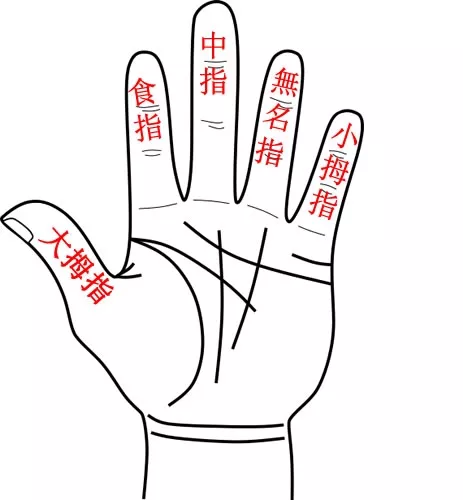
In palmistry, the five fingers are said to reflect different life stages and family relationships.
Thumb
The thumb represents childhood and the relationship with parents.
- People with long, sturdy thumbs are said to have an easy childhood, good health, and academic success, benefiting from their parents' love and support.
- The first segment of the thumb represents willpower. When this segment is overly long, it suggests strong willpower and fearlessness in the face of failure, but it may come with less rational judgment in decision-making. Conversely, a short first segment suggests weaker willpower and a tendency to give up easily when facing setbacks.
- The second segment of the thumb represents rationality. A long second segment is associated with intelligence, clear thinking, and calmness, while a short one suggests weaker comprehension and less rationality.
- When a person extends their hand, a wider angle between the thumb and the other four fingers indicates a more independent, proactive, and responsible personality, with a preference for creativity and freedom. A smaller angle suggests a more conservative, dependent nature, less creativity, and a tendency to be introverted or anxious.
Index Finger
The index finger represents youth and relationships with siblings.
- Those with a straight, well-proportioned index finger are said to experience a smooth youth, good health, academic success, and a thriving career. They tend to enjoy harmonious relationships with siblings or supportive friends and act responsibly in romantic relationships.
- People with a crooked or short index finger may face challenges in youth, with poorer health and hard work that yields limited results.
- If the tip of the index finger extends past two-thirds of the first segment of the middle finger, it suggests ambition and notable ups and downs during youth.
- An index finger longer than the ring finger suggests leadership ability and skill in managing others, but also a tendency to build from scratch rather than inherit a family enterprise.
Middle Finger
The middle finger represents middle age and the self.
- Those with a straight, well-proportioned middle finger are said to enjoy a smooth middle age, good health, career success, and financial stability, and they tend to be detail-oriented and persistent.
- People with a crooked or short middle finger may encounter challenges in middle age, experience poorer health, rely more on others, and show less perseverance.
Ring Finger
The ring finger represents adulthood and relationships with spouses.
- Those with a straight, well-proportioned ring finger are said to enjoy a prosperous adulthood, good health, career success, a happy family life, and a fulfilling marriage with a good partner. They also tend to have a strong artistic sense and aesthetic appreciation.
- People with a crooked or short ring finger may face challenges in adulthood, with poorer health and a less satisfying marriage.
- If the tip of the ring finger reaches the same length as the middle finger, it suggests strong personal opinions and a taste for risk, but possibly less patience.
- If the tip of the ring finger does not exceed half of the first segment of the middle finger, it may suggest a weaker aesthetic sense.
- Those with a ring finger longer than the index finger may find leadership and managing subordinates more challenging.
- A ring finger that is both longer and more curved than the index finger may indicate a tendency to be more submissive in relationships.
Pinky Finger
The pinky finger represents old age and relationships with children.
- Those with a straight, well-proportioned pinky finger are said to enjoy a smooth old age, good health, longevity, and well-behaved children, allowing them to enjoy their later years.
- People with a crooked or short pinky finger may face challenges in old age and poorer health, and should pay attention to respiratory or gastrointestinal well-being.
- If the tip of the pinky finger exceeds the first segment of the ring finger, success in public service or business is more likely, potentially leading to wealth.
- If the tip of the pinky finger does not exceed the first segment of the ring finger, more flexible careers—such as sales, teaching, medicine, science, or the arts—may be a better fit.
Furthermore, the length, thickness, angle, shape, joints, spacing between fingers, visibility of joints, and nail health are all believed to reflect a person's vitality, personality, and fortune. Long fingers often indicate deep thinking, attention to detail, and a slower work pace; if excessively long, they may suggest narrow-mindedness, authoritarian tendencies, and decisiveness. Short fingers suggest impatience, quick judgment, and a rapid work pace, but may lead to impulsiveness and a lack of endurance; short, thick fingers suggest clever thinking but may also indicate hypocrisy; plump fingers suggest laziness; while thin fingers suggest a tendency for thoughtful research but may also signal stinginess.
In summary, strong, straight fingers of balanced length are considered favorable, while irregular or markedly crooked fingers are viewed as less favorable in this tradition, unless shape is influenced by physiology or health.