Palmistry: Analyzing the Nine Palaces, Eight Trigrams, and Nine Stars Chart
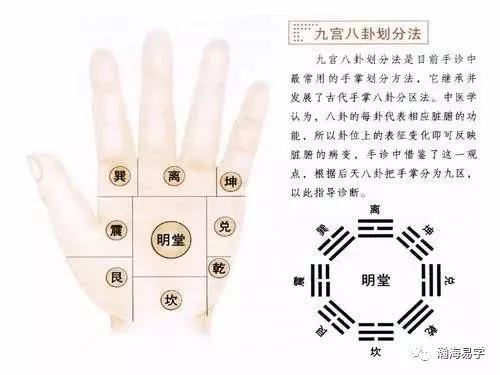
The palm is anatomically divided into the following areas: the thenar region, the hypothenar region, the palm area, and the interdigital area. In ancient China, the I Ching divided the palm into several regions based on the eight trigrams (post-heaven), while palmists in countries like Japan divided the palm into nine star regions based on the nine celestial bodies in astronomy. Both methods aim to illustrate the correspondence between internal organs and diseases as reflected in the palm. While there are some differences between these two methods, there are also overlapping aspects.
A comparison between the Chinese eight trigrams and the foreign nine star mounts:
1. Gen Palace + 1/2 Kan Palace = Venus Mount
Pathological Significance:
- Abnormalities in respiratory, digestive, and reproductive functions.
- Certain genetic issues and mental or psychological abnormalities.
2. Zhen Palace = First Mars Mount
Pathological Significance:
- Insufficient blood supply to the heart and brain.
- Endocrine dysfunction.
3. Xun Palace = Jupiter Mount
Pathological Significance:
- Stomach and duodenal disorders.
- Regulates liver and gallbladder functions, such as gallbladder disorders, emotional states, and energy levels.
4. Li Palace = Saturn Mount
Pathological Significance:
- Cerebrovascular diseases.
- Insufficient blood supply to the heart.
- Disorders of the nose and teeth.
5. Back 1/2 Kun Palace = Mercury Mount
Pathological Significance:
- Abnormal large intestine function.
- Weak urinary and reproductive functions.
- Reflects ophthalmic diseases.
6. Front 1/2 Kun Palace = Sun Mount
Pathological Significance:
- Abnormal mental and psychological states, such as neurasthenia.
- Reflects breast diseases.
7. Dui Palace = Second Mars Mount
Pathological Significance:
- Poor respiratory function.
- Cerebrovascular diseases.
- Poor liver and intestinal function.
8. Qian Palace + 1/2 Kan Palace = Moon Mount
Pathological Significance:
- Urinary and reproductive diseases.
- Digestive function, specifically the large intestine.
- Endocrine and psychological abnormalities.
9. Ming Tang: Mars Plain
Pathological Significance: Indicates cardiovascular diseases and psychological conditions.
Some might ask whether palm diagnosis uses a holographic approach or the nine palace eight trigrams star chart as diagnostic standards. The nine palace eight trigrams star chart provides only a general conclusion, while the holographic approach offers a clearer and more detailed diagnosis.
Source of images and text: Han Hai Talks about the I Ching