What Are the Facial Features of Someone Who Appears Insincere?

Image source: Pixabay
Hello everyone, and welcome to this installment of our facial features series. Today, we’ll explore the facial characteristics often linked to people perceived as "inconsistent" and "not entirely honest."
When discussing these traits, many tend to use negative adjectives. However, it’s crucial to understand that inconsistency doesn’t equate to being duplicitous, and a lack of honesty doesn’t inherently imply sinister motives. We encourage readers to approach these traits from a neutral and objective standpoint, rather than rushing to negative judgments.
Important note before reading: The traits highlighted in this article are detailed and should be assessed as a whole. You cannot draw a conclusion based on just one feature! Facial features must be considered in their entirety. Utilize this information rationally to avoid potential misunderstandings.
Eye Observation
Observing the eyes is essential for understanding a person’s "inner world."
Firstly, let’s discuss the "triple white eye," which we have covered in previous articles. It is said that "those with more white visible above their eyes tend to be manipulative," suggesting that individuals with this eye shape often possess deep, potentially negative intentions.
Next, we have "sheep eyes." As indicated by the name, this eye shape resembles that of a sheep, with small dark pupils and a larger amount of white, categorizing it as "four white eyes." People with sheep eyes are often deeply thoughtful and have a decisive (sometimes even ruthless) nature. They might act inconsistently in their speech and behavior for personal gain, showing different faces to different people.
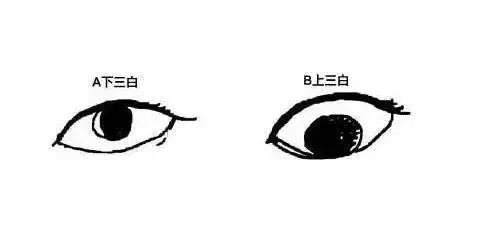
In general, individuals with smaller eyes tend to be more "reserved," meaning they often keep things to themselves. However, there are variations: those with small eyes and small pupils might have inner thoughts they choose not to share, while those with small eyes and large pupils, if their gaze isn’t shifty or exaggerated, could be shy and kind-hearted.
Note: If a person has small eyes and large pupils, and their gaze is clear and sincere, consider other features as well. If their lips are not thin, their nose isn't crooked, and their earlobes are thick, they may not be perfect but likely have a kind-hearted nature with clear boundaries. Even if they have deep thoughts, it is part of their personality, and their character is probably good, making them suitable for closer relationships.
When discussing eye expressions, observe certain behaviors: if someone frequently looks away or lowers their head before speaking, the former might suggest they are concealing nervousness, while the latter indicates deep thoughts. In these cases, the likelihood that their words are insincere increases.
Those with dim and wandering gazes tend to be evasive and bury their thoughts deeply. If their gaze is also accompanied by watery, squinty eyes (which curve when smiling) and noticeable lower eyelids, their words may easily gain trust or likability.
Moreover, if such individuals are good-looking, they become even more appealing. Celebrities might attract a following, while ordinary folks should be wary of being "charmed" by them. Whether or not their words and actions are sincere, others might easily believe them to be genuine.
However, eye expressions should generally be evaluated in conjunction with specific facial features. People sometimes lie or are insincere due to unavoidable circumstances, but such occasional behavior should not be the sole measure of their true nature. If many other traits mentioned in this article are present, or if an unusual gaze becomes habitual, the likelihood of inconsistency increases.
Nose Observation
When examining the nose, we must first mention the "three-bend nose" and "three-curve nose":
The three-bend nose features a noticeable bend when viewed from the side, suggesting a scheming nature;
The three-curve nose, also known as a "crooked nose," implies that the person may have some cunning or dark thoughts.
Furthermore, if the tip of the nose droops, like a Jewish nose or an eagle beak nose, the person might be shrewd, calculating, and focused on personal gain. Such individuals are often quite intelligent; they generally avoid causing trouble unless they perceive a threat to their interests, at which point they may employ crafty tactics.

In essence, these individuals prioritize their own interests and dislike losing. If their overall facial features are good, they might have promising careers and financial prospects.
When assessing the nose, consider it alongside the philtrum: individuals with a three-bend or three-curve nose and a crooked philtrum tend to be strong-willed and stubborn, often having more faith in themselves than anything else, which may lead to unconventional ideas and perspectives.
If a crooked philtrum is accompanied by thin, upturned lips, both men and women may hold unconventional views not widely accepted. The advantage is they are clever and full of ideas, but they might take shortcuts and be overly clever, increasing the likelihood of inconsistency.

Mouth Observation
In physiognomy, the mouth is viewed as the area of expression and reception. Inconsistency and lack of honesty often surface in a person’s speech and behavior; therefore, observing the mouth can reveal some insights.
Previously, we mentioned the "cat mouth" (characterized by long, upward-curving corners similar to a cat or certain animated characters). While this indicates the person is articulate and sociable, it doesn’t ensure complete sincerity. Such individuals may have a clever, slippery side, or a personality that is light and indifferent like a cat.
A cat mouth with thin, upturned lips, especially when combined with sheep eyes (and further accentuated by a crooked philtrum or nose), embodies a "classic" face skilled in manipulation and flattery. Upon encountering such individuals, it is crucial to observe their gaze and the aura they emit—
If their gaze is warm and leaves a positive impression, they might simply be opportunistically self-serving. However, if their gaze is unkind, they might possess more ruthlessness, requiring caution in interactions to avoid blind trust or offense while maintaining politeness and distance.
Introducing the "thunder mouth" (characterized by puffy corners, famously represented by the Monkey King):
This mouth shape suggests that the person tends to talk a lot and be straightforward, so they are not necessarily insincere or inconsistent. They might, however, occasionally come across as arrogant, which can impact their relationships negatively.
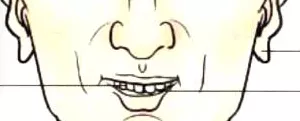
Additionally, individuals with protruding teeth, large gaps between teeth, or sharply-shaped teeth might exaggerate or distort facts when speaking, indicating a tendency towards inconsistency. This is particularly true if paired with "chicken beak" ears.
Overall Facial Observation
Facial asymmetry, such as uneven eyebrows, differently sized eyes, single/double eyelids, or uneven lip thickness, often indicates internal conflicts and self-doubt, leading to tangled thoughts. As such, individuals with noticeable facial asymmetry might exhibit inconsistent thoughts and behaviors or struggle to express their true feelings, leading to self-contradictions and difficulty in being open.
However, it must be noted that possessing the aforementioned features alone does not define one’s character. Given their complex inner thoughts and emotions, these individuals might experience psychological issues, and their ideas may fluctuate. This is especially true for those with facial asymmetry accompanied by dim or lifeless gazes, or signs of sadness or fatigue. They should pay close attention to their mental and physical health to prevent emotional disturbances. (In previous facial care articles, we advised this group to focus on mental well-being, as their chaotic thoughts and emotional exhaustion can lead to inconsistency, potentially causing more harm to themselves than others. Achieving peace and tranquility is essential to nurture their hearts.)
Previously, I noticed a reader asking whether individuals with asymmetrical faces and eyes should be avoided in relationships. Such a conclusion is quite premature:
For instance, if such individuals have good ear features, full lips, and gentle eyes, they may actually be empathetic people. However, they might be sensitive and prone to internal conflict, leading to inconsistency in their words and actions. This is unfortunate and often requires the care and support of friends and family.
On the other hand, if someone with facial asymmetry also possesses many other negative facial traits, such as heavy eyebrows, deformed ears, severely crooked nose/philtrum/lips, or unfriendly gazes, then caution is warranted in relationships. One should not be misled by superficial appearances; remaining vigilant is always wise.