The Yin-Yang and Cosmic Principles Reflected in Facial Features
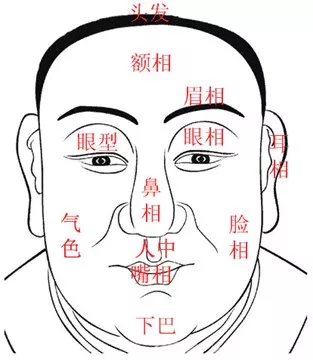
Humans encapsulate the energies of yin and yang, reflect the forms of heaven and earth, and are gifted with the essence of the five elements, making them the spirit of all things. Thus, the head mirrors the heavens, while the feet echo the earth; the forehead symbolizes the sky, the jaw and cheeks the earth, the eyes resemble the sun, moon, and stars, the voice parallels thunder, the blood vessels imitate rivers, the bones are like metals and stones, the nose and forehead represent mountains, and the hair resembles grass. The universe and the world are all contained within.
Although the human face is small, it synchronizes with, embodies, and shares the same structure and quality as the universe and the earth. Therefore, we can understand the world and the cosmos through it. The information contained in a person's face is like a microcosm.
The facial features, distributed in various directions, are akin to the celestial bodies of the universe and the mountains and rivers of the earth, complementing and harmonizing with each other. The interplay of yin and yang indicates fortune and misfortune, revealing a vast universe within a person's face. Specifically, several aspects can be considered:
1. It can reveal a person's health and lifespan
Physical appearance acts as a symbol of life, representing one's fate. While many people are reluctant to believe that physiognomy can reveal destiny, they often observe external appearances to gauge development and direction. For example, by observing a tree's growth, one can predict whether it will become timber; observing a seedling can help estimate its survival rate.
Humans are no different, as being part of nature means their vitality and energy are inevitably reflected in their appearance. Life is a product of nature, and so is appearance; these elements correlate with one's fate. Generally, a person's appearance corresponds to their vitality.
Traditional Chinese medicine also examines facial features and complexion by observing the five senses. For instance, a collapsed nasal septum causing a saddle nose is often congenital or caused by syphilis; a nose with a curved shape may indicate inherited diseases from one's parents.
French scientists have also noted that the shape and lines of the nose are directly related to cancer. Research on two thousand cancer patients, both deceased and surviving, found a correlation between nose morphology and cancer.
They concluded that individuals with hooked noses are most susceptible to lung and throat cancers; those with flat noses are more prone to brain and lymphatic cancers; individuals with enlarged noses are likely to develop colon and pancreatic cancers; and those with pointed noses are at higher risk for liver and breast cancers.
2. It can reveal a person's character and destiny
Remember, appearance is the vessel of destiny, and destiny is shaped by the movement of appearance. One's fate can be observed through their appearance.
Besides genetic inheritance from parents, a person's appearance is significantly affected by changes in their environment and mental state. In childhood, genetics largely determine appearance, but as one ages, this influence fades. The saying "appearance arises from the heart" captures this concept. Your heart’s state manifests in your appearance and shapes your fate.
Therefore, to understand a person's fate, one must first understand their heart, as expressed through their facial features and overall appearance. Thus, physiognomy can quickly reveal a person's personality and character, indicating their potential fate.
Aspects of interpersonal relationships, romance and marriage, career, financial fortune, and health can be discerned from a person's facial features, especially the positions of the five senses and the twelve palaces, which serve as a unique method for understanding the mysteries of fate.
Mastering the knowledge that physiognomy offers allows us to grasp the underlying laws of fate, enabling us to make informed choices in friendships, associations, and personal conduct, greatly enhancing our chances of success.
3. It can reveal a person’s behavior and opportunities
Life’s opportunities and luck ultimately depend on the image one possesses and how society recognizes, accepts, and resonates with that image; this is then reflected in various accidental and inevitable opportunities and outcomes in social activities.
For instance, an overweight person is unlikely to pursue bodybuilding, gymnastics, or dance; a person without a mouth cannot work in sales, marketing, or advertising; someone unable to handle pressure is unlikely to take on leadership roles; a person lacking authority cannot work in management; and those with excessive greed are likely to encounter issues related to lust and wealth.
4. It can reveal a person’s path and methods for changing their fate
While individuals with different appearances have distinct life characteristics and fate traits, leading to varying social opportunities, it is important to remember that appearances can change. These changes follow natural and social laws.
According to natural law, as the energies of heaven and earth change, so too do appearances. Aging alters appearance distinctly from youth, and physiognomy suggests that one’s appearance can change every fifteen days, aligning with biological rhythms reflected in the seasons. Appearance also changes with age and living environment.
Social law reflects "appearance arises from the heart." Changes in mindset and thoughts can influence or even determine changes in one's appearance. A kind heart leads to a kind appearance, while a malicious heart leads to an unkind appearance. The face changes with the heart. The Buddha's thirty-two dignified features are a result of countless eons of cultivation; features of a sage or enlightened being are also the result of accumulated effort over countless lifetimes.
In practical terms, great monks often exhibit dignified appearances, while immoral individuals may have seductive demeanors.
Buddhism teaches that appearance is also a form of virtue and can be cultivated. Changing one's fate and appearance requires inner cultivation and practice. While surgery may offer temporary results, if one’s character does not change, the initial appearance will eventually return. This approach may improve some life opportunities but can also lead to loss if not aligned with inner character changes.
Therefore, if you are dissatisfied with your fate or appearance, focus on self-cultivation, starting with a good heart and good intentions, and strive to maintain kindness.
5. All forms are ultimately transient and elusive
Forms can change and be altered, making them ultimately elusive and transient. Therefore, do not become attached to them, do not be arrogant, and do not misuse them. Having a popular face does not make you invincible; conceit and self-righteousness are mistakes because all forms are transient and will change.
What always follows you is your karma, or cause and effect. The favorable face you possess in this life likely results from blessings earned in past lives. Without continued cultivation of good deeds, these blessings may diminish.
Even if a person has a less favorable appearance or certain shortcomings, they can compensate through self-cultivation, practice, and improving their behavior, demeanor, communication, decision-making, and life experiences.
Learning to observe faces and recognize features allows us to understand character strengths and weaknesses, helping us find ways to compensate and address shortcomings. Whether in self-cultivation or interactions, one can respond calmly, paving a smoother life path, reducing unnecessary obstacles, and gaining a broader perspective in all areas.