Face Reading Secrets: The Twelve Palaces (Part 1) by Jin Zizai
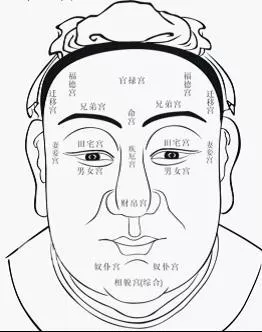
After discussing the facial features, we turn to the Twelve Palaces. These twelve palaces encompass all aspects of facial traits and fortune, making them a core foundation of physiognomy. This is why the “Ma Yi Shen Xiang” begins with the Twelve Palaces, underscoring their importance. A skilled reader well-versed in the Twelve Palaces can discern character and forecast fortune, helping one seek good luck and avoid misfortune. The interpretations below draw on my personal experience, supplemented by Ma Yi’s teachings, presented briefly.
First Palace: Life Palace
The Life Palace, also called the Palace of Wishes, sits between the eyebrows above the bridge of the nose, an area known as the Yintang.
Basic Interpretations, Always Accurate
First: When full and luminous, things go smoothly; when sunken and dull, many plans fall through.
Second: When the eyebrows meet, it indicates separation from home and limited spousal support.
Third: Marks or moles here point to many obstacles in life and the easy loss of family wealth.
Q: What if there is a scar on the Life Palace?
A: A scar is read like a mark or mole and signals challenges around age twenty-eight in life.
Q: If there are no good moles on the face, does that mean there are no good marks at all?
A: Generally yes; however, a mole between the eyebrows, slightly above the Yintang, is considered auspicious, signifying accumulated virtue and blessings, as with Teacher Zhang Tielin.
Second Palace: Wealth Palace
The Wealth Palace lies in the Earth Mansion and includes the Heavenly Storehouse, Earth Vault, Golden Armor, and Well Stove. It governs financial luck.
Basic Interpretations, Always Accurate
First: When bright and moist, wealth accumulates; when dry and thin, money is easily squandered.
Second: A straight, well-defined nose points to lifelong prosperity; a crooked nose suggests midlife difficulties.
Third: Exposed nostrils make saving difficult; moles on the wings of the nose signal financial losses.
Q: If the nose is well-shaped but has a bad color, how should it be interpreted?
A: Color is critical. A strong, prominent nose usually prospers, but if it appears red, expect heavy losses; if it looks blackened, beware sudden legal trouble.
Q: Does having a mole on the nose mean one will always lose money?
A: Yes—it indicates lifelong financial leakage, and removing it will not help.
Third Palace: Sibling Palace
The Sibling Palace, also called the Friendship Palace, sits between the eyebrows and governs friendship luck.
Basic Interpretations, Always Accurate
First: Long eyebrows indicate broad friendships; short eyebrows point to impatience and irritability.
Second: Thick eyebrows suggest a hasty, rough temperament; thin eyebrows imply difficulty relying on a spouse.
Third: Uneven eyebrows point to disparities among siblings; yellowish brows suggest deceitful brothers.
Q: What does a broken eyebrow signify?
A: A broken eyebrow indicates physical loss and weak emotional ties with siblings.
Q: What does it mean to have no eyebrows?
A: Having no eyebrows points to impulsiveness, but first determine whether a medical condition is causing hair loss—you can’t generalize.
Fourth Palace: Property Palace
The Property Palace lies between the eyes and the upper eyelids and governs family fortune and property.
Basic Interpretations, Always Accurate
First: Eyes glossy like lacquer indicate a thriving family enterprise; red veins warn of sudden emergencies.
Second: Asymmetrical eyes make it hard to maintain property; red streaks suggest family wealth is depleted.
Third: Phoenix eyes with high eyebrows signal wealth and local renown; dull or cloudy eyes suggest hardship and instability.
Q: What does it mean if the upper eyelid is very narrow?
A: A very narrow upper eyelid suggests potential quality issues with one’s residence.
Q: Does the Property Palace represent assets, including stocks?
A: Yes. The Property Palace covers all possessions, both tangible and intangible.
Fifth Palace: Children Palace
The Children Palace, also known as the Gender Palace, sits below the eyes and is also referred to as the Tear Hall. It governs offspring luck.
Basic Interpretations, Always Accurate
First: When the Three Yangs are full and bright, descendants prosper; when sunken, there is little affinity with children.
Second: Fine dark lines point to a blessed child; a net-like pattern suggests children drifting away.
Third: Also consider the philtrum—deep is favorable, flat is not—and further examine Mercury, as it can indicate loneliness in old age.
Q: Does a mole in the Children Palace mean one will have difficulties with children?
A: In traditional terms, “clashing” refers to relational discord. Moles in the Children Palace often point to burdens involving children.
Q: Does the Children Palace also include the philtrum?
A: The Twelve Palaces are not independent. The Children Palace includes the Tear Hall, philtrum, Mercury, and Tiger Ears, among others, and should be considered collectively.
Sixth Palace: Servant Palace
The Servant Palace, according to Ma Yi, lies in the Earth Pavilion and is closely related to Mercury. It governs management luck.
Basic Interpretations, Always Accurate
First: A full chin indicates many helpers; a mouth shaped like the character “口” suggests responsiveness.
Second: A pointed, small Earth Pavilion signals being abandoned by others; a sunken Earth Pavilion suggests weak or unreliable helpers.
Third: A crooked Earth Pavilion indicates dissatisfaction; a mole on the Earth Pavilion often portends water-related troubles.
Q: Can a person with a small chin manage subordinates well?
A: “Chin” is a broad concept; some have small bones but ample flesh, which can indicate great wealth, like Zeng Zhiwei.
Q: Does a large chin indicate a good Servant Palace?
A: A large chin often comes with many subordinates; however, it does not necessarily mean a good Servant Palace—it should be paired with high cheekbones.