Understanding Fortune and Blessings Through the Area Below the Nostrils
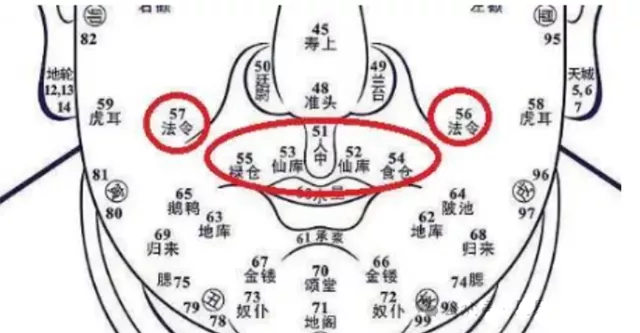
The "Xian Ku," a mysterious area located just below the nostrils and above the philtrum, is regarded by many physiognomists as a key indicator of a person's fortune and wealth. It's believed to hold a magical power that can reveal a person's inner destiny through their outward appearance.
In the domains of facial physiognomy and feng shui, the status of the Xian Ku is of utmost importance. Some experienced practitioners even think that the shape of the Xian Ku is closely linked to the condition of the family kitchen. When the Xian Ku presents a pleasing appearance, the home kitchen often appears spacious and bright; conversely, if the Xian Ku is poorly formed, the kitchen may seem cramped and chaotic. This intriguing connection suggests that the Xian Ku relates not only to an individual's fortune but is also closely tied to the overall luck of the family.
As time goes by, the Xian Ku also bears significance concerning age-specific fortunes. The left Xian Ku corresponds to fortunes at the age of fifty-two, while the right Xian Ku reflects destiny at fifty-three. These two ages often represent critical turning points in many people's lives, making the shape and color of the Xian Ku an important reference for predicting future paths.
What then defines a favorable Xian Ku? Generally, a good Xian Ku is broad, thick, raised, and fleshy, without chaotic horizontal lines or blemishes, and features a centered philtrum. Individuals with such a Xian Ku typically enjoy smooth financial fortunes, have supportive friends, and receive joyful news from their children frequently. Their kitchens are spacious and tidy, symbolizing a rich and harmonious family life. More importantly, these individuals often possess strong digestive systems, enabling them to enjoy good food and wealth well into their later years, making them truly fortunate.
In contrast, if the Xian Ku shows unfavorable signs, such as lacking flesh, having blemishes or horizontal lines, or a skewed philtrum, it may signify a less ideal fate. Such individuals might negatively influence their children, and their kitchens may appear cramped and disorganized. They are also more prone to digestive issues, which could significantly reduce their enjoyment of food.
Many interpretations exist concerning moles on the Xian Ku. If it is a good mole, it is advised not to remove it lightly, as it symbolizes abundant wealth and is considered a rare auspicious mark. The presence of this mole not only suggests a life of abundance but also reflects a unique appreciation for food and exceptional culinary skills. For women, having such a mole may indicate being a virtuous wife and mother, gaining the affection of their husbands, and enjoying a fulfilling marriage.
Conversely, if the mole on the Xian Ku is deemed negative, the meaning shifts entirely. It no longer symbolizes good fortune and may forewarn of potential financial loss. People with negative moles often struggle to accumulate wealth through social ties and may instead overspend due to gatherings with frivolous friends. For women, such a mole may also impact marital happiness due to neglect in household chores.
Beyond the Xian Ku itself, the surrounding areas known as the "Shi Cang" (Food Store) and "Lu Cang" (Wealth Store) are also significant in facial physiognomy. They are considered the palaces for receiving and storing wealth, closely linked to a person's financial luck. The shape and color of these areas can also provide insights into a person's financial trajectory and wealth accumulation.
Illustration and text by Zhou Yi, Physiognomy Expert