How to Identify a Good Woman Through Facial Features and Body Language

In traditional Chinese thought, all things are categorized as yin and yang, with men associated with yang energy and women with yin essence. Physiognomy applies the same framework. Following the idea that the upper body corresponds to yang and the lower body to yin, the head is yang and the feet are yin; on the face, the forehead is yang and the jaw is yin. Accordingly, when reading a man’s features, attention centers on the head and forehead, while for a woman, the key areas are the feet and jaw.
Yet everything contains both yin and yang—“without yin, nothing is born; without yang, nothing grows.” Thus, when assessing a woman’s features, both must be considered. The best areas to gauge the yin–yang balance are the waist and hips. A slender, supple waist is taken as the clearest sign of femininity, while full, rounded hips are viewed as a classic emblem of masculinity.
Therefore, across times and cultures, if one seeks to read a woman’s qualities, the jaw, waist, hips, and feet are seen as the most revealing points—often offering the quickest emotional impressions, especially for men.
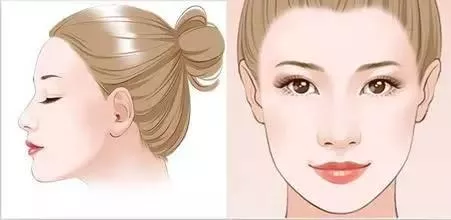
Jaw
Historically, physiognomists praised “a full forehead and a square jaw” as signs of good features. In this framework, the forehead belongs to the upper, yang aspect and is linked with men, while the jaw belongs to the lower, yin aspect and is linked with women. Thus, a woman’s fortune is often read through the qualities of her jaw.
Since women are said to embody more yin and tend toward softer, rounder contours, the ideal jaw in this view is full, rounded, and substantial. Women with such traits are described as calm, enjoying relative comfort in life, and having favorable later years. While an oval face can be attractive, an overly pointed jaw is taken to signal insufficient yin and less promising prospects, potentially bringing marital difficulties and challenges in old age. A sharp, thin jawline is often interpreted as a sign of a less generous nature. Very prominent cheekbones may suggest a strong focus on self-interest, which can strain relations with a partner’s family, especially in-laws. By contrast, overly thin cheekbones are associated with pessimism, indecision, and limited support for a partner’s career. In traditional terms, neither extreme was considered favorable for women.
Beneath the lower lip lies a hollow known in traditional Chinese medicine as the “Chengjiang” point. In physiognomy, a woman’s “Chengjiang” is ideally recessed enough to hold a fingertip, which is considered auspicious. This recess is said to “hold fluid,” symbolizing abundant yin and robust reproductive and endocrine function. In older beliefs, such women were thought likely to have more children and enjoy family harmony. Conversely, a thin, pointed chin with a flat “Chengjiang” was taken to imply childlessness and loneliness in later life.

Waist and Hips
Physiognomy isn’t limited to specialists; in everyday life, people also make quick judgments from appearances. In the past, for example, when a bride entered her husband’s household, the mother-in-law might discreetly appraise the bride’s waist and hips as a clue to fertility. In agrarian societies, the number of offspring could directly affect a family’s survival and growth. Thus, evaluating a woman’s waist and hips has been seen not only as an aesthetic matter but also as having biological implications.
In traditional China, both experts and laypeople believed that the larger and rounder a woman’s hips, the greater her sexual and reproductive capacity. Likewise, the slimmer and more flexible the waist, the more alluring and passionate she was considered. Even in the Tang Dynasty, which favored fuller figures, women still aspired to a narrow waist. Today, although “slim beauty” is widely pursued, figures like Marilyn Monroe and Li Wen continue to be regarded as “sex symbols” and “goddesses” admired by men and emulated by women.
This suggests that, despite long evolution, human beings have not completely erased animal instincts from the subconscious. Researchers at Harvard University have reported that women with a pear-shaped figure (larger hips with a smaller waist) tend to show higher fertility and hormone levels, especially around ovulation. Some estimates claim that, under comparable conditions, such women are roughly three times more likely to conceive than women with other body types. In this light, the traditional practice of assessing a woman’s waist and hips as indicators of sexuality and fertility is not without a scientific basis.

Feet
Many experts, both in China and abroad, consider the feet among the most sexually expressive and alluring parts of the body, particularly to men. A woman’s feet are often seen as a potent, seductive attribute. From Cinderella’s “glass slipper” in the West to China’s “three-inch golden lotus,” and even the derogatory slang “broken shoes,” one can sense the blend of ambiguity, attraction, and imagination that feet inspire.
Thus, a man who skips the face, slim waist, and rounded hips to focus first on a woman’s feet is seen as an adept observer—someone who “understands women better than women themselves.” In physiognomy, women are categorized as yin, and feet are also yin, making women’s feet a concentrated expression of femininity. If one aims to understand a being defined as feminine, the feet are considered a fitting place to look.
By examining the look and shape of a woman’s feet, one is said to discern the strength of her yin, her temperament, and her emotional tendencies—an absorbing exercise that rewards careful attention. Aestheticians often describe the ideal feminine foot as “small, slender, pointed, and curved.” Physiognomists likewise favor feet that are petite and delicate, seeing smallness as a feminine beauty and largeness as a masculine sign. In this view, a robust, powerful look is less desired than a petite, refined one. Slender feet suggest delicacy and a need for support, while pointed, curved lines echo nature’s archetypal feminine curves. These gentle, subtle contours seem to voice a woman’s quiet sorrows and longings, calling forth tenderness and care.
Conversely, very large feet are said to show excess yang and deficient yin, implying less emotional sensitivity, softness, and refinement. Feet with heavy muscle and fat are taken to indicate strong yin, along with a calculating, critical, and self-assured disposition. Prominent veins on the feet are linked with excess liver yang and a quick temper, sensitivity, and volatility. Pronounced hair on the calves may signal higher male hormones and lower estrogen, often paired with masculine traits—speaking loudly and quickly and a strong will to lead and control—earning the label “tomboy.”