Does Body Weight Influence Destiny? Exploring the Connection Between Facial Features and Fortune
Image source: Pixabay
Hello everyone, welcome to this installment of our facial features series. Today, we're exploring the concept of "weight" and tackling some common misconceptions, such as: Does physiognomy truly favor being plump over being thin? Does being heavier necessarily equate to a better fate?
"Having Flesh" ≠ Obesity
Traditionally, the idea of auspicious facial features often involves the concept of "having flesh." This has been elaborated on in previous articles by Lei Men Yi, and here are some examples:
The chin, or the "Dige" (the lower part of the face), is considered the "servant position" of the face and is tied to a person's wealth and fortune. A square and full Dige is generally preferred, indicating good fortune in later life;
The nose, representing the wealth palace, is considered better when it has a rounded, fleshy tip rather than a bony one. Full and strong nostrils are favored over narrow ones, as narrow features can impact financial luck and affect women's marital prospects;
A face with fleshy cheekbones and a balanced round-square shape suggests a smoother life. Having some flesh on the face adds thickness, which is seen as a sign of good fortune;
The waist, hips, and back should also have some flesh and width, as being overly thin is seen as inauspicious;
...
From the descriptions above, it is clear that many features benefit from some flesh, leading some to mistakenly equate being overweight with being fortunate, while viewing thinness as unfavorable. This confusion is compounded by sayings like "Being plump is a blessing, while being thin is a sign of misfortune," which contribute to misconceptions about weight and fortune.
A core issue with these misconceptions is that people often confuse the terms "plump," "broad," and "having flesh" in physiognomy with "being fat," particularly regarding body shape—
In reality, individuals with the aforementioned favorable facial features are not necessarily overweight; many are quite slim. For example, in a past episode of a variety show, a guest physiognomist discussed this issue:
While talking about the Dige, they noted that a square and full Dige is auspicious, but it doesn't directly relate to weight. Some individuals may not appear overweight yet have a double chin, which indicates having flesh, beneficial for wealth and fortune.
It stands to reason that if physiognomy solely relied on body weight to assess fortune, its credibility would be low. Therefore, it’s important not to confuse concepts and to adopt a nuanced perspective.
Of course, when it comes to "fortune," being moderately plump is indeed better than being overly thin. Phrases like "being able to eat is a blessing" and "a round face is a blessing" hold some truth, but this is relative to being "overly thin" and must fall within a healthy context.
Structure and Harmony
In examining facial features, it is crucial to emphasize the principle of "not judging in isolation." Evaluating a singular feature cannot provide a direct assessment of a person's fate;
One feature might be favorable, while another might not be; a feature might look average on its own, yet complement other features; or a feature may be attractive individually but not harmonize with the overall face... These are crucial considerations in physiognomy, which focuses on achieving overall facial harmony.
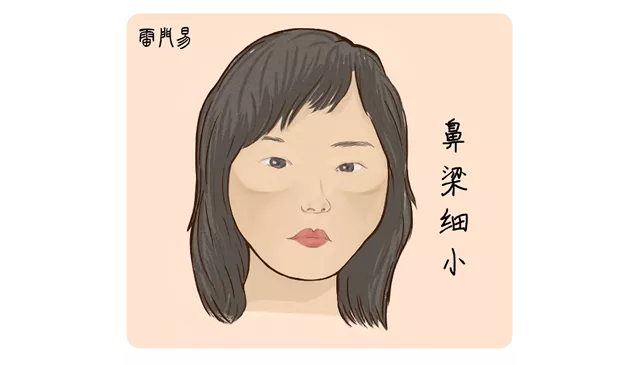
For instance, while a round and full face symbolizes good fortune, a situation where the nose is too small with a flat bridge creates a "large face with a small nose," suggesting struggle and hard work.
Additionally, there are significant considerations regarding the elemental classification of facial features.
According to the five elements in physiognomy, individuals are categorized into five types: Metal, Wood, Water, Fire, and Earth. Only a few have a "pure" facial structure (such as a pure type without notable characteristics of other elements), while most exhibit a mix of two or more elements (for example, a Water type with Earth characteristics).
Therefore, whether a person's facial features are relatively pure or mixed—and how they are mixed, which element is dominant or secondary—all these factors influence a person's level and fortune.
In terms of being plump or thin, Water and Earth types usually appear plumper, while Wood types generally appear slimmer. In summary:
Water types: Tend to appear plump, with more flesh on their face or body, often having a higher body fat percentage and softer flesh, giving an impression of being "falsely plump" or swollen (even if not actually overweight), thus more accurately described as "fat." (For more on Water types, click here: Detailed Explanation of Water Types)
Earth types: Appear solid and heavy, with larger heads, round faces with flesh, shorter and thicker necks. Their flesh is firmer, and they have a larger bone structure, making "sturdy" a fitting description. (For more on Earth types, click here: Detailed Explanation of Earth Types)
Wood types: Generally have at least an average or slender build, regardless of height, with long limbs, appearing upright and not bulky. (For more on Wood types, click here: Detailed Explanation of Wood Types)
Going back to our main topic, since the elemental attributes of facial features differ, whether being a bit plump or thin is better varies among individuals—
For instance, someone with a dominant Wood attribute would usually be slender, with favorable traits like kindness and gentleness. Gaining excessive weight might disrupt their natural balance. Conversely, someone with a dominant Earth attribute might find weight loss challenging, and being solid and heavy is typical. Pursuing weight loss might result in "Wood overcoming Earth," reducing their potential.
Of course, the discussion around the five elements in physiognomy is quite complex. Most people's facial features are not purely of one type, making it hard to draw conclusions based solely on theory without assessing individual appearances. It's crucial to emphasize the importance of structure; different structures have varying preferences and aversions regarding weight.
Health First, Weight Second
Finally, the most important takeaway from this article is the significance of health. Although we're discussing physiognomy here, and I am not a health expert, it is essential to touch on this topic. While we should be well-versed in physiognomy, we must also incorporate practical wisdom applicable to everyday life.
Health undoubtedly influences a person's facial features. Health is "internal," while facial features are "external." When the body is healthy, with all organs and functions operating normally, the face will reflect positive attributes. Conversely, health issues will inevitably mar one's facial features over time.
Therefore, when considering weight, it fundamentally depends on one's physical and mental health. Understanding and caring for one’s body and mind, ensuring both are in a comfortable and peaceful state, is key;
At this point, whether one is a bit plump or thin becomes less important. Why? Because one's physical and mental sensations are sensitive and genuine. A healthy state nourishes one's facial features; feeling relaxed, peaceful, joyful, and uplifted signifies a suitable current weight.
In this way, one doesn’t need to be shackled by external standards or societal beauty norms, such as "You're too thin; it doesn't look good" or "You've gained weight; you should lose some." On the foundation of one's own physical and mental health, such comments become irrelevant. What matters is knowing that one's current state is suitable for themselves, and that is enough.
Specifically, both excessive weight and being underweight are undesirable:
Excess weight results in unnecessary fat, which is not the "broadness" discussed in physiognomy but rather a sense of bulkiness and heaviness. Being underweight can result in a gaunt appearance, detrimental to accumulating fortune and enjoying blessings. Both extremes can lead to health issues (even if they don’t impact daily life), and health risks will lower the quality of one's facial features.
Moreover, there is no exact standard for being overweight or underweight, as these perceptions are significantly influenced by the era, societal aesthetics, and expectations. Hence, the number on the scale isn't as important as body proportion and health indicators. Even if two individuals seem "overweight" or "underweight," differences in their physical and mental health will naturally reflect in their facial features.
For example, compare two individuals trying to lose weight: one uses extreme methods to shed pounds, while the other adopts healthier eating habits and moderate exercise. The differences in their facial features will be evident—
The former risks malnutrition and health issues, while the latter is likely to develop positively. Improved health leads to a better complexion and posture, and the latter’s rational approach indicates wiser choices, resulting in a more content and self-loving mindset.
Countless choices accumulate to form what we call "fortune." Truly accepting oneself and treating oneself well will undeniably enhance and revitalize one's facial features.