Facial Reading: Understanding Wocan Eyelids and the Generational Effects on Family Size
A person's destiny springs from wisdom, which is the innate foundation, while destiny can be influenced by acquired experiences. People navigate life through knowledge and experience, mere manifestations of wisdom. Destiny can be split into two components: fate and fortune. Fate designates a person's innate potential, while fortune refers to one's physical existence and environment, particularly evident in human social behaviors. Everything is a creation of the mind, which embodies wisdom. Our mental constructs shape our acquired destiny. Consciousness is the source of the universe, and the universe reflects our minds; therefore, the mind governs destiny.
Low Mountain Root, Shortened Parental Lifespan
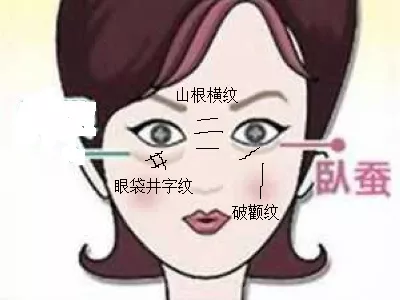
The Mountain Root is located at the bridge of the nose, between the inner corners of the eyes. According to Liu Heng, a person with uneven forehead lines may experience the early loss of a father, and a low Mountain Root suggests poor health or an early demise of parents, or that one parent may have mediocre fortune. In physiognomy, Liu Heng refers to the Mountain Root as the Palace of Illness, representing one's mental state, social status, and outlook. Those with a high Mountain Root tend to have a more elevated disposition, often leaning towards self-centeredness, whereas individuals with a low Mountain Root usually possess a more down-to-earth temperament and an easygoing personality.
Dull Eyes, Poverty and Low Status
The eyes are the outward reflection of our spirit, representing clarity. In physiognomy, a face is rated out of ten (Liu Heng notes: one point for the forehead, one for the eyebrows, one for the cheekbones, one for the nose, one for the chin and jaw, and five for the eyes), underscoring the importance of the eyes. However, the eyes can't be assessed purely by physiognomy; much depends on the social experience and observational skills of the physiognomist. A gentle yet resilient gaze is a sign of a person destined for success. In contrast, a weak and dull gaze often predicts a life of failure. A cruel and violent gaze indicates a life marred with misfortunes, while a cunning and greedy gaze hints at strained family ties.
Eye Bags and Network Lines, Few Offspring for Three Generations
Eye bags, also known as the area beneath the eyes, are termed the Three Yin and Three Yang in physiognomy. Liu Heng explains that the Three Yin are Taiyin, Jueyin, and Shaoyin, and the Three Yang are Taiyang, Yangming, and Shaoyang. The eye bag area corresponds to the stomach meridian, representing the nurturing of offspring. The presence of grid-like or flower-like lines in this area suggests challenges in conceiving and, even with pregnancy, difficulties in carrying to term.
Low Sexual Gate, Financial Loss
The Sexual Gate, known as the Palace of Spouses in physiognomy, is associated with the gallbladder meridian and signifies decisiveness. A sunken or marked with dark vertical lines Sexual Gate indicates someone who may adversely impact their marriage and is likely to suffer financial loss due to indecision.
Deep Crow's Feet, Marrying Twice
For women over thirty-five and men over forty, pronounced crow's feet suggest a face that may negatively affect a spouse, regardless of gender, and indicate tendencies towards indulgence and lust, leading to poor health and excessive depletion of kidney energy.
Upturned Eye Tails, Unfavorable for Relationships
Those with upturned eye tails, according to folk sayings summarized by Liu Heng, would be better associating with turtles than with such individuals. This highlights an unpleasant nature. These upturned tails, when paired with short eyebrows that do not cover the eyes or meet the eye tails, suggest individuals who are often heartless and ungrateful, neglecting righteousness in pursuit of profit.
Ears Behind the Jaw, Ungratefulness
Among unfavorable facial traits, ears set behind the jaw top the list. Known as "rebellious bone," Liu Heng describes these individuals as ones who repay kindness with malice. With a tendency to seek vengeance on benefactors, they epitomize ingratitude. Additionally, those with rebellious bone adhere to the belief that "a gentleman's revenge is never late," implying prolonged retaliatory actions. Furthermore, they take concrete steps for revenge: a hooked nose indicates scheming, while rebellious bone actions may lead to financial ruin. Other names for rebellious bone include "explosive jaw" and "reverse jaw."
Interrupted Earth Lines Harm Wives and Daughters
The sky lines, human lines, and earth lines on the forehead represent the three talent lines. Sky lines denote the father and future, human lines indicate siblings and abilities, and earth lines symbolize the mother and savings. Interrupted or diagonally cut sky lines forecast concerns regarding the father and future. Similarly, if human lines are disrupted, issues with siblings and cooperation are likely. Interrupted earth lines imply poor maternal health and potential financial loss.
Wide Distance Between Eyebrows, Vulnerability to Temptation
Eyebrows signify the palace of relationships, and the area between them is called the Yintang. A wide distance between the eyebrows can increase the size of the Yintang. Liu Heng views a wide distance as a sign of a carefree nature, but if excessively wide, it indicates weak defenses and shallow cunning, making one easily swayed by unscrupulous individuals.
Low Nose Bridge, Lack of Ambition
The nose bridge symbolizes a person's willpower. A flat and low nose bridge often suggests a lack of ambition, either through complacency or lacking independence and initiative, making self-sufficiency difficult. Liu Heng notes that if both the nose wings and forehead are short and narrow, the individual's effectiveness is severely reduced, leading to an unaccomplished life.