The Nine Stars of Qi Men Dun Jia

In Qimen, the Nine Stars represent heavenly timing. This covers not only natural phenomena like weather but also broader social currents, such as political climates. For an individual, they can also reflect inborn (genetic) factors, innate qualities, and temperament.
The correspondences among the Nine Stars, the Nine Palaces, and the Eight Trigrams are fixed, as follows:
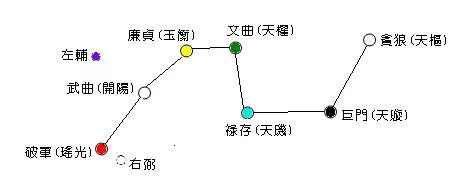
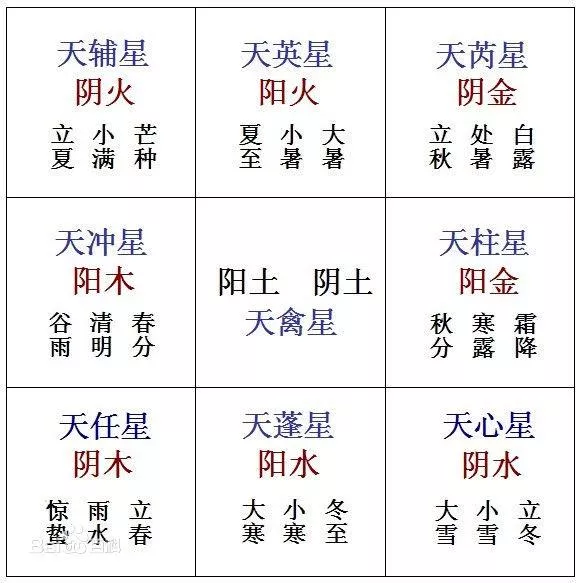
Tianpeng Star in Palace 1 (Kan)
Tianpeng Star, also called the Greedy Wolf Star, is a Yang Water star. In classical texts it was considered inauspicious for its bold, reckless nature and its association with crimes such as murder, robbery, and large-scale corruption. In Qimen divination for criminal cases, Tianpeng is used as the primary indicator of the offender—this is its core attribute. That said, good and bad are relative; everything has two sides. Under certain conditions, Tianpeng can also signify good fortune, such as a general defending the frontier, a daring entrepreneur engaged in speculation, or a wise person willing to take risks. Overall, its defining traits are intelligence, boldness, and a penchant for covert action.
Tianrui Star in Palace 2 (Kun)
Tianrui Star, also known as the Giant Gate Star, is a Yin Earth star. It was deemed inauspicious in ancient times for its hidden, grasping tendencies and its link to illness; accordingly, in Qimen medical divination it serves as a primary indicator of disease. It also has a positive side: in readings about pregnancy it can represent expectant mothers; in career assessments it can symbolize farmers; and in the context of apprenticeship it can represent students. As the star of the Kun Palace, it embodies Kun’s qualities—mother, women, land, the general populace, grassroots communities, and students.
Tianchong Star in Palace 3 (Zhen)
Tianchong Star, also known as the Lu Cun Star, is a Yang Wood star. It was praised as auspicious in antiquity for its courage and aggressiveness on the battlefield. In the workplace it shows decisiveness and efficiency. However, it can also be impulsive, brusque, and unstable, so some consider it only moderately auspicious.
Tianfu Star in Palace 4 (Xun)
Tianfu Star, also known as the Wenqu Star, belongs to the Wood element. Under Qimen’s Yin–Yang division it is considered Yang, though from the perspective of the Xun trigram, which represents the eldest daughter, it can also be viewed as Yin. Traditionally identified with the heavenly Wenqu Star—linked to culture and education—it is regarded as highly auspicious. In Qimen applications, it often represents teachers, head teachers, examination institutions, and academic attainment. In short, a major distinction between humans and animals is culture. A person’s level of education and refinement is closely tied to destiny, especially in today’s social environment, making the role of Tianfu Star all the more important.
Tianqin Star in Palace 5 (Center)
Tianqin Star, also known as the Lianzhen Star, is a Yang Earth star. Because Earth nurtures all things, ancient monarchs implemented the Nine Palaces and Ming Tang system, with the sovereign operating from the Center Palace. In Qimen divination, the commander is likewise hidden in the Center, making Tianqin in the center a highly auspicious star.
Tianqin Star embodies the qualities of central Earth: loyalty, honesty, and the capacity to bear burdens. When it occupies a palace, undertakings can be accomplished and all seasons are favorable. Qimen has nine palaces but only eight trigrams, so the Center does not correspond to a trigram or a door. Since doors are pathways leading outward, there cannot be a door in the center. So which trigram or door corresponds to Tianqin in the center? Because the center represents Earth, it corresponds to the Kun trigram of Palace 2 and to the Dead Door. In dynamic Qimen charts, Tianqin in the center and the accompanying Sanqi and Liuyi always align with Palace 2 (Kun), rotating together. Wherever Tianrui Star falls, Tianqin Star will also fall in the same palace. However, since Tianrui and Tianqin belong to Palaces 2 and 5 respectively, and Earth’s Sanqi and Liuyi have nine positions, the Sanqi and Liuyi carried by Tianrui and Tianqin differ, leading to different uses.
Tianxin Star in Palace 6 (Qian)
Tianxin Star, also known as the Wuqiu Star, belongs to the Metal element. Under Qimen’s Yin–Yang division, Palace 6 uses the Yin Dun system, making Tianxin Yin; however, from the perspective of Qian—as Heaven and the elder father—Tianxin can also be considered Yang. It is the martial counterpart to the Wenqu Star, marked by intelligence, capability, leadership, and the potential to achieve great careers. It is also gentle, meticulous, adaptable, benevolent, and eager to help others, making it favorable in Qimen predictions. Tianxin can signify leaders and officials, as well as doctors and medicine. It promotes goodness and supports benevolence, and is therefore highly auspicious.
Tianzhu Star in Palace 7 (Dui)
Tianzhu Star, also known as the Pojun Star, belongs to the Metal element. Under Qimen’s Yin–Yang division, Palace 7 uses the Yin Dun system, and since Dui represents a young girl, it is also considered Yin. In ancient thought it was linked to autumn’s killing energy and warfare—fear, strangeness, destruction, and damage—hence the name Pojun, and it is generally regarded as inauspicious. However, all things have two sides; as Tianzhu (“pillar”), it also has the qualities of standing firm, resisting chaos, and serving as a mainstay. Therefore, one should judge it by the overall configuration—door, deity, and the Sanqi and Liuyi—rather than labeling it categorically inauspicious. Its characteristics include combativeness and destructiveness, yet also eloquence and persuasiveness. Thus the old sayings: “When Tianzhu aligns with the configuration, it speaks frankly and offers counsel,” and “The Seven-Red Tianzhu is stationed at the western wall; those with spirit will debate brilliantly in the world; if stirred, they excel in skills and arts.” In determining a person’s profession, if the use star falls on Tianzhu Star, it often points to careers in the military, law enforcement, teaching, acting, or diplomacy.
Tianren Star in Palace 8 (Gen)
Tianren Star, also known as the Zuofu Star, is a Yang Earth star. In ancient times it was believed that Earth nurtures all things—especially in spring, when growth begins—making it highly auspicious. Its traits include bearing burdens with great virtue, loyalty and honesty, diligence and selflessness, kindness, and a willingness to help others. In terms of profession, if the use star falls on Tianren Star, it often relates to land and agriculture.
Tianying Star in Palace 9 (Li)
Tianying Star, also known as the Youbi Star, is a Yin Fire star. Occupying the Li Palace, it is characterized by fierce flames and volatility. Thus it has bright, civilized, positive aspects, but when taken to extremes it can be associated with bloodshed and disaster, hence the name Central Peace Star. In terms of profession, if the use star falls on Tianying Star, it often relates to fire and the civil sphere.
The correspondences among the Nine Stars, Nine Palaces, and Eight Trigrams in Qimen are eternally unchanging. However, since the Nine Stars represent heavenly timing, they must fly on the heavenly chart. If a star returns to its native palace, it is called “Fu Yin.” For example, if Tianpeng Star returns to Palace 1 (Kan), then both the heavenly chart and the earthly chart show Tianpeng Star in that palace; in Qimen this is called “Star Fu Yin,” meaning the Nine Stars have returned to their original palace, lying on the earthly chart, weeping and lamenting.
If a star flies to the palace opposite its native position, Qimen calls it “Fan Yin.” For instance, if Tianpeng Star, native to Palace 1 (Kan) in the north, flies to Palace 9 (Li) on the heavenly chart, which is directly opposite in the south, then the heavenly chart shows Tianpeng Star while the earthly chart shows Tianying Star—this is “Fan Yin.” Correspondingly, as Tianpeng Star flies to the heavenly chart of Palace 9 (Li), the Tianying Star on the earthly chart of Palace 9 also flies to the heavenly chart of Palace 1 (Kan), with each occupying the other’s position. This creates inevitable opposition and conflict, bringing suffering—what Qimen calls the “Nine Stars Fan Yin.”