How to Tell Whether a Situation Is Fortunate or Unfortunate
In traditional Chinese culture, divination is an important part of feng shui (geomancy). It employs methods and omens such as turtle shells, coins, bamboo sticks, paper cards, and celestial phenomena to infer future blessings and misfortunes. The character “占” (zhan) originally means “to observe,” while “卜” (bu) refers to the ancient practice of scorching turtle shells and interpreting the signs to judge the unknown or forecast the future.
It is commonly believed that all forms of divination stem from the I Ching. As the saying goes: “Without studying the Book of Songs, one cannot speak; without studying the I Ching, one cannot divine.” Today, Dr. Zheng will explain how to determine fortunes using the Nine Palace Flying Stars so that, with very simple tools, you can assess the auspiciousness of a particular matter yourself.
I. What are the Nine Palace Flying Stars?
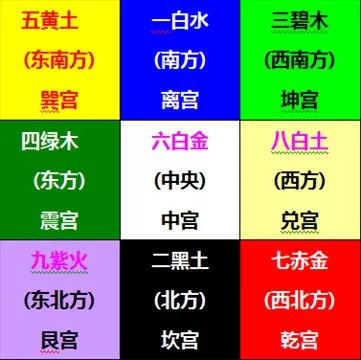
First, we need to understand what the Nine Palace Flying Stars are. In feng shui, there is a saying: “Heaven has nine stars, and Earth has nine palaces.” Dr. Zheng explains that in a nine-square grid there are nine flying stars, which are:
One White, Two Black, Three Green, Four Jade, Five Yellow, Six White, Seven Red, Eight White, and Nine Purple stars.
Dr. Zheng reminds everyone that the Nine Palace Flying Stars are arranged according to the Luo Shu. The path of the flying stars begins in the center palace and follows the Luo Shu sequence; therefore, this path is also known as the Luo Shu trajectory (Luo Shu steps). If you’re not yet familiar with the “Luo Shu,” you can set this aside for now and continue with the content below.
II. Which are the auspicious and inauspicious stars among the Nine Palace Flying Stars?
The nine flying stars are divided into auspicious and inauspicious groups. Dr. Zheng hopes everyone will keep the following distinctions in mind:
(1) The Five Auspicious Stars of the Nine Palace Flying Stars
- One White (Water Star): Governs career, interpersonal relationships, and romance.
- Four Jade (Wood Star): Governs wisdom and education; it has the greatest impact on students and people engaged in academic research.
- Six White (Metal Star): Governs authority and can stimulate opportunities, thus closely tied to one’s career.
- Eight White (Earth Star): Governs the inflow and outflow of wealth.
- Nine Purple (Fire Star): Governs marital harmony and happiness.
When these five auspicious stars are well positioned and in harmony with the home’s layout and the resident’s destiny, they can bring the owner a year of good fortune. If they are poorly positioned, it is like a hero with no battlefield—full of potential but little effect—rendering them ineffective. If the layout or arrangement is flawed, it can lead to more setbacks than successes, wasting the advantages of the auspicious stars.
(2) The Four Inauspicious Stars of the Nine Palace Flying Stars
- Two Black (Earth Star): Can cause both physical and mental illness; thus, it is regarded as the star of sickness.
- Three Green (Wood Star, also known as the Chiyou Star): Known for provoking disputes and may even bring lawsuits.
- Five Yellow (Earth Star): Notorious for attracting disasters and troubles; it is the most malevolent of the nine stars.
- Seven Red (Metal Star): Can attract thieves and schemers.
III. Practical Application of the Nine Palace Flying Stars
With the above in mind, the following steps will be clear:
First, gather nine playing cards: Ace of Diamonds, Two of Spades, Three of Clubs, Four of Clubs, Five of Spades, Six of Diamonds, Seven of Spades, Eight of Diamonds, and Nine of Hearts.
Next, Dr. Zheng suggests you follow the procedure below:
- Wash your hands thoroughly as a simple purification ritual.
- Sit facing south. Place the cards face down on the table and shuffle them clockwise with both hands.
- After shuffling, arrange the cards neatly face down and cut the deck several times.
- Cup the cards between your hands, focus silently on the matter you wish to ask about, then gently blow on the cards.
- Spread the cards face down on the table and draw one at random. Be decisive; do not hesitate.
- Dr. Zheng reminds you: If any card falls onto the table or floor during the process, it indicates the day is unsuitable for divination. Also, only divine once per day for the same matter—multiple attempts are ineffective and can be counterproductive.
Next, interpret the result by matching the drawn card to the following:
- Ace of Diamonds: Signifies authority and wealth; favorable for both reputation and finances.
- Two of Spades: Portends misfortune and illness.
- Three of Clubs: Associated with disputes, gossip, and lawsuits.
- Four of Clubs: Represents intelligence; beneficial for writing, planning, and especially administrative roles.
- Five of Spades: The most unfavorable card, indicating accidents, financial loss, and calamity.
- Six of Diamonds: A strong, proactive card; favorable for taking the initiative and also linked to wealth.
- Seven of Spades: A retreating card, akin to being laid off or sidelined; indicates a weak position.
- Eight of Diamonds: A card of prosperous wealth; easy to acquire money.
- Nine of Hearts: Represents romantic relationships and benefactors of the opposite sex, suggesting that wealth may arrive with help from the opposite gender.
Dr. Zheng's Commentary
- All forms of divination are grounded in the principles of the I Ching, and the method in this article is no exception; the Nine Palace Flying Stars are among the most direct expressions of these principles.
- Understanding the Nine Palace Flying Stars clarifies the fundamentals of adjusting a home’s feng shui. Because their positions change annually, the five auspicious stars may at times show inauspicious traits, while the four inauspicious stars may occasionally appear auspicious. They are not permanently fixed. Regardless of change, each star has its own role. The influence of these annual flying stars lasts only one year; while not as strong as the resident’s destiny or the home’s inherent feng shui, it remains significant.
- A home’s feng shui and a person’s destiny are like gunpowder, while the year’s feng shui is like the incense that ignites it. Good “gunpowder” produces beautiful fireworks, brightening the owner’s year; poor “gunpowder” can explode, making the year fraught with difficulties. Whether outcomes are auspicious or inauspicious depends on whether the home’s feng shui aligns with the resident’s destiny.
- To judge the auspiciousness of a matter, Dr. Zheng suggests using multiple divination tools in parallel, as this may yield better results. Above all, remember: feng shui is all around us.
Dr. Zheng Weijian / Text