Is the Blood Moon an Omen of Bad Luck?
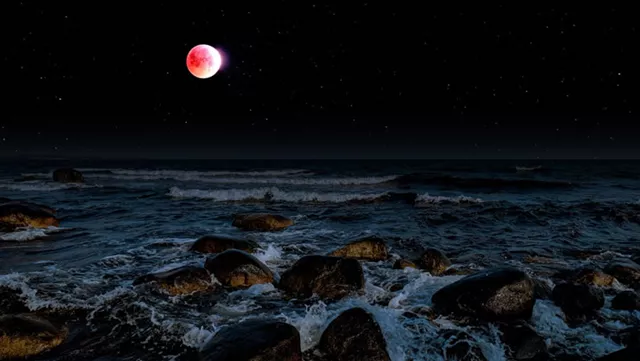
On November 8, a total lunar eclipse known as a "Blood Moon" took place, a rare astronomical event visible in Asia, North America, Central America, and Oceania. Feng Shui experts have noted that this rare Blood Moon is considered a "bad omen."
According to a Yahoo News report, the Taipei Astronomical Museum predicted the moon would rise at 5:02 PM on the evening of the 8th. By 5:08 PM, it would start entering the Earth's umbra, marking the beginning of the eclipse with the "initial contact," after which the shadow would gradually expand. The "totality" phase was expected to start at 6:16 PM, with the moon completely within the Earth's umbra, causing its surface to turn dark red, signifying the total eclipse phase.
The museum explained that the "maximum eclipse" would occur at 6:59 PM, when the moon is closest to the center of the umbra, appearing darkest and reddest. The "emergence" phase would begin at 7:42 PM, indicating the end of totality as the moon gradually moves out of the umbra. The "full moon" phase would return at 8:49 PM, when the moon completely exits the umbra and regains its full shape. It wouldn't be until 9:57 PM that the "penumbral eclipse" would conclude, and the moon would fully restore its original brightness.
The museum highlighted that during this event, the dark red moon, known as the "Blood Moon," would hang prominently in the night sky for nearly an hour and a half. Additionally, this occurrence coincided with the rare "Red Moon Occultation of Uranus," making it a once-in-a-lifetime event.
However, astrology expert Tang Qiyang shared on Facebook that regarding the once-in-a-millennium Blood Moon and the total lunar eclipse obscuring Uranus, "I personally would never go out to see it, not even step outside, just for everyone's reference." Her words suggested a deeper significance.
Hong Kong Feng Shui master "Master Qi" also posted on Instagram, stating that historically, the moon turning red was known as a "Blood Moon," and ancient cultures considered this phenomenon a "bad omen." A red moon is believed to herald extreme cold and heavy yin energy; during a Blood Moon, the yin energy is strong, the malevolent energy is rampant, and the righteous energy diminishes, indicating an "extremely ominous celestial event." Such a Blood Moon is believed to be accompanied by natural disasters, human misfortunes, and social unrest.
Principle of Lunar Eclipse
As reported by BBC Chinese, a lunar eclipse occurs when the Earth comes between the Sun and the Moon, aligning all three in a straight line, causing the Moon to be covered by Earth's shadow (comprising the umbra and penumbra) and preventing it from being directly illuminated by sunlight. Simply put, during a lunar eclipse, we see the shadow cast by the Earth on the surface of the Moon.
As the Moon moves into different shadow regions of the Earth, three types of lunar eclipses can occur: total lunar eclipse, partial lunar eclipse, and penumbral lunar eclipse.
A total lunar eclipse happens when the entire Moon enters Earth's umbra. Some sunlight passes through Earth's atmosphere, filtering out most of the blue light and leaving only red light, giving the Moon a copper-red appearance, typically referred to as a "Blood Moon." Because Earth's diameter is four times larger than the Moon’s, its shadow is also wider, allowing the eclipse to last over an hour.
A partial lunar eclipse occurs when only part of the Moon enters Earth's umbra. Depending on the extent of the eclipse, the shaded part of the Moon may appear dark red or charcoal gray, due to the contrast between the shadowed region and the unaffected surface of the Moon.
A penumbral lunar eclipse happens when the Moon enters Earth's penumbra. This type of eclipse is more challenging to discern with the naked eye; the smaller the portion of the Moon in the penumbra, the harder it is to observe, which is why this type of eclipse is rarely highlighted.