How to Interpret Your Zodiac Horoscope
Today, let’s talk about how to assess your fortune. Many people aren’t quite sure how to evaluate their own luck. If you want to read your fortune in the context of your personal situation, it helps to understand the logic behind it.
1. How do we assess our fortune?
For example, if you’re an Aries, your money house is typically Taurus and your partnership house is Libra. Challenging activity in Taurus can affect your finances, while supportive activity in Libra can boost relationships and even bring romantic opportunities. An astrologer simply summarizes what’s happening in the different zodiac signs in plain language for you. The same logic applies to every sign.
2. Why should we also consider our rising sign?
The rising sign is crucial; it marks the beginning of your birth chart and sets your overall trajectory. To get a more accurate read on your fortune, you need to know your rising sign. (There are plenty of websites where you can look up the exact degree of your rising sign, but I won’t recommend any here to avoid the appearance of advertising.)
3. Why can the rising sign and sun sign sometimes be inaccurate?
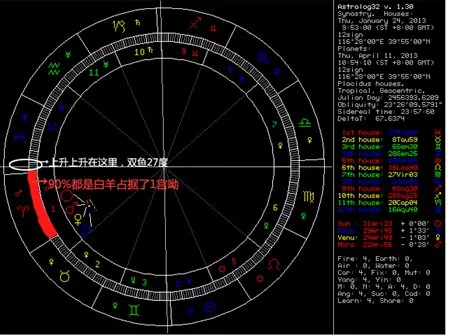
This takes a bit of astrological know-how. For example, if your rising sign is at 27 degrees Pisces, your chart layout is effectively about 95% Aries rather than Pisces. In that case, your money house isn’t Aries—it shifts to Taurus (in the 12-house system, the sign following your rising sign is typically the money house. So a Pisces rising usually has Aries as the money house, and an Aries rising has Taurus. But in special cases like the one shown—often when the rising sign is in late degrees—the configuration can shift). As a result, forecasts written for Pisces may not resonate. This is especially true with major events like new moons and full moons, which signal important beginnings in life. The house in your natal chart where these events land is key to understanding which area of life they will influence.
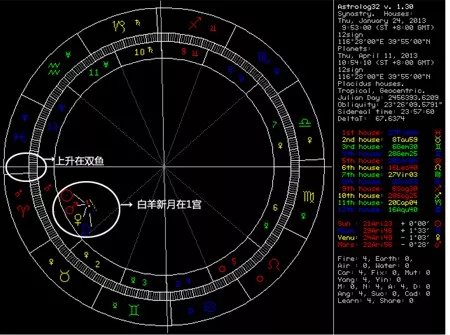
Continuing with the example of a Pisces rising at 27 degrees, you can see in the image that the Sun, Moon, Venus, and Mars are all in Aries. If we only read the Pisces forecast, an astrologer might say this intense Aries activity would bring financial losses to Pisces, since Aries is considered Pisces’s money house. However, in this chart the Sun, Venus, Mars, and Moon are clustered in the native’s 1st house. This strong Aries new moon doesn’t target the finances of this Pisces rising; it signals fresh starts and self-identity—much closer to the Aries forecast—bringing new opportunities and openings in the native’s life.
Situations like this often occur when your rising or Sun sign is in the late degrees of a sign; other degrees may not feel it as strongly. A tip: if your rising or Sun sign forecast doesn’t fit, look at the next sign as well. For example, if you’re a Virgo rising at 26 degrees and the forecast doesn’t resonate, check Libra. If you already know your rising or Sun sign is late-degree and the following sign matches better, don’t assume your birth time is wrong or that you “belong” to the next sign. These aren’t in conflict—it’s common for late-degree placements to align more with the next sign’s forecast.