Breaking Career Bottlenecks: How Your Saturn-Jupiter Aspects Can Guide You

[Editor's Note]
Hitting a career bottleneck? It's time to take a closer look at your Saturn and Jupiter placements. As the only two social planets, Saturn and Jupiter reveal how we engage with the broader societal process.
In a natal chart, there are many indicators related to career pursuits. For example, the Sun shows "who I am," while the Midheaven (MC) indicates how we share that solar light with the world. The placements of your natal Saturn and Jupiter, however, illuminate the "world": how we propel the world forward and how it influences us in return. This dynamic drives our choices, advancements, breakthroughs, and transformations on the career path.
So, how do we locate the thread of Saturn/Jupiter? The answer lies in their aspect relationship.
With over 25 years of deep experience in business astrology, astrologer Georgia Stathis sees Saturn-Jupiter relationships falling into 8 types. Each type corresponds to how we inspire others, what kind of businessperson we become, and how we achieve career inspiration. It's precisely the activation of Saturn and Jupiter that sparks our career transformations, turning them into the threads for breaking through professional bottlenecks and seeking career turning points.
When we start seeking the key threads for career changes, Jupiter and Saturn become especially prominent. In business astrology, the Moon represents the public and products, so I suggest combining lunar phases with the Jupiter/Saturn phases in your natal chart for practical use.
When the Sun and Moon conjoin, a New Moon occurs, signaling the start of the lunar cycle—and a full lunar cycle lasts 28 days, with each phase providing different energies.
According to Dane Rudhyar's theory, we can divide the 45° calculations into eight lunar phases, including:
- New Moon Phase (0°-45°)
- Crescent Moon Phase (45°-90°)
- First Quarter Moon Position (90°-135°)
- Gibbous Moon Phase (135°-180°)
- Full Moon Phase (180°-225°)
- Disseminating Moon Phase (225°-270°)
- Last Quarter Moon Phase (270°-315°)
- Balsamic Moon Phase (315°-360°)
The same energetic responses arise in the phases of Saturn/Jupiter. Since Jupiter moves faster than Saturn, the Saturn-Jupiter phases here refer to the applying aspect from Saturn as the starting point, rotating counterclockwise to Jupiter's position relative to Saturn.
For example, if in your birth chart, starting from Saturn and rotating counterclockwise, the aspect to Jupiter is 0-45°. Then your Saturn-Jupiter relationship is in the "New Moon" phase. If it's in the 45-90° phase, it's in the "Crescent Moon" phase... and so on.
After applying this concept to hundreds or thousands of charts, I discovered a remarkably accurate pattern. Especially in business astrology, when assessing a company's business potential, the first thing to consider is the Saturn-Jupiter aspect. Different phase positions indicate what type of businessperson you'll become or how you handle business. It also shows how you inspire yourself and others. So, what does the Jupiter/Saturn aspect in your natal chart reveal about your career pursuits?
How to Find Your Saturn/Jupiter Relationship?
- Generate your birth chart; you can click [Chart Generator] to find it.
- Locate Saturn in your natal chart.
- Starting from Saturn, rotate counterclockwise to find Jupiter.
- Calculate the degree between Jupiter and Saturn, and match it to the types below.
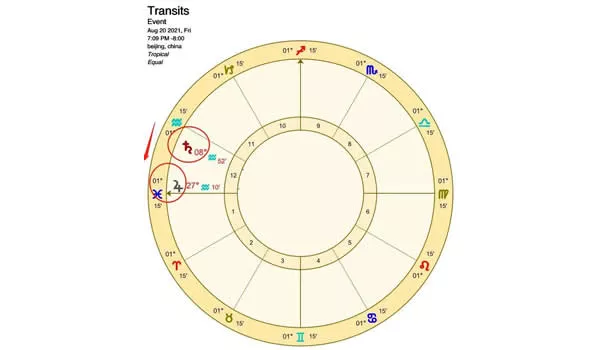
Example Above:
- Saturn at 8°52' Aquarius, Jupiter at 27°10' Aquarius.
- Starting from Saturn, rotate counterclockwise.
- Jupiter's angular distance from Saturn = 27°10' Aquarius - 8°52' Aquarius = 18°18'.
- The aspect is the Saturn-Jupiter New Moon phase type.
Jupiter/Saturn Aspect: 0°-45°
When your natal Jupiter is positioned 0-45° counterclockwise from your natal Saturn, it's the New Moon phase. Saturn-Jupiter New Moon people are innovative enthusiasts who love new things—many are exceptionally skilled at invention and creation. In this phase, we find some individuals using their intuition to respond to their work or office environment.
Saturn-Jupiter New Moon people can be a bit self-centered; salespeople often have this placement. They thrive and grow through constant challenges. The "New Moon" phase signifies new beginnings, fresh perspectives, innovative ideas, and strong individuality. For Saturn-Jupiter New Moon people—especially those with a natal conjunction—special caution is advised.
John Lennon is a great example. Born in 1940, his Saturn/Jupiter conjunction was in Taurus, a sign associated with art and music. Lennon was assassinated in 1980, when Jupiter and Saturn were conjoining in Libra, the sign of a peace advocate. You'll find this synchronicity astonishing.
Of course, this doesn't mean everyone born during a Saturn-Jupiter conjunction will die at the hands of an assassin. But historically, Saturn-Jupiter conjunctions do mark the onset of industries and economies—a time when major world players begin or end their "terms." As the cycle progresses, the Saturn-Jupiter New Moon phase brings freedom into the new cycle and releases past limitations. It paves the way for new ways of unfolding.
Jupiter/Saturn Aspect: 45°-90°
When your natal Jupiter is positioned 45°-90° counterclockwise from your natal Saturn, it's the Crescent Moon phase. People born in the Saturn-Jupiter Crescent Moon phase build their work on a series of obstacles, formed by overcoming those hurdles. For instance, those in government clerical roles face daily bureaucratic red tape and paperwork that needs completing. Their personality carries innate tenacity. They must establish new leadership.
I find that many with this placement create obstacles just to overcome them. It's like Libra sometimes deliberately manufacturing blockages, only to restore balance through their own efforts.
Eleanor Roosevelt's husband, Franklin Delano Roosevelt, suffered from polio. At the time, women weren't allowed in politics, but during his illness over several years, she became his advocate. In that period, major world issues demanded attention, and she rose to the challenge admirably.
As the transit progresses, the Saturn-Jupiter Crescent Moon phase will reveal issues like budget cuts, handling documents, coordinating meetings, or whether to adapt—or introduce some routine and protocol into the organization. The abundance of details and hurdles in the workplace might leave you feeling at a loss; they may need a good assistant. You'll notice Saturn-Jupiter Crescent people often hold multiple jobs, but not necessarily in the same place for long; they travel frequently too.
Jupiter/Saturn Aspect: 90°-135°
When your natal Jupiter is positioned 90°-135° counterclockwise from your natal Saturn, it's the Saturn-Jupiter First Quarter Moon phase. These individuals often have strong management abilities. They excel at creating structures and frameworks in their workplace. They define and execute according to rules. Saturn-Jupiter First Quarter people are the type who make plans for themselves and stick to them.
Their work style leans toward structured, goal-oriented approaches. Under the push of First Quarter energy, they have the drive to accomplish anything, even if those actions might create crises or face inevitable resistance from others.
Richard Carpenter, along with his sister Karen, formed The Carpenters. He not only discovered and formed the band but also co-wrote many songs with his creative partner John Bettis. His third house is emphasized, including a Jupiter there. Additionally, his Saturn in the 12th house conjoins Neptune, ruler of his 4th house, symbolizing family members. This hints at working with siblings or managing them.
In transits, when Jupiter forms a First Quarter phase with your natal Saturn, you'll find yourself needing to create the entire chart's structure. This building process requires significant time investment despite heavy difficulties, but it's a key phase for establishing solid foundations.
Jupiter/Saturn Aspect: 135°-180°
When your natal Jupiter is positioned 135°-180° counterclockwise from your natal Saturn, it's the Saturn-Jupiter Gibbous Moon phase. These people have a strong need for a sense of presence; they need to feel their work impacts many lives. Aimee Semple McPherson is someone with this placement. She was an American evangelist who founded the Foursquare Church International and performed for over 5,000 congregants in her own church.
In Lois Rodden's Profiles of Women, it's noted: "McPherson was a workaholic and a positive go-getter. She established 400 chapels, 200 missionary societies, a Bible college, and a radio station... McPherson was called the 'Barnum of Religion,' a glamorous (most suited to Gibbous Moon phase) evangelist."
The work of Saturn-Jupiter Gibbous people often involves higher goals or inspiration. Their profession must have some philosophical stance. The Gibbous aspect is very similar to the number "9" in numerology, representing a large part of the reason and purpose for doing something, along with its selfless aspect. This is akin to the energy of the 9th house in the chart.
From the Saturn-Jupiter Gibbous Moon phase through the subsequent Full Moon and Disseminating Moon phases, it's a stage where one's creative spirit can be expressed, sparking new directions or goals in career life. This is also the outcome of the Gibbous phase's vision: it makes you excited about what you're doing and eager to share it with anyone willing to listen.
Additional Explanation
In numerology, the number 9 represents the "completion" of a cycle or a transitional number. It passes through 1 and restarts a new cycle, leading to new experiential domains.
The square (90 degrees) and its derivatives—the semisquare (45 degrees) and sesquiquadrate (135 degrees)—can be linked to the lunar cycle and the number 9. You'll notice each aspect degree contains 2-3 numbers that add up to 9.
For example, the semisquare (45 degrees) representing Crescent and Balsamic phases: 4 + 5 = 9. The number 4 relates to hard work and potential obstacles; 5 represents learning.
For the 135-degree Disseminating Moon phase, we add 1 + 3 + 5, again getting a total of 9. 1 represents a new face or identity; 3 communication; 5 learning. Similarly, 90 degrees: 9 + 0 = 9.
As we move from the 45-degree semisquare to the 90-degree square, then to the 135-degree sesquiquadrate, we experience a transformation in approach. This is the foundation I apply to career life cycles for professional development and company transformations.
In Tarot, the 9 is the Hermit or High Priestess, illuminating direction for people and requiring them to follow it. When drawing the Hermit, readers often describe how something concludes, sensing an impending new beginning—though it's felt, not yet seen.
The opposition at 180 degrees is another manifestation totaling 9.
In opposition aspects, two points exist as far apart as possible within the 360-degree circle. The 180 degrees involves the individualist number 1 and 8 (linked to Capricorn's symbol), representing what we need to release for a fresh start.
Opposition is when two points are maximally distant: objectively sifting out ineffective things, distinguishing, or finding a unified way to oppose.
Jupiter/Saturn Aspect: 180°-225°
When your natal Jupiter is positioned 180°-225° counterclockwise from your natal Saturn, it's the Saturn-Jupiter Full Moon phase. In work, Saturn-Jupiter Full Moon people are in a state of sustained tension. Their jobs often involve major risks, dangers, and actions. Thus, their work is recognized as an all-or-nothing existence. However, the risks in their work are essentially the motivation driving them forward.
For those in high-risk professions, this is a classic placement. Like firefighters who must parachute from planes into forest fire centers—but without such risks, they'd feel they've lost the meaning of being a firefighter. These Saturn-Jupiter Full Moon people need to feel their existence's value amid various risks.
Therefore, Saturn-Jupiter Full Moon people's issues often lie in not focusing enough on details. Their work may have social or societal reform qualities but can also harbor extremist elements.
Famous actor James Earl Jones has this placement; his works include the groundbreaking TV miniseries Roots and voicing Darth Vader in the three Star Wars films. As a young man, he stuttered severely, but later became highly successful. Ironically, what people most recognize is his deep, rich voice.
In the charts of extremists like cult leader Marshall Applewhite and pastor Jim Jones, we also see the Saturn-Jupiter Full Moon aspect. They're remembered not just for their suicidal behaviors but because they led many followers to lose their lives for some higher ideal or belief system.
In transits, this is like a rubber band stretched to its limit—you must let go. If not, it snaps. If you realize you must release something in this phase, when you do let go, you'll have the capacity to tackle greater challenges.
Jupiter/Saturn Aspect: 225°-270°
When your natal Jupiter is positioned 225°-270° counterclockwise from your natal Saturn, it's the Saturn-Jupiter Disseminating Moon phase. These people often engage in professions requiring sharing vast amounts of information, like teachers, consultants, writers, transportation specialists, public information workers, etc.—all very suitable for this aspect.
They naturally excel at finding the right information and disseminating it at the right time.
In transits, you can touch on things of value to yourself. Moreover, you'll desire to provide this information to those who can benefit. This is a phase for sharing your ideas; others will recognize your value by seeing your abilities. But be mindful: when sharing ideas, you might come across as overly forceful or a know-it-all.
Jupiter/Saturn Aspect: 270°-315°
When your natal Jupiter is positioned 270°-315° counterclockwise from your natal Saturn, it's the Saturn-Jupiter Last Quarter Moon phase. This is the most difficult phase to define. Saturn-Jupiter Last Quarter people find constant new challenges in work. To some extent, this is stimulating, but it also means that to survive, they must continually learn new skills.
This ongoing preparation pressure can easily lead to frustration, as they either face challenges or feel perpetually lost. Generally, Saturn-Jupiter Last Quarter people may engage in work related to dismantling old structures, or societal reforms involving release and redistribution, like accounting tasks.
Entertainer Josephine Baker and other playwrights and actors like Woody Allen have this placement.
People with Jupiter in the Last Quarter phase in their chart may struggle with focus. Their minds constantly tear down and rebuild ideas, exacerbating the inability to concentrate. If their chart has fixed energies dominant, they may find it hard to disperse thoughts; but with many mutable energies, they handle lively thought patterns better and use the process for creative output.
In the Saturn-Jupiter Last Quarter phase, Jupiter's position is before Saturn, so the cycle's light and inspiration are fading, making way for new things.
Famous writer Ernest Hemingway had his natal Jupiter midway between the Last Quarter and Balsamic phases. Even after writing incredible literary works, he remained entangled in his life's meaning, always questioning what it all was.
In transits, these people may decide to learn something new to add value to their future work. They also realize that on the path ahead, they might need to let go of the current environment while opening up new things. Even if others think they've provided useful information, they themselves may still feel dissatisfied with what they've done.
Jupiter/Saturn Aspect: 315°-360°
When your natal Jupiter is positioned 315°-360° counterclockwise from your natal Saturn, it's the Saturn-Jupiter Balsamic Moon phase. In the Saturn-Jupiter conjunction, the Balsamic aspect is the final phase. Thus, Saturn-Jupiter Balsamic people naturally need a lot of privacy in work. Behind-the-scenes roles make them comfortable; they lack a strong need for public presence.
Behind-the-scenes work stimulates their creativity, so their profession may relate to some form of art. This art could provide the "seeds" of new ideas for the next generation of artists or thinkers. Similarly, we can see these qualities in Ernest Hemingway's chart throughout his life.
His natal Saturn/Jupiter aspect was between the Last Quarter and Balsamic phases. Thus, he also had Saturn-Jupiter Balsamic traits. So, his seemingly quiet side was actually prescient. In the silence of Saturn-Jupiter Balsamic people, they always sense through intuition what the future holds.
Like the example above, even though Saturn-Jupiter Balsamic people can intuitively perceive the future, they remain a very cautious type. They naturally operate, illuminating the path for others. But at the same time, they always wonder what they're thinking or doing that's relevant, or what constitutes the right information.
People with this placement are better suited for training-related positions, research roles, and behind-the-scenes jobs. They can discover how their observational skills help others. They may also be those recognized and acknowledged posthumously for a creative work. In transits, they might want to withdraw for a while, sit quietly, and rethink their direction, allowing new ideas to emerge.
Conclusion
Beyond the Saturn-Jupiter relationship in your natal chart, if you look at transits, this theory can better serve your career phases.
Since transiting Jupiter conjoins natal Saturn every 12 years, each conjunction creates a "New Moon" opportunity for one's career. In the following 12 years, as Jupiter progresses, it begins a brand-new lunar cycle with Saturn.
Based on the phase of transiting Jupiter to your natal Saturn, you can pinpoint your current phase and determine how to act in the present cycle. By applying Dane Rudhyar's lunar phase theory, we gain a new perspective on career planning.
Additionally, you can use lunar cycles similarly on your natal outer planets: Uranus, Neptune, and Pluto. This provides a broader view, revealing your transformation processes in innovation, spirit, and reform. From there, you can also combine transiting Jupiter with other personal planets—like the Sun, Moon, Mercury, Mars, and Venus—to see what you discover.
Translation: Valerie